
Prediction Markets Head to Supreme Court After Kalshi Loses New York Ruling
A July 7 Manhattan federal ruling against Kalshi deepens a national circuit split, putting a Supreme Court showdown over state sports betting authority on a four-week clock.
Category: News · By Growl Games Editorial Team · Mon Jul 13 2026 · Updated Tue Jul 21 2026
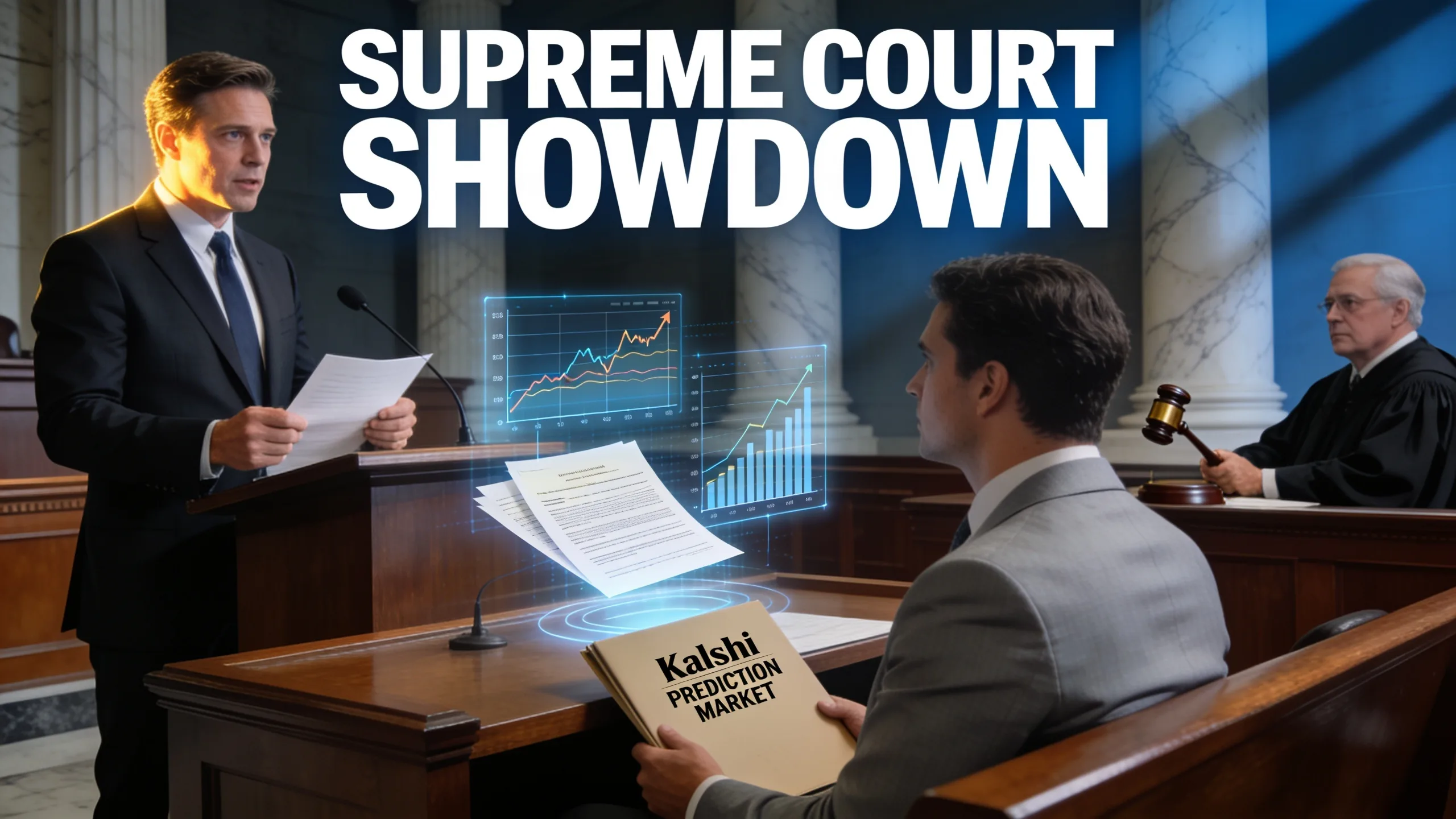
A federal judge in Manhattan handed prediction markets their sharpest legal setback of 2026 on July 7, ruling that Kalshi's federal derivatives licence does not protect the platform from New York's gambling enforcement — and the case is now almost certainly heading to the U.S. Supreme Court. With a New Jersey petition deadline of August 4 and a pivotal Sixth Circuit hearing locked in for July 30, the next four weeks will determine whether America's $17 billion-a-month prediction market boom operates under federal commodities law or state gambling authority.
The ruling in KalshiEX LLC v. Williams, issued by U.S. District Judge Analisa Torres of the Southern District of New York, rejected preemption arguments under all three available theories — express, field, and conflict — finding that the Commodity Exchange Act (CEA) does not override New York gambling law. Kalshi filed its appeal to the Second Circuit the same day. The decision deepens a national circuit split that legal observers and prediction-market traders alike now assign a roughly 64% probability of landing before the nation's highest court before year's end.
In This Article
What Is at Stake for Operators and Bettors
The fight reduces to one classification question: are sports event contracts federally regulated derivatives — or state-regulated bets? The answer determines whether a single federal agency or fifty separate gaming commissions have authority over a product that now handles $220 billion in combined monthly trading volume across Kalshi and Polymarket, up from $28 billion a year earlier.
Kalshi and Polymarket are licensed by the Commodity Futures Trading Commission (CFTC) as designated contract markets (DCMs) and argue their sports contracts are swaps — federally preempted financial instruments, not state-licensed bets. State gaming regulators, the American Gaming Association (AGA), and a 39-state amicus coalition disagree, pointing out that sports contracts make up 70–90% of prediction market activity and that the platforms bypass state consumer protections, problem-gambling safeguards, and tax frameworks. The AGA estimates prediction markets have already diverted more than $500 million in potential sports betting tax revenue from state coffers.
- Pro-states ruling: Platforms must obtain gaming licences in each jurisdiction or geofence — concentrating activity back to licensed sportsbooks and restoring state tax flows.
- Pro-federal ruling: Nationwide availability locked in, accelerating the exodus of handle from traditional operators; states lose tax leverage entirely.
- No SCOTUS grant: Current patchwork persists, with different rules per circuit — Michigan shut Kalshi down for two weeks in June under court order; Minnesota criminalises operation from August 1.
The July 7 New York Ruling, Explained
Judge Torres denied Kalshi's motion for a preliminary injunction, finding that the CEA's "Special Rule" provision — which expressly preempts certain state laws that interfere with swaps on DCMs — does not extend to New York's gambling statutes under any reading. The court rejected express preemption because the statute's plain text does not mention gambling law; field preemption because Congress did not intend federal derivatives regulation to occupy the entire gambling space; and conflict preemption because New York law does not make it impossible to comply with federal obligations.
This conflicts directly with the Third Circuit's April ruling in KalshiEX v. Flaherty, where a 2-1 panel found that Kalshi's sports event contracts are likely swaps preempted from state regulation. That dissent, written by Circuit Judge Jane Richards Roth, called Kalshi's rebranding of sports wagers as event contracts "acts of alchemy" — language now echoing through every state-court proceeding in the country.
Circuit-by-Circuit Litigation Map
| Circuit / Court | Case / Parties | Current Status | Outcome for States |
|---|---|---|---|
| 2nd Circuit (NY) | KalshiEX v. Williams | Kalshi appeal filed July 7, 2026 | Favourable — Torres denied Kalshi injunction |
| 3rd Circuit (NJ) | Flaherty v. KalshiEX | NJ SCOTUS petition due Aug 4, 2026 | Unfavourable — 2-1 panel sided with Kalshi |
| 4th Circuit (MD) | Maryland v. Kalshi | Oral arguments heard May 7, 2026 | Pending ruling |
| 6th Circuit (OH/TN) | Consolidated CFTC / state cases | Oral arguments July 30, 2026 — Cincinnati | 39-state amicus; CFTC as active party |
| 9th Circuit (NV) | Kalshi v. Nevada | Arguments heard Apr 2026; ruling pending | Three judges expressed scepticism of preemption |
| MN State (felony ban) | CFTC v. Minnesota | Oral arguments held week of July 7 | Ban effective Aug 1 absent injunction |
The Critical Four-Week Calendar
The procedural sequencing over the next month is unusually tight and could set the legal framework for U.S. sports betting for a generation.
- July 30: Sixth Circuit hears consolidated Ohio and Tennessee appeals in Cincinnati. A ruling against Kalshi creates a formal circuit split against the Third Circuit — almost guaranteeing SCOTUS review.
- August 1: Minnesota's felony ban on prediction market operation takes effect, absent a federal injunction. The CFTC has sued to block it.
- August 4: Deadline for New Jersey to file its SCOTUS petition in Flaherty v. KalshiEX. Justice Samuel Alito granted a shorter extension than the state requested. Kalshi has retained former U.S. Solicitor General Neal Katyal — a signal that the company treats Supreme Court review as a real, near-term event, not a contingency.
The New Jersey case carries historical weight: it was New Jersey that won the 2018 Supreme Court case striking down the Professional and Amateur Sports Protection Act (PASPA) and launched the legal sports betting era. Now the same state is arguing that a federal agency is trying to unwind state authority over that very market through a regulatory back door.
Industry Impact: Sportsbooks, Tax Revenue, and Congress
Against this legal backdrop, licensed sportsbooks are watching their competitive position shift in real time. Kalshi's monthly trading volume hit a record $17 billion in May 2026, a 2,500% jump year-over-year. That growth has accelerated during the 2026 FIFA World Cup, with combined prediction market trading on the tournament running into the billions. States that raised sports betting taxes — Illinois introduced a progressive rate up to 40% plus a $0.25–$0.50 per-wager fee — saw licensed handle fall while prediction markets grew unconstrained.
Congress has not stood aside. Senators John Curtis (R-Utah) and Adam Schiff (D-California) introduced the bipartisan Prediction Markets Are Gambling Act in March 2026, which would amend the CEA to prohibit sports and casino-style event contracts on CFTC-regulated platforms. The bill remains in early stages. Meanwhile, New Jersey is advancing S 4447, a state licensing framework for prediction markets carrying a 9% tax rate — one legislative hedge against whichever way courts rule.
The CFTC, under chair Michael Selig, has filed suits against at least nine states — Arizona, Connecticut, Illinois, Kentucky, Minnesota, New Mexico, New York, Rhode Island, and Wisconsin — asserting exclusive federal jurisdiction. Its position depends heavily on whether appellate courts read the CEA's preemption clause broadly enough to cover state gambling enforcement. The New York ruling on July 7 says they should not.
Sources
Research for this article drew on primary court filings, official agency statements, and authoritative legal and trade reporting. Primary sources are listed first.
- TechTimes — Kalshi Loses New York Ruling (July 10, 2026) ↗ https://www.techtimes.com/articles/320054/20260710/kalshi-loses-new-york-ruling-federal-license-fails-block-state-gambling-law.htm
- Gaming America — NJ Has One Month to Take Battle to SCOTUS ↗ https://gamingamerica.com/news/1085018/new-jersey-has-one-month-to-take-prediction-market-battle-to-the-supreme-court
- CoinDesk — Kalshi Embroiled in Legal Fights Across U.S. (July 5, 2026) ↗ https://www.coindesk.com/news-analysis/2026/07/02/kalshi-and-prediction-market-sector-embroiled-in-mixed-bag-of-legal-fights-across-u-s
- Legal Sports Report — NJ Extension Request Could Send Case to SCOTUS ↗ https://www.legalsportsreport.com/268714/report-nj-extension-request-could-send-kalshi-case-to-supreme-court/
- CNBC — Third Circuit Rules NJ Cannot Regulate Kalshi (April 7, 2026) ↗ https://www.cnbc.com/2026/04/07/new-jersey-cannot-regulate-kalshis-prediction-market-us-appeals-court-rules.html
- CBS News — CFTC Has Now Sued Nine States Over Prediction Markets ↗ https://www.cbsnews.com/news/prediction-markets-kalshi-polymarket-cftc-kentucky-lawsuit/
- American Gaming Association — State of the States 2026 Report ↗ https://www.americangaming.org/resources/state-of-the-states-2026/
- CBS Sports — Prediction Market Legal Status by State (July 2026) ↗ https://www.cbssports.com/prediction/news/prediction-market-legal-states/
The Third Circuit's conclusion that sports bets fall under the exclusive jurisdiction of the Commodity Exchange Act would federalize a multibillion-dollar-a-year sports-wagering industry at the expense of every state law in the country.
— Jeremy Feigenbaum, Solicitor General, State of New Jersey · Extension Application to the U.S. Supreme Court, June 26, 2026