
India's OGAI Registers Zero Games, Logs 201 Complaints
Four months after PROGA took effect, India's online gaming regulator has certified no platforms amid a Supreme Court constitutional challenge to the real-money gaming ban.
Category: News · By Growl Games Editorial Team · Wed Sep 30 2026 · Updated Wed Sep 30 2026
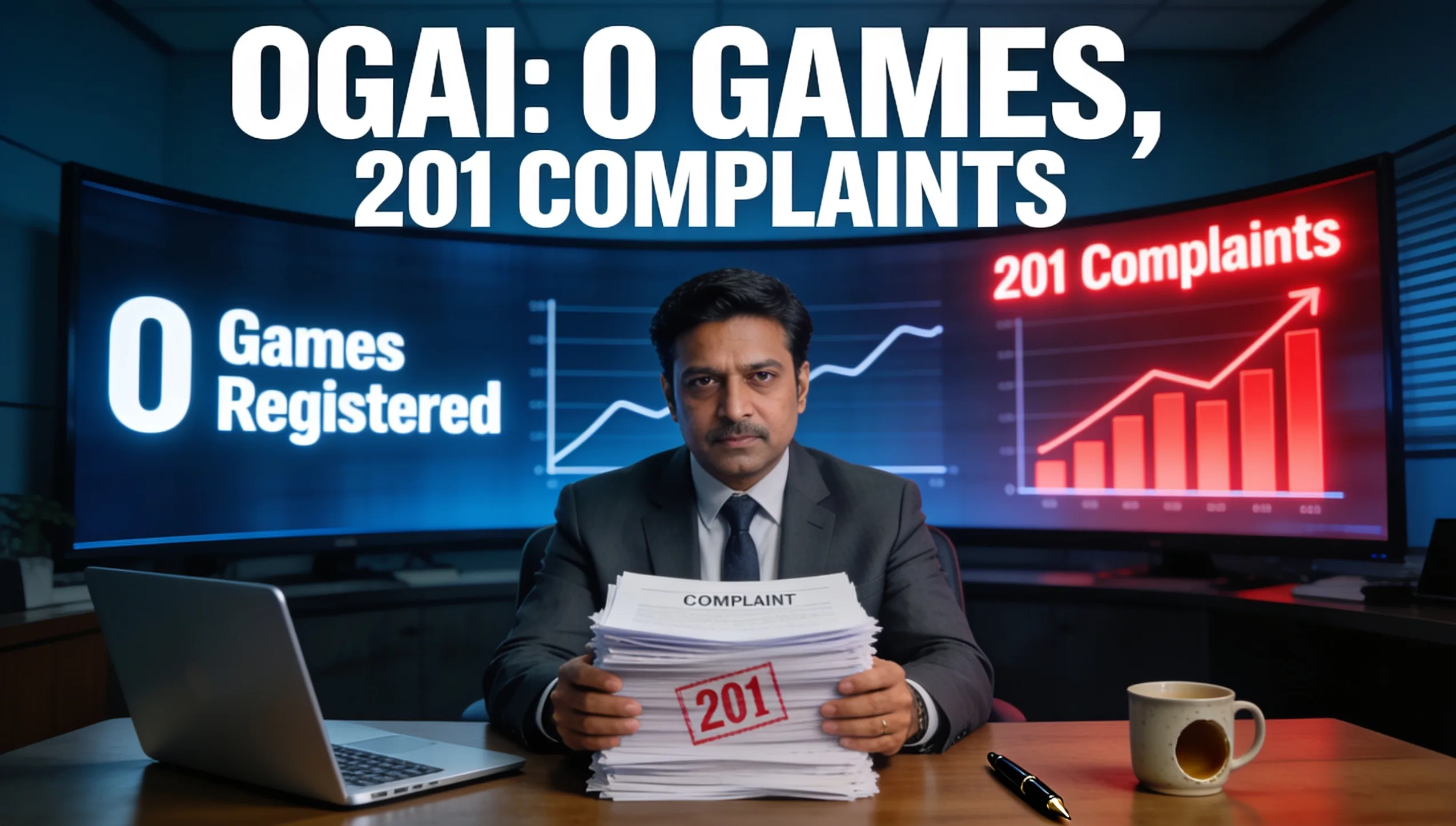
Four months after India's most sweeping gaming law took effect, the regulator created to oversee it has registered zero games — not one of the estimated 1,900 companies and 1.3 lakh employees in the sector has cleared the new framework. The Online Gaming Authority of India (OGAI) disclosed the figures to the Central Information Commission (CIC) in response to a Right to Information request, confirming that as of September 1, 2026, the authority had received 201 complaints while granting no certifications under the Promotion and Regulation of Online Gaming Act (PROGA) 2025.
The disclosure lands as the constitutionality of PROGA itself remains before a Supreme Court three-judge bench — Chief Justice Surya Kant and Justices Joymalya Bagchi and V.M. Pancholi — with the next hearing listed for August 5, 2026. For operators and bettors alike, the combination of a blanket real-money gaming ban, a paralysed regulator, and a pending constitutional challenge has left India's ₹1.7 lakh crore (~$23 billion) online gaming market in a state of deep legal limbo.
Table of Contents
What the RTI Revealed
The CIC disclosure was triggered by an RTI application seeking data on games permitted to operate, complaints involving online gaming platforms, and actions taken against unauthorised services. MeitY confirmed that no official registrations had been recorded under OGAI since the authority was constituted by gazette notification on April 22, 2026.
The 201 complaints received cover a four-month window from May to September 2026. MeitY did not break down complaint categories in its CIC response. Information Commissioner P.R. Ramesh reminded the ministry that RTI obligations require providing information "available on record" — not inferences or explanations — leaving industry watchers with raw numbers but little procedural context.
- OGAI was created as an attached office of MeitY, chaired by an Additional Secretary
- Only two categories are eligible for registration: e-sports and online social games (non-monetary)
- Real-money games — including fantasy sports, rummy, poker, and casino games — are outright prohibited under PROGA
- Zero games registered across all eligible categories in four months of operation
PROGA: The Law That Changed Everything
Parliament passed the Promotion and Regulation of Online Gaming Act, 2025 on August 22, 2025. Draft rules followed on October 12, 2025, with final rules notified on April 22, 2026 and enforcement beginning May 1, 2026. The law eliminated the long-standing skill-versus-chance distinction that had allowed fantasy sports and card games to operate legally, replacing it with a blanket ban on any game involving financial stakes.
The sector it targets is substantial. Real-money gaming accounted for 85.7% of India's online gaming revenue — roughly $3.2 billion annually — before PROGA came into force. Banks, payment gateways, and intermediaries withdrew services within days of enactment, effectively halting operations for the majority of platforms.
| Category | Status Under PROGA | Registration Required | Revenue Share (Pre-PROGA) |
|---|---|---|---|
| Online Real-Money Games (ORMG) | Prohibited | Not applicable | ~85.7% (~$3.2bn) |
| E-Sports | Permitted & promoted | Yes — via OGAI | Minority share |
| Online Social Games | Permitted (non-monetary) | Yes — if notified by authority | Minority share |
Enforcement on the Ground
Despite zero formal registrations, enforcement activity has accelerated. On September 18, 2026, Delhi Police filed an FIR against Real11 Fantasy Sports LLP for alleged cyber and financial fraud involving a ₹1.39 crore deposit dispute. Separately, the Enforcement Directorate is pursuing the Mahadev betting app case, with a chargesheet naming EaseMyTrip co-founder Nishant Pitti as an accused.
Criminal penalties under PROGA are severe:
- First offence: imprisonment up to 3 years, fines up to ₹1 crore
- Repeat offences: 3–5 years imprisonment, fines of ₹1–2 crore
- Parallel civil challenges filed in Karnataka, Madhya Pradesh, and Delhi High Courts have created overlapping legal uncertainty for operators
Supreme Court Challenge
The constitutional challenge to PROGA — T.C.(C) No. 133/2025 — is led by Dr. K.A. Paul of Head Digital Works, with Senior Advocates C.A. Sundaram and Arvind Datar representing petitioners including gaming companies, entrepreneurs, and advocacy groups. The bench consolidated multiple High Court petitions in September 2025.
Five constitutional grounds are under examination:
- Article 19(1)(g) — freedom to carry on a lawful trade
- Article 14 — arbitrary discrimination by eliminating the skill/chance distinction
- Federalism — whether the Act encroaches on state legislative authority over betting and gambling
- Article 21 — unreasonable restrictions on livelihood and consumer autonomy
- Delegation — excessive powers granted to the Union Government
Complicating the challenge: the Supreme Court has already issued two earlier judgments upholding online real-money game bans, giving the bench precedent that favours restrictions.
What Operators Face Now
The OGAI's zero-registration figure exposes a structural problem: the only legal pathway for any gaming company — ORMG platforms or otherwise — runs through an authority that has yet to certify a single product in four months. For the 1,900 companies that operated before PROGA, the options are stark: shut down, pivot to non-monetary formats, pursue legal challenges, or continue operating illegally and risk criminal prosecution.
International operators considering India market entry face an equally clear picture: a regulatory authority that is functionally paralysed, a Supreme Court challenge that could take years to resolve, and enforcement that is already producing criminal filings. Until OGAI processes its first registration or the Supreme Court bench issues a substantive ruling, the market that was the world's fastest-growing real-money gaming sector remains effectively closed.
Sources
Primary and secondary sources used in this report, in order of citation.
- Casino News Daily — India’s OGAI Records 201 Complaints, No Registrations ↗ https://www.casinonewsdaily.com/blog/2026/09/25/indias-ogai-records-201-complaints-no-registrations/
- MediaNama — No Games Registered Under India’s New Gaming Rules ↗ https://www.medianama.com/2026/09/223-online-gaming-law-india-zero-registrations/
- Supreme Court Observer — Challenge to PROGA 2025, T.C.(C) No. 133/2025 ↗ https://www.scobserver.in/cases/challenge-to-the-promotion-and-regulation-of-online-gaming-act-2025/
- Wikipedia — Promotion and Regulation of Online Gaming Act, 2025 ↗ https://en.wikipedia.org/wiki/Promotion_and_Regulation_of_Online_Gaming_Act,_2025
- Legal 500 — India’s Online Gaming Reset: Decoding PROGA and the 2026 Rules ↗ https://www.legal500.com/developments/thought-leadership/indias-online-gaming-reset-decoding-proga-and-the-2026-rules/
- iGaming Business — India Supreme Court Delays Hearing on Online Gaming Ban ↗ https://igamingbusiness.com/gaming/gaming-regulation/india-supreme-court-delays-hearing-online-gaming-ban/
No online game has been granted registration under the Online Gaming Authority of India, while 201 complaints had been received as on September 1, 2026.
— MeitY, Ministry of Electronics and Information Technology · Disclosure to the Central Information Commission, September 2026