
New York Sues Kalshi, Calls Prediction Market Illegal Gambling
New York's $36 billion lawsuit against CFTC-regulated Kalshi could force prediction markets off US sportsbook platforms and rewrite how event contracts are regulated nationwide.
Category: News · By Growl Games Editorial Team · Sun Aug 02 2026 · Updated Sun Aug 02 2026
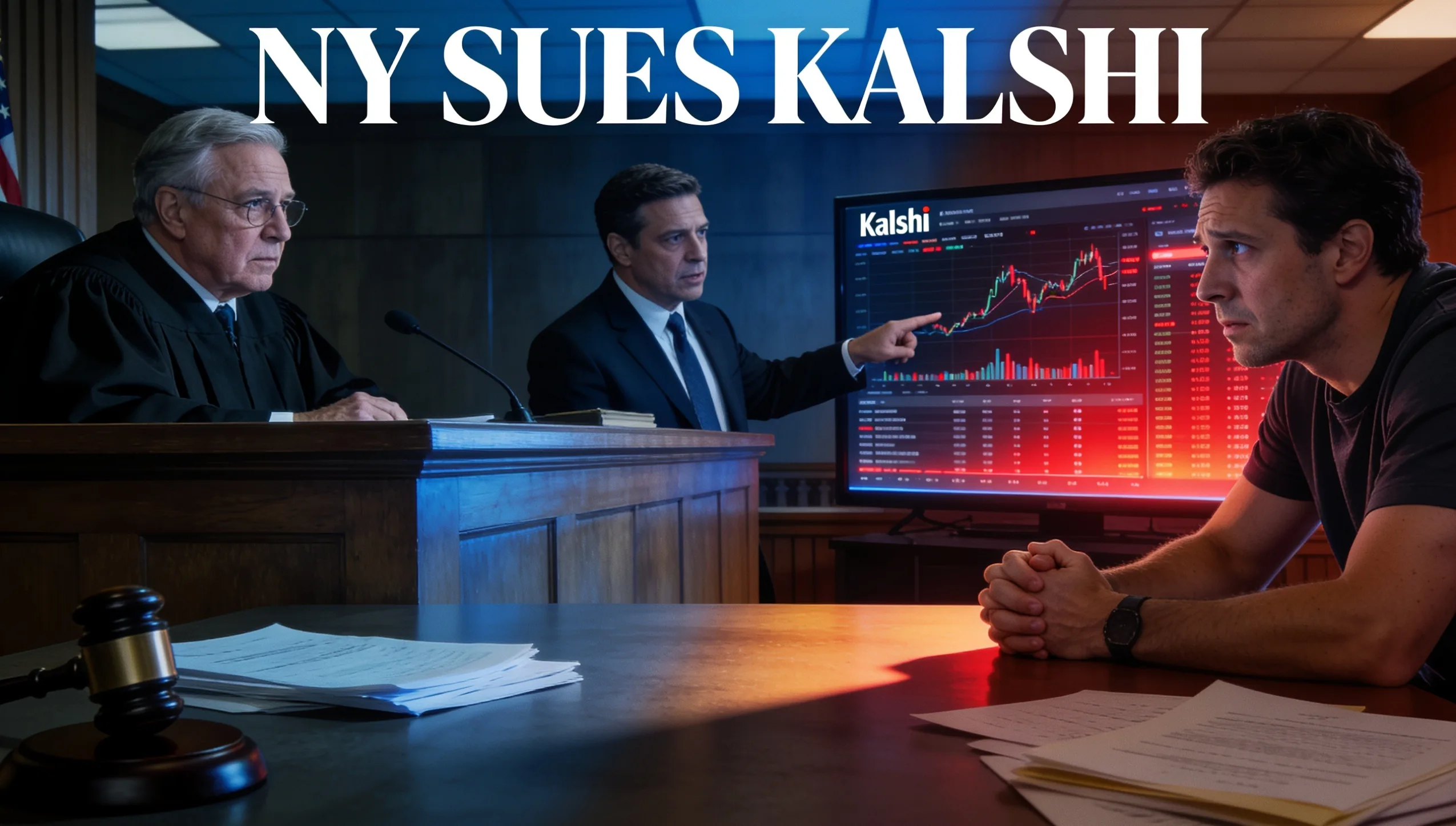
New York Attorney General Letitia James filed suit against prediction market platform Kalshi on July 31, 2026, in New York Supreme Court, Manhattan, accusing the federally licensed exchange of running an "illegal gambling operation" without a state gaming licence. The state is seeking a temporary restraining order and damages that could total as much as $36 billion — calculated as triple Kalshi's estimated New York gains plus $100,000 per unauthorised wager.
The lawsuit lands at a pivotal moment for prediction markets. Kalshi was valued at $40 billion in a funding round being finalised as of late June 2026 — an eightfold increase from its $5 billion valuation a year earlier — and its annualised trading volume had reached $178 billion by April 2026, up 32-fold year-over-year. New York's action now threatens to cut off one of Kalshi's largest user markets and set a legal precedent that could reshape how prediction markets operate across the country.
Table of Contents
The Lawsuit
Governor Kathy Hochul and AG Letitia James jointly authorised the complaint filed in Manhattan on July 31, 2026. The core allegation is that Kalshi accepts wagers from New York residents on sports outcomes — including professional and college events, golf tournaments, and parlay-style "combo" bets — without holding a New York State gaming licence.
James is seeking an injunction to bar Kalshi from operating in the state, a full accounting of all customer bets and company gains attributable to New York users, and civil damages as described above. Governor Hochul stated that Kalshi "has chosen to ignore New York's gaming laws, which exist to protect consumers, prevent problematic gambling, deliver funding for critical public services, and ensure that every company plays by the same rules."
What New York Objects To
State regulators have identified several practices that differ materially from what licensed sportsbooks in New York must follow:
- Kalshi accepts users aged 18 and older; licensed New York sportsbooks require users to be at least 21.
- The platform offers markets on New York college teams, which state law prohibits for licensed books.
- Kalshi carries no statutory responsible-gambling obligations — no self-exclusion registry integration, no mandatory problem-gambling messaging, no state-mandated deposit limits.
- No gaming tax revenue flows to New York from Kalshi's activity, depriving public services of funds that licensed operators contribute.
- Products include event contracts resembling point-spread bets — such as whether Alabama beats Hofstra by more than 10.5 points — and multi-leg parlay equivalents branded as "combo" markets.
Federal vs. State Jurisdiction
Kalshi holds registration as a Designated Contract Market (DCM) under the Commodity Futures Trading Commission (CFTC), which regulates derivatives and futures exchanges at the federal level. The platform argues this registration grants federal preemption: states cannot treat its contracts as gambling any more than they could shut down a stock exchange.
The CFTC has backed that position aggressively. The agency filed emergency opposition to New York's enforcement action, labelling it "overreach" that threatens the derivatives markets it oversees. Separately, the CFTC has sued nine states — including New York — in a parallel federal action seeking to establish exclusive federal jurisdiction over event contracts.
New York counters that Kalshi's products are gambling in substance, whatever their legal classification. Judge Analisa Torres found the state's interests in preventing gambling addiction, preserving sports integrity, and limiting unregulated contracts "heavily" outweighed Kalshi's federal preemption arguments. Kalshi called the suit "political theater," arguing New York "seeks to place itself in the position of a nationwide derivatives regulator." Gaming law expert Bennett Liebman put the stakes plainly: "Either Kalshi wins or it loses 100%."
Kalshi vs. Licensed Sportsbooks: Key Differences
| Feature | Licensed NY Sportsbook | Kalshi (Prediction Market) |
|---|---|---|
| Minimum age | 21 | 18 |
| NY college team markets | Prohibited | Offered |
| State gaming licence | Required & held | Not held |
| Responsible gambling obligations | Statutory (self-exclusion, limits, messaging) | None mandated by state |
| State tax on gross gaming revenue | 51% (NY online sports betting rate) | None paid to state |
| Federal regulator | N/A | CFTC (Designated Contract Market) |
| Product type | Sports wagers | Event contracts (futures) |
Operator and Bettor Impact
For licensed sportsbook operators already paying New York's 51% online sports betting tax — the highest of any US state — the case is directly commercial. If Kalshi is ruled a lawful federal exchange, competitors could relaunch as CFTC-registered DCMs and sidestep state licensing costs entirely. That prospect has drawn the established gaming industry firmly behind New York's position.
New York's suit also follows similar actions: the state sued Coinbase and Gemini in April 2026 over comparable prediction market activities. Across the country, Illinois issued cease-and-desist letters to 65 sweepstakes casino operators in February 2026, signalling a broader state-level pushback against platforms that compete with licensed gambling without submitting to state regulation.
For bettors, the immediate risk is access. A court granting New York's restraining order could see Kalshi accounts in the state frozen or geo-blocked with little notice, with open positions settled without consent. Kalshi warned that enforcement "would just hurt New Yorkers, who would be driven offshore" — a pattern regulators in multiple states are already grappling with elsewhere. The case is widely expected to reach federal appellate courts and potentially the US Supreme Court.
Sources
Reporting draws on official statements, court coverage, and financial reporting from the following sources, cross-checked for accuracy.
- The Washington Post — New York sues prediction market platform Kalshi alleging 'illegal gambling operation' ↗ https://www.washingtonpost.com/business/2026/07/31/prediction-markets-kalshi-lawsuit-new-york/abbcfd52-8cdb-11f1-8912-d71e69d679d7_story.html
- PYMNTS — New York Sues Kalshi in Fight Over Prediction Market Regulations ↗ https://www.pymnts.com/economy/markets/2026/new-york-sues-kalshi-in-fight-over-prediction-market-regulations/
- NY1 — Breaking Down New York's Lawsuit Against Prediction Market Kalshi ↗ https://ny1.com/nyc/all-boroughs/news/2026/07/31/breaking-down-new-york-s-lawsuit-against-prediction-market-kalshi
- CoinDesk — Kalshi Targets $40 Billion Valuation, Widening Lead Over Rival Polymarket ↗ https://www.coindesk.com/business/2026/06/24/kalshi-targets-a-massive-usd40-billion-valuation-widening-lead-over-rival-polymarket
- RotoWire — Prediction Markets Legal Timeline 2026: States, Courts & Federal Regulation ↗ https://www.rotowire.com/prediction-markets/legal-timeline
Kalshi has chosen to ignore New York's gaming laws, which exist to protect consumers, prevent problematic gambling, deliver funding for critical public services, and ensure that every company plays by the same rules.
— Governor Kathy Hochul, State of New York · Statement on New York v. Kalshi, July 31, 2026