
India Supreme Court Upholds Online Gaming Ban, ₹1L Cr GST
Landmark twin rulings end the skill-vs-chance debate, validate retrospective 28% GST demands and strengthen state powers over real-money gaming operators
Category: News · By Growl Games Editorial Team · Mon Jul 13 2026 · Updated Tue Jul 21 2026
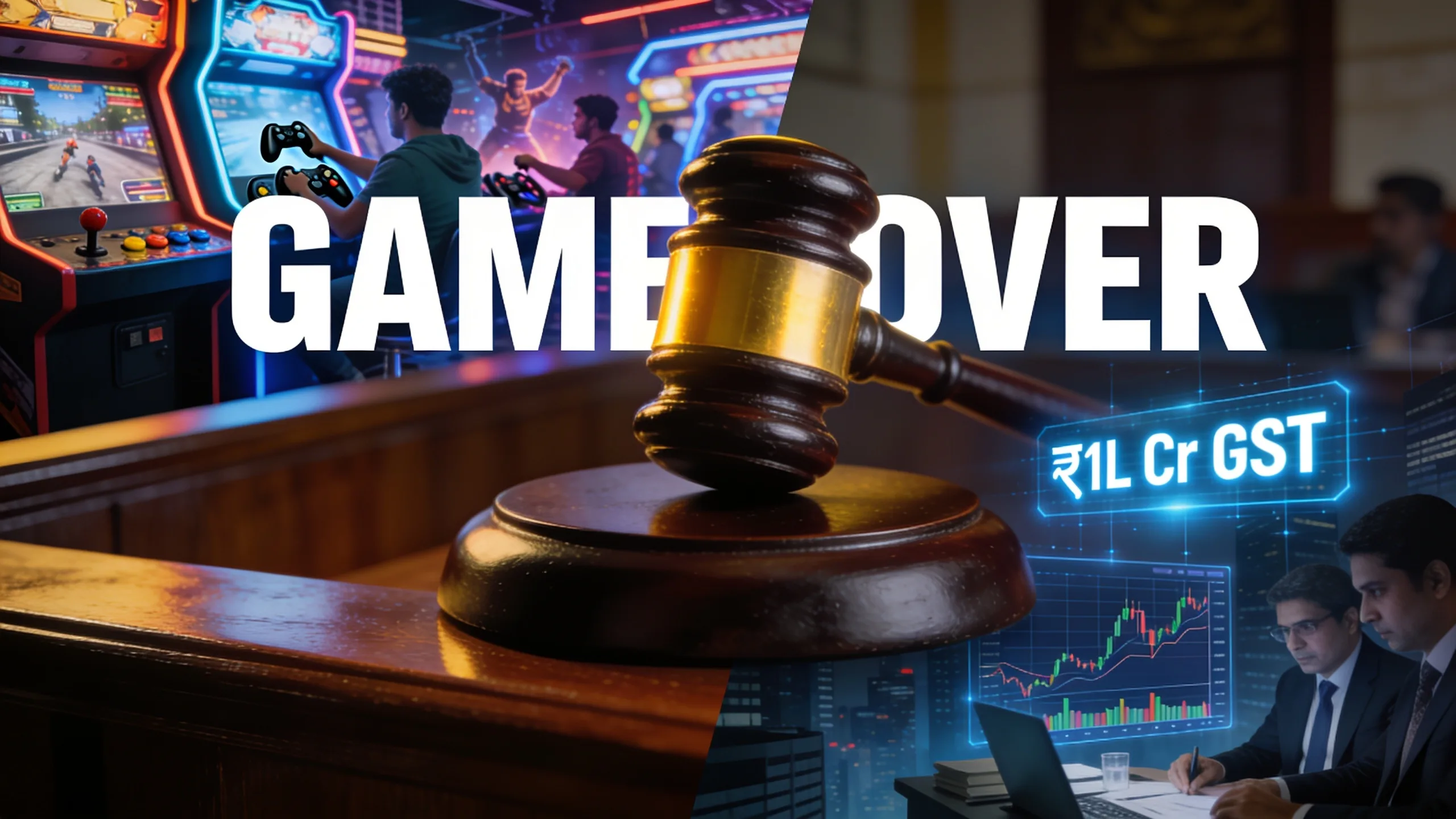
India's Supreme Court delivered twin rulings on 27 May 2026 that have reshaped the country's online gaming landscape. In State of Tamil Nadu v. Junglee Games India Pvt. Ltd. (2026 INSC 594), Justices J.B. Pardiwala and R. Mahadevan ruled that state governments retain full constitutional power to ban online games played for money—including skill-based formats like rummy, poker and fantasy sports. The bench declared that once money is staked on an uncertain outcome, the activity becomes betting and gambling regardless of any skill element.
In a companion ruling the same week, Directorate General of GST Intelligence v. Gameskraft Technologies, the court upheld retrospective 28% GST on the full face value of all bets placed on real-money gaming platforms. Industry-wide tax demands now exceed ₹1 lakh crore (roughly $12 billion). Major operators including Dream11, MPL, PokerBaazi and Zupee had already suspended real-money operations after the federal Promotion and Regulation of Online Gaming Act (PROGA) took effect on 1 May 2026. Over 3,000 employees across the sector have been laid off.
Table of Contents
What the India Supreme Court Decided
The Junglee Games ruling overturned earlier decisions by the Madras High Court and the Karnataka High Court, both of which had struck down state amendments banning online games played for stakes. Those lower courts had reasoned that skill-based games deserved constitutional protection under Article 19(1)(g)—the right to practise any trade or business.
The Supreme Court disagreed. The bench held that Entry 34 of the Constitution's State List covers all wagering activity, not only pure-chance gambling. In a widely noted observation, the court described the proliferation of online betting as a threat to public order and public health, and stated that technological advances have turned every smartphone into a "virtual common gambling house." The ruling restores the enforceability of Tamil Nadu's 2021 gaming reforms and Karnataka's police-law amendments targeting online betting platforms.
The ₹1 Lakh Crore GST Blow
The Gameskraft decision landed the following day and applied the same logic to taxation. The court ruled that online gaming platforms are suppliers—not mere intermediaries—and that GST at 28% applies to the entire amount deposited by players, not just the platform's commission or gross gaming revenue.
Critically, this applies retroactively. Gaming companies had argued that applying the 28% rate to periods before the October 2023 GST Council clarification was unconstitutional. The Supreme Court rejected that argument. The combined tax exposure now facing firms like Gameskraft, Dream11, Games24x7, Delta Corp and Head Digital Works runs into multiples of the cumulative revenue these companies ever generated.
| Factor | Before May 2026 | After Rulings |
|---|---|---|
| Skill vs. chance distinction | Skill games protected by courts | Irrelevant once money is staked |
| State ban powers | Struck down by High Courts | Upheld by Supreme Court |
| GST rate & base | 18% on platform fee (industry position) | 28% on full deposit value, retroactive |
| Federal framework | PROGA enacted, enforcement pending | PROGA active from 1 May; OGAI operational |
| Operator status | Real-money platforms operating | Major platforms suspended; 3,000+ layoffs |
India Online Gaming Ban: PROGA and the OGAI Framework
The Supreme Court rulings arrived just weeks after PROGA and the Promotion and Regulation of Online Gaming Rules 2026 took effect on 1 May 2026. Parliament passed the law in August 2025, banning all online money games—any game where users deposit funds with an expectation of monetary return. Offences are cognisable and non-bailable, carrying penalties of up to three years' imprisonment and fines of up to ₹1 crore.
The law established the Online Gaming Authority of India (OGAI), a six-member body chaired by MeitY's Additional Secretary with representatives from five ministries. The OGAI classifies games, maintains a public list of prohibited online money games, and coordinates with banks and payment gateways to block transactions linked to banned platforms. E-sports and non-monetary social games remain permitted and can apply for registration. The government had already blocked approximately 8,400 gambling websites and apps before PROGA took effect.
Impact on Operators and Bettors
India's real-money gaming sector was valued at roughly $3.8 billion in annual revenue before the ban. Dream Sports, parent of Dream11, had achieved an $8 billion valuation after raising $840 million from investors including Tiger Global, D1 Capital and Falcon Edge. The company has since pivoted to its sports media arm FanCode and game development studio. MPL shifted to free-to-play. Paytm First Games formally exited real-money gaming.
For bettors, the practical effect has been swift. UPI payment gateways now block merchant codes linked to prohibited platforms. Users who attempt to deposit on offshore betting apps find transactions rejected at the banking layer. The OGAI's payment-enforcement rules require banks to verify a platform's registration certificate before processing any gaming-related transaction, with criminal exposure for non-compliant bank officers.
What Comes Next
Despite the sweep of these rulings, the legal battle is far from settled. Constitutional challenges to PROGA itself have been transferred to the Supreme Court and remain pending. The core question—whether Parliament has the competence to regulate betting and gambling under Union List Entry 31 (communications) when it is traditionally a state subject under Entry 34—has not been answered. The Junglee Games judgment strengthens state authority, which some legal analysts argue could actually undermine the Centre's claim to occupy the field.
Meanwhile, the OGAI is processing its first e-sports registrations and preparing to publish its official negative list of prohibited games. Industry bodies including the All India Gaming Federation and the E-Gaming Federation have warned that a blanket prohibition will push users toward unregulated offshore platforms and could put over 200,000 jobs across 400+ companies at risk.
Sources
Primary legal and regulatory sources, followed by specialist industry reporting.
- Supreme Court Observer — Challenge to PROGA 2025 ↗ https://www.scobserver.in/cases/challenge-to-the-promotion-and-regulation-of-online-gaming-act-2025/
- CAclubindia — SC Banning Online Money Gaming Is within States' Power ↗ https://www.caclubindia.com/articles/supreme-court-banning-the-online-money-gaming-is-within-the-states-power-55343.asp
- Asia Gaming Brief — SC Declares Phones 'Virtual Gambling Houses' ↗ https://agbrief.com/news/india/04/06/2026/indias-supreme-court-declares-every-mobile-phone-a-virtual-gambling-house-in-landmark-online-gaming-ruling/
- Business Today — SC Upholds 28% GST on Online Gaming ↗ https://www.businesstoday.in/latest/corporate/story/supreme-court-upholds-28-gst-on-online-gaming-rs1-lakh-cr-tax-burden-looms-533671-2026-05-27
- Outlook Respawn — The Legal Battle That Dismantled India's RMG Sector ↗ https://respawn.outlookindia.com/gaming/gaming-originals/the-legal-battle-that-dismantled-indias-real-money-gaming-sector
- iGaming Expert — India Upholds State Rights on RMG Laws ↗ https://igamingexpert.com/regions/asia/india-state-rights-rmg/
Once the element of wagering is introduced, the nature of the game ceases to be of relevance.
— Justice J.B. Pardiwala, Supreme Court of India · State of Tamil Nadu v. Junglee Games (2026 INSC 594), 27 May 2026