
India Supreme Court Bans Real-Money Gaming in Landmark 2026 Ruling
The Junglee Games judgment eliminates the skill-vs-chance defence, validates state bans, and exposes operators to ₹1 lakh crore in retrospective GST liability.
Category: News · By Growl Games Editorial Team · Sat Jun 13 2026 · Updated Tue Jul 21 2026
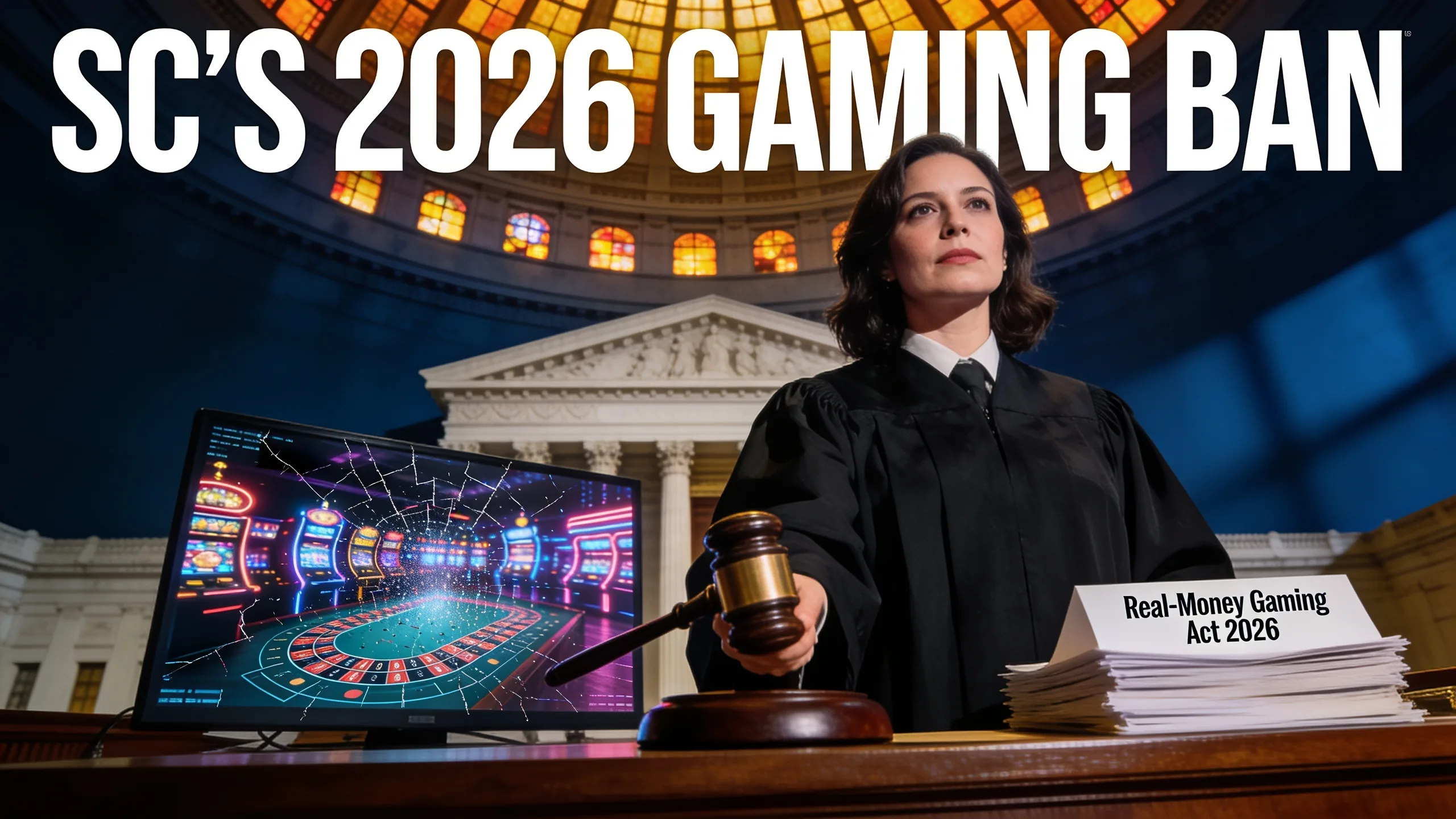
India's Supreme Court has issued the most consequential ruling on online gaming in over six decades, declaring on 27 May 2026 that every smartphone in the country is a virtual common gambling house and that real-money wagering on any game — regardless of how much skill it involves — is constitutionally prohibited under state law. The bench of Justices J.B. Pardiwala and R. Mahadevan handed down judgment in State of Tamil Nadu & Ors. v. Junglee Games India Pvt. Ltd. & Ors. (2026 INSC 594), restoring bans enacted by Tamil Nadu and Karnataka that lower courts had struck down.
The ruling arrives only weeks after the Promotion and Regulation of Online Gaming (PROGA) Act 2025 and its accompanying Rules 2026 took force on 1 May 2026, cementing a national prohibition on real-money online games. In the same week, the same bench upheld 28% GST on the full face value of bets in a linked ruling against Gameskraft Technologies, exposing the sector to an estimated ₹1 lakh crore (approximately $1.2 billion USD) in retrospective tax liabilities. For operators, bettors, and the platforms that serve them, the combined impact is seismic.
In This Article
What the Court Actually Decided
The case had been working through Indian courts since 2021, when the Madras High Court first struck down amendments to the Tamil Nadu Gaming and Police Laws (Amendment) Act, 2021 that criminalised wagering on skill-based games including rummy, poker, and fantasy sports. The Karnataka High Court similarly invalidated state-level gaming restrictions in 2022. Both high courts had ruled that "betting" in Entry 34 of List II of the Constitution applied only to games of pure chance — and that skill-based games therefore enjoyed fundamental-right protection as legitimate business under Article 19(1)(g).
The Supreme Court overturned both judgments entirely. Allowing the appeals of Tamil Nadu and Karnataka, it held that the moment money is staked on the uncertain outcome of any game, the activity constitutes "betting and gambling" under Entry 34 — irrespective of whether the underlying game is one of skill or chance. That means rummy, poker, fantasy cricket, and all real-money gaming formats are now classed as res extra commercium — outside the scope of protected commerce — and no proportionality test or Article 19 challenge can be mounted against a state ban.
The Death of the Skill-vs-Chance Defence
For over seventy years, the Indian gaming industry had relied on a reading of the 1957 RMDC decisions and the 1996 K.R. Lakshmanan ruling to argue that games predominantly requiring skill were beyond the reach of gambling law. That pillar has now been demolished. The bench ruled that "betting and gambling" in Entry 34 must be read as a composite expression, not as "betting on gambling" — meaning the chance content of the underlying game is legally irrelevant once a stake is placed. The court went further, observing that popular platforms do not run genuine fixed-prize tournaments but instead offer systematic inducements for repeated wagering, and that even AI-powered prediction models cannot reliably forecast a cricket match outcome — making the claim of predictive skill implausible for mass market participants.
Major platforms that had already suspended real-money features after PROGA came into force — including Dream11, Mobile Premier League (MPL), PokerBaazi, and Zupee — now face a closed legal door. The ruling also restores operative provisions of the Tamil Nadu Gaming and Police Laws (Amendment) Act, 2021 and amendments to the Karnataka Police Act, 1963 targeting online betting, virtual gambling platforms, and unregulated gaming operators.
The GST Blow: ₹1 Lakh Crore at Stake
The constitutional ruling runs in parallel with a fiscal one. The same bench restored a show-cause notice against Gameskraft Technologies — operator of the Rummy Culture platform — that the Karnataka High Court had quashed in 2023. The notice relates to back-tax demands computed on the full face value of player deposits at 28% GST under Rule 31B of the CGST Rules, 2023, which was introduced retrospectively from 1 October 2023. The industry had argued that demands prior to that date could not be retrospectively applied; the court disagreed. With Gameskraft's individual notice reportedly exceeding ₹21,000 crore, and similar demands pending across the sector, the aggregate exposure is estimated above ₹1 lakh crore.
| Platform / Entity | Category | Status After Ruling | Key Exposure |
|---|---|---|---|
| Junglee Games India | Rummy (RMG) | Real-money ops prohibited | Original respondent; TN ban restored |
| Gameskraft Technologies | Rummy Culture | GST notice reinstated | ₹21,000 crore+ retrospective demand |
| Dream11 / MPL | Fantasy sports | Suspended post-PROGA | Sector-wide GST exposure ~₹1 lakh crore |
| PokerBaazi / Zupee | Poker / Casual RMG | Real-money ops suspended | State bans now constitutionally valid |
| Tamil Nadu / Karnataka | State governments | Bans declared constitutional | Other states expected to follow |
State Power vs the Federal PROGA Framework
The ruling creates a nuanced — and potentially combative — relationship with the central PROGA framework. PROGA traces its authority to Entry 31 (communications) of the Union List, while the Supreme Court's judgment affirms state competence under Entry 34 (betting and gambling) and, independently, Entry 1 (public order) of the State List. Industry legal teams are expected to argue in the pending PROGA constitutional challenge that the federal law has impermissibly encroached on a state domain — using the very same judgment that destroyed their own skill defence as a weapon against central prohibition. The court explicitly noted it was not deciding the Entry 31 vs Entry 34 question, leaving that battlefield open. Industry stakeholders are now closely watching whether the state-rights ruling prompts additional states to introduce tighter gaming controls, accelerating market fragmentation.
What Survives — and What Does Not
Despite the sweeping language of the judgment, not every gaming product is extinguished. The court drew clear lines:
- Pure skill games without monetary stakes remain protected under Article 19 and may continue to operate.
- Genuine fixed-prize skill tournaments — where the prize pool is pre-announced and independent of individual wagers — are distinguished from real-money gaming platforms and may survive scrutiny.
- E-sports were explicitly carved out of PROGA where outcomes depend on player skill and no bets or stakes are placed, and the National Sports Governance Act, 2025 recognises them as a legitimate category.
- Free-to-play and ad-funded social games carry no real-money exposure and remain unaffected.
- Licensed land-based formats in Goa, Sikkim, and Daman operate under state licensing regimes not addressed by this ruling.
For operators currently serving Indian players from offshore — including platforms licensed in Anjouan, Curaçao, or Malta — the ruling strengthens the legal justification for payment-processing blocks, banking restrictions, and advertising prohibitions under Indian law. The risk profile for grey-market operators targeting India has materially increased.
Sources
Primary and secondary sources used in the preparation of this article, verified across legal, regulatory, and industry outlets.
- CAclubindia — Full Legal Analysis: Junglee Games 2026 INSC 594 ↗ https://www.caclubindia.com/articles/supreme-court-banning-the-online-money-gaming-is-within-the-states-power-55343.asp
- Asia Gaming Brief — SC Declares Every Mobile Phone a Virtual Gambling House ↗ https://agbrief.com/news/india/04/06/2026/indias-supreme-court-declares-every-mobile-phone-a-virtual-gambling-house-in-landmark-online-gaming-ruling/
- iGaming Expert — India Upholds State Rights on RMG Laws ↗ https://igamingexpert.com/regions/asia/india-state-rights-rmg/
- iGaming Today — India SC Upholds States' Right to Regulate Online Gaming ↗ https://www.igamingtoday.com/india-supreme-court-upholds-states-right-to-regulate-online-gaming/
- iGaming Business — India Publishes New Online Gaming Regulations (PROGA 2026) ↗ https://igamingbusiness.com/legal-compliance/regulation/india-publish-new-online-gaming-regulations/
- Prime Legal Blog — Supreme Court Judgment on Online Gaming 2026 ↗ https://blog.primelegal.in/supreme-court-judgment-on-online-gaming-2026/
The moment stakes are involved, the medium of playing or the nature of the game as one of skill or chance is irrelevant — it will constitute betting and gambling.
— Justice J.B. Pardiwala & Justice R. Mahadevan, Supreme Court of India · State of Tamil Nadu v. Junglee Games India Pvt. Ltd. (2026 INSC 594), 27 May 2026