
India Real-Money Gaming Ban Upheld by Supreme Court
Twin May 2026 rulings validate state bans on staked online games and confirm ₹2.5 lakh crore GST liability across the sector.
Category: News · By Growl Games Editorial Team · Thu Jul 16 2026 · Updated Tue Jul 21 2026
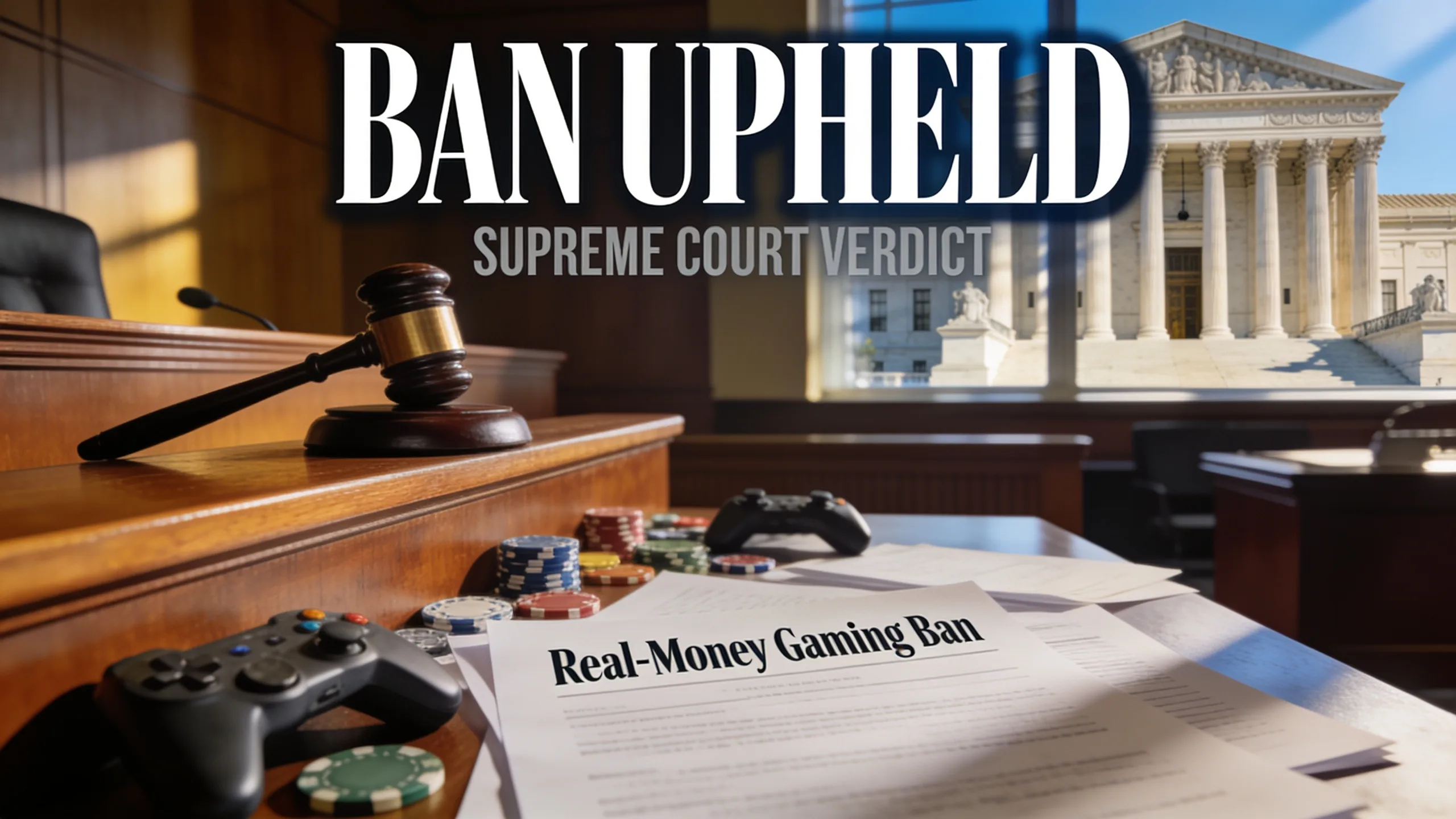
India's real-money gaming sector absorbed two knockout blows in a single week. On 27 May 2026, the Supreme Court of India handed down twin rulings — State of Tamil Nadu v. Junglee Games India Pvt. Ltd. (2026 INSC 594) and Directorate General of GST Intelligence v. Gameskraft Technologies Pvt. Ltd. — that together upheld both the constitutional right of states to ban online money gaming and the legality of 28% GST levied on the full face value of every bet. The verdicts arrived just weeks after the federal Promotion and Regulation of Online Gaming (PROG) Act 2025 and its accompanying PROG Rules 2026 came into force on 1 May 2026.
The financial fallout is severe. Validated GST demands across the sector now total nearly ₹2.5 lakh crore (roughly $30 billion) — an amount analysts describe as a balance-sheet event rather than a litigation matter. Platforms including Dream11, Mobile Premier League (MPL), PokerBaazi, Zupee, and Junglee Games itself halted real-money operations immediately. The combined effect of PROGA and the court rulings has left India's $8.6 billion projected online gaming market — and the offshore shadow economy growing in its wake — fundamentally reshaped.
In This Article
The Junglee Games Ruling Explained
Delivered by Justice J.B. Pardiwala and Justice R. Mahadevan, the Junglee Games judgment settled a decade-long dispute over whether state governments could ban wagering on skill-based games such as rummy, poker, and fantasy sports. Tamil Nadu and Karnataka had passed laws criminalising online games played for money, which lower courts — including the Madras High Court and Karnataka High Court — had struck down in favour of the industry.
The Supreme Court reversed those decisions. The bench ruled that Entry 34 of the State List (betting and gambling) in the Seventh Schedule of the Constitution grants states broad power to prohibit staked gaming regardless of whether the game is one of skill or chance. The skill-versus-chance distinction, long the industry's primary legal shield, was found not to limit state legislative competence where the legislature has chosen to remove any statutory exemption for skill games.
- The court found the High Courts had made "an egregious error" by reading Entry 34 narrowly to cover only games of pure chance.
- Gaming companies had argued skill-based games are protected commercial activity under Article 19(1)(g) of the Constitution; the bench disagreed in this context.
- The ruling also implicitly strengthened PROGA's standing: if states can ban online money games, Parliament's parallel ban under Union List powers is harder to challenge.
Gameskraft: 28% GST on Full Face Value
The following day, Justice Mahadevan delivered the companion fiscal ruling in the Gameskraft case. It confirmed that online gaming platforms — including fantasy sports operators — are suppliers of actionable claims constituting "goods" under the GST framework, and that the 28% levy applies to the full face value of every deposit, not the operator's commission.
The commercial difference is enormous. On a ₹100 deposit under the old platform-fee model, GST amounted to roughly ₹1.50–₹1.80. Under the face-value model now upheld, the charge is ₹28 — a 15-to-18-fold increase. Because players routinely redeploy winnings across multiple games, the cumulative "face value" during a period can far exceed total deposits, which is precisely how Gameskraft Technologies received a single GST demand of ₹21,000 crore on revenues of ₹4,650 crore. The court restored that notice for adjudication.
PROGA and PROG Rules 2026: The Regulatory Backbone
The Supreme Court decisions sit on top of the most significant piece of Indian gaming legislation in generations. PROGA, passed by Parliament in August 2025 and fully operative from 1 May 2026, imposes a complete pan-India ban on all online money games — whether involving skill, chance, or both. It also bans advertising of such games and restricts financial institutions from processing related transactions. Violations carry penalties of up to ₹1 crore in fines and three years' imprisonment.
The PROG Rules 2026, notified on 22 April 2026, create the operational architecture. Their key provisions include:
- Establishment of the Online Gaming Authority of India (OGAI) under the Ministry of Electronics and Information Technology (MeitY), headquartered in Delhi.
- A 90-day classification test to determine whether any game qualifies as a prohibited online money game, a permissible e-sport, or a social game.
- Mandatory age verification, parental controls, usage time limits, and in-app counselling tools for operators of permitted platforms.
- A two-tier grievance system: platform level first, then OGAI appeal within 30 days, with a further appeal to the MeitY Secretary.
- Data localisation: permitted platforms must retain traffic data and metadata on servers within India.
- Extraterritorial reach: foreign-incorporated platforms with Indian user bases face the same obligations, with country of origin listed as an explicit registration trigger.
The Offshore Blowback: A $15 Billion Shadow Market
The practical consequence critics warned about has materialised. A CUTS International survey of Delhi NCR users found that offshore platform usage climbed from 68.3% pre-ban to 82% post-ban — a 20.1% relative increase. Daily access rates jumped from 3.4% to 42.3% and average session lengths extended beyond two hours. The illegal offshore betting market could exceed $15 billion in 2026, according to industry estimates.
MeitY has blocked more than 8,400 illegal sites and apps since PROGA came into force. Offshore operators are countering with mirror domains, VPN-routing, Telegram and WhatsApp promotion, and "mule" UPI accounts to bypass payment blocks. The Law Commission of India's 2018 Report No. 276 explicitly cautioned that banning gambling entirely risks accelerating unregulated activity — a warning now borne out.
Operator Impact at a Glance
| Factor | Before May 2026 | After PROGA + SC Rulings |
|---|---|---|
| Real-money gaming legality | Permitted by many High Court orders; skill games protected | Banned nationwide under PROGA; states also empowered to ban |
| GST on deposits | ~18% on platform fee (effective ~1.5–1.8% of deposit) | 28% on full face value of every deposit |
| Sector GST exposure | Contested; lower courts split | ≈ ₹2.5 lakh crore (~$30 billion) validated by Supreme Court |
| Key platforms | Dream11, MPL, PokerBaazi, Zupee active | All halted real-money operations; 3,000+ jobs lost |
| Regulatory body | Fragmented; state-by-state frameworks | OGAI (central regulator under MeitY) from 1 May 2026 |
| Offshore/illegal activity | Estimated $100B+ in annual unlicensed transactions | Shadow market projected at $15B+ and growing in 2026 |
| E-sports & social games | No distinct national framework | Permitted; OGAI registration required for e-sports recognition |
Sources
Primary and industry sources cross-checked for this report, prioritising official court citations, government notifications, and specialist legal analysis.
- CAClubIndia — Full legal analysis, State of T.N. v. Junglee Games India (2026 INSC 594) ↗ https://www.caclubindia.com/articles/supreme-court-banning-the-online-money-gaming-is-within-the-states-power-55343.asp
- CAClubIndia — Gameskraft GST ruling: 28% on full face value analysis ↗ https://www.caclubindia.com/articles/supreme-court-on-gst-online-gaming-tax-applies-on-betting-and-gambling-irrespective-of-skill-or-chance-55335.asp
- Akashvani / News on Air (Government of India) — PROG Rules 2026 official notification ↗ https://newsonair.gov.in/promotion-regulation-of-online-gaming-rules-2026-comes-into-force/
- iGaming Business — India publishes PROG Rules 2026 ↗ https://igamingbusiness.com/legal-compliance/regulation/india-publish-new-online-gaming-regulations/
- Supreme Court Observer — Junglee Games and Gameskraft: skill-vs-chance doctrine reshaped ↗ https://www.scobserver.in/journal/from-skill-to-stakes-how-junglee-games-and-gameskraft-reshape-indias-online-gaming-laws/
- MediaNama — India blocks 8,400+ sites; CUTS International offshore usage survey ↗ https://www.medianama.com/2026/01/223-india-blocks-242-gambling-sites-total-above-7800/
- Business Today — GST ruling: ₹1 lakh crore tax burden, sector-wide operator impact ↗ https://www.businesstoday.in/latest/corporate/story/supreme-court-upholds-28-gst-on-online-gaming-rs1-lakh-cr-tax-burden-looms-533671-2026-05-27
This judgment is the single most consequential pronouncement on the gaming sector in over six decades — and it must be read together with its fiscal twin in the very same week.
— Ketan Joshi, Associate Partner, Maheshwari & Co. · Legal analysis of Junglee Games and Gameskraft, June 2026