
India Real-Money Gaming Ban: PROGA 2026 Kills $2.75B Industry
India's PROG Act 2025 and its enforcement rules are live — Dream11 is shut, offshore betting is surging, and a Supreme Court ruling has revived INR 2.5 lakh crore in GST demands against operators.
Category: News · By Growl Games Editorial Team · Mon Jul 13 2026 · Updated Tue Jul 21 2026
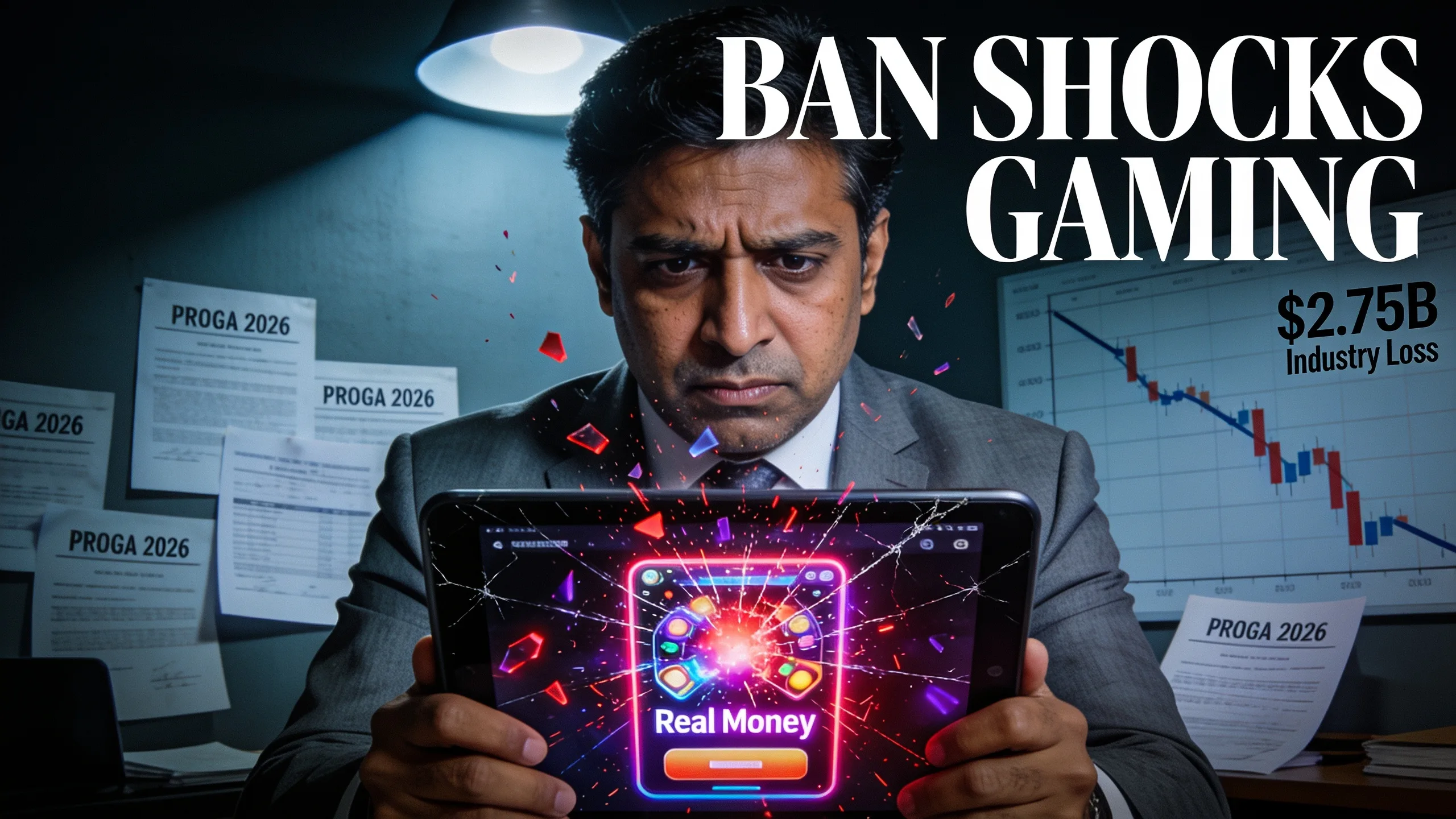
India's real-money gaming (RMG) ban has moved from legislative text to lived reality. The Promotion and Regulation of Online Gaming (PROG) Act 2025 — enacted by Parliament on 22 August 2025 — came fully into force on 1 May 2026, backed by the PROG Rules 2026 and a newly constituted central regulator, the Online Gaming Authority of India (OGAI). The law imposes a categorical prohibition on all online money games, making no distinction between games of skill and games of chance.
The industry it hit was enormous. India's online gaming market generated INR 232 billion in revenue in 2024, with 77% of that coming from transaction-based formats. Within the first 90 days of PROGA's passage, RMG platforms recorded asset write-downs exceeding $840 million. Dream11 — valued at $8 billion — shut its core operations entirely. MPL, with 120 million registered users globally, suspended all money-based play. The Supreme Court then delivered a second hammer blow on 27 May 2026, validating retrospective 28% GST on the full face value of player deposits — creating tax demands that collectively total nearly INR 2.5 lakh crore.
In This Article
What the PROG Act and 2026 Rules Actually Do
The PROG Act classifies online games into three categories: prohibited online money games (any game involving financial stakes or deposits with the expectation of monetary reward), permissible online social games, and recognized e-sports. Crucially, the prohibition is not based on the skill-versus-chance distinction that India's courts had spent decades refining — it is based solely on whether money is staked.
The PROG Rules 2026, framed under Section 19 of the PROG Act and notified on 22 April 2026, provide the operational architecture. Key provisions include:
- Payment enforcement: Banks and payment intermediaries are empowered — and obligated — to block transactions linked to prohibited platforms. Rule 19 requires financial institutions to verify Certificates of Registration before processing payments for any gaming platform.
- User safety mandates: Age verification, parental controls, session time limits, in-app counselling referrals, and fair-play monitoring are all required of permissible operators.
- Game determination: The OGAI conducts a five-factor test to classify whether any given product constitutes an online money game. The process must conclude within 90 days.
- Criminal penalties: Offering or facilitating an online money game carries up to three years' imprisonment and fines of up to INR 1 crore. Advertising such platforms attracts up to two years and INR 50 lakh.
- E-sports recognition: The Act, for the first time, formally recognizes e-sports as a competitive skill-based sport under the National Sports Governance Act 2025. Registered e-sports operators receive digital Certificates of Registration valid for up to 10 years.
The OGAI: India's New Central Gaming Regulator
The Online Gaming Authority of India was constituted on 28 April 2026, six days after the Rules were notified, and operates as an attached office of the Ministry of Electronics and Information Technology (MeitY), headquartered in Delhi. It is chaired by the Additional Secretary of MeitY and includes joint secretary-level representation from the Ministries of Home Affairs, Finance, Information and Broadcasting, Youth Affairs and Sports, and Law and Justice.
The OGAI holds civil court powers: it can summon witnesses, receive evidence on affidavit, and issue binding directions. Within its first 11 days of operation, blocking orders and compliance advisories were already reaching bank treasury desks, and e-sports federations were uploading registration applications. Over 8,376 URLs associated with illegal betting and gambling had been blocked or actioned by Indian authorities prior to the Rules coming into force, with more than 4,800 of those removed after the PROG Act's passage.
Supreme Court Rulings: GST and State Powers
Two Supreme Court decisions have compounded the industry's difficulties. On 27 May 2026, a bench of Justices JB Pardiwala and R Mahadevan ruled in State of Tamil Nadu & Ors. v. Junglee Games India Pvt. Ltd. & Ors. (2026 INSC 594) that staking money on uncertain outcomes — including in fantasy sports, online rummy, and poker — constitutes "betting" under Entry 34 of List II of the Constitution. This settled the GST dispute in the government's favour, validating retrospective tax demands on the full deposit value at 28%, not on gross gaming revenue.
The same ruling confirmed that individual states retain full authority to regulate, restrict, or prohibit online gaming within their own borders — even where PROGA's federal framework applies. This creates a fragmented compliance landscape: operators must now navigate both central OGAI rules and the potentially stricter laws of individual states, particularly Tamil Nadu and Karnataka, both of which have historically pursued tighter controls.
| Legal Development | Date | Impact on Operators |
|---|---|---|
| PROG Act 2025 — Parliamentary Passage | 22 Aug 2025 | Immediate RMG suspension by Dream11, MPL, PokerBaazi, WinZO, Zupee |
| PROG Rules 2026 — Gazette Notification | 22 Apr 2026 | OGAI constituted; payment-gateway enforcement obligations activated |
| PROGA + Rules — Full Commencement | 1 May 2026 | Criminal penalties live; money game ban fully enforceable |
| Supreme Court — GST Ruling (2026 INSC 594) | 27 May 2026 | Retrospective 28% GST on full deposit value confirmed; ~INR 2.5L Cr in demands revived |
| Supreme Court — State Powers Ruling | Late May / June 2026 | States confirmed free to impose stricter rules than PROGA; multi-jurisdiction compliance now mandatory |
The Offshore Surge: Prohibition's Unintended Effect
Multiple surveys confirm that PROGA has driven Indian bettors toward unregulated offshore platforms rather than eliminating demand. Before the ban, 68% of users reported using offshore platforms; that figure rose to 82% post-PROGA, according to data cited by industry sources. A CUTS International survey in Tamil Nadu found a 15.2 percentage point rise in offshore platform usage in the months following enforcement. Offshore gaming by Indian residents was estimated by industry observers to be worth a conservatively calculated $20 billion annually, with associated tax evasion exceeding $4 billion — already surpassing total domestic industry revenues before the ban.
Offshore operators accessible via VPN, mirror domains, and UPI workarounds face no Indian regulatory oversight, no consumer protection obligations, and no grievance redressal requirements. Constitutional challenges to PROGA — filed by Head Digital Works (operator of A23 Rummy), GamesKraft, and other petitioners — remain active in the Supreme Court on grounds that the blanket ban violates Article 19(1)(g) rights and exceeds Parliament's constitutional competence over what is fundamentally a state-list subject.
What Operators and Bettors Need to Watch
For any operator with India exposure, the compliance picture is now layered across three axes: central OGAI rules, state-level restrictions, and an unresolved constitutional challenge at the Supreme Court. The most plausible medium-term outcomes, as assessed by Indian gaming lawyers, are either a phased licensing framework mandated by the court or a full reversal that restores skill-game protections — but neither is imminent.
- Payment compliance is live now. Banks and payment gateways face personal criminal liability if they process transactions for prohibited platforms. Any operator routing Indian player deposits must have OGAI determination status or face payment infrastructure withdrawal.
- E-sports is the only growth vertical. Social games and e-sports remain legal, and the first wave of OGAI e-sports registrations is underway. The sector is projected to reach INR 316 billion in total gaming revenue by 2027 — almost entirely driven by non-money formats if PROGA holds.
- Retrospective GST is a survival issue. Dream11 faces a show-cause notice for INR 40,000 crore in alleged GST evasion. Delta Corp received notices totalling INR 23,204 crore. With the Supreme Court validating these demands, insolvencies are a realistic outcome for several major platforms.
- The Supreme Court constitutional hearing is the pivotal moment. If the court finds PROGA's blanket ban disproportionate or outside Parliament's competence, a regulated licensing regime could emerge — potentially reopening the market to licensed domestic and international operators.
Sources
Primary sources listed first, followed by regulatory analysis and industry coverage used to cross-check figures and legal details.
- Press Information Bureau (Government of India) — PROG Rules 2026 Official Notification ↗ https://static.pib.gov.in/WriteReadData/specificdocs/documents/2026/apr/doc2026430859401.pdf
- World Casino Directory — Supreme Court Ruling, State of Tamil Nadu v. Junglee Games (2026 INSC 594) ↗ https://news.worldcasinodirectory.com/indias-supreme-court-rules-on-online-betting-states-can-regulate-wagering-123052
- iGaming Business — India Publishes New Online Gaming Regulations ↗ https://igamingbusiness.com/legal-compliance/regulation/india-publish-new-online-gaming-regulations/
- iPleaders — OGAI: Powers, Registration and Enforcement Under PROGA 2026 ↗ https://blog.ipleaders.in/online-gaming-authority-india-ogai/
- The Quint — India's Online Gaming Rules 2026: Fixing the Past, Risking the Future ↗ https://www.thequint.com/opinion/india-online-gaming-rules-fixing-the-past-risking-the-future
- Outlook Respawn — The Supreme Court Verdict That Dismantled India's RMG Sector ↗ https://respawn.outlookindia.com/gaming/gaming-originals/the-legal-battle-that-dismantled-indias-real-money-gaming-sector
- iGaming Today — India Bans 8,376 Websites as Offshore Access Persists ↗ https://www.igamingtoday.com/india-bans-8376-websites-associated-with-online-betting-and-gambling-as-offshore-access-persists/
- Legal 500 — India's Online Gaming Reset: Decoding PROGA and the 2026 Rules ↗ https://www.legal500.com/developments/thought-leadership/indias-online-gaming-reset-decoding-proga-and-the-2026-rules/
Whenever you see blanket bans across Asia on real money gaming, you see an immediate surge in black market and offshore activity. Players don't stop — they simply move. India is simply too large a market to abandon.
— Industry analyst, quoted in iGaming Expert · May 2026