
India Gambling Ban Drives Offshore Surge in 2026
India blocked 8,376 gambling URLs since the PROG Act took force — but offshore player numbers are rising, not falling, with a $20 billion shadow market absorbing the demand.
Category: News · By Growl Games Editorial Team · Fri Jul 10 2026 · Updated Tue Jul 21 2026
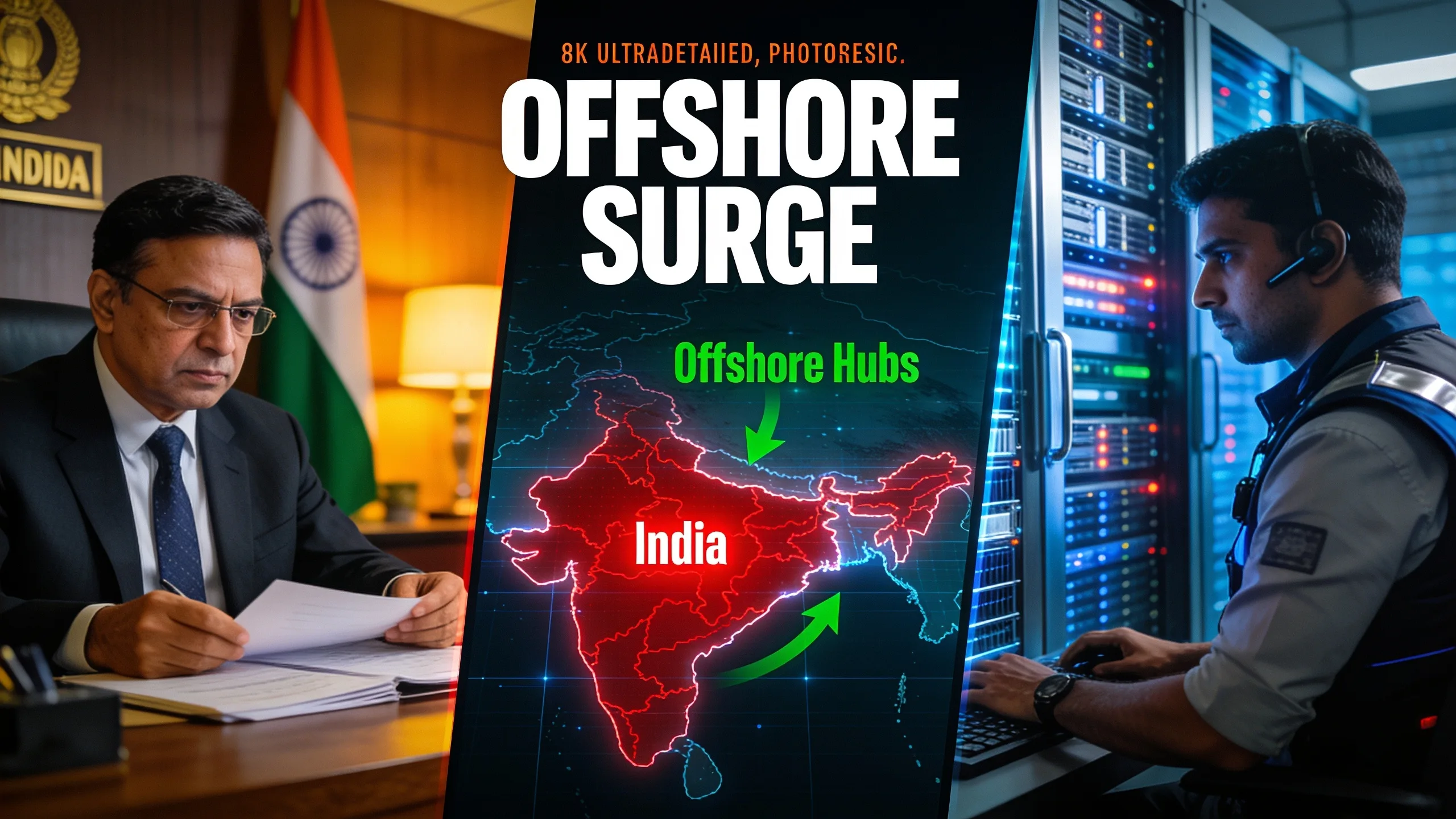
India's nationwide online gambling ban is producing the opposite of its intended effect. Ten weeks after the Promotion and Regulation of Online Gaming (PROG) Act 2025 and its implementing PROG Rules 2026 came into full force on 1 May 2026, government data and independent surveys show offshore platform usage accelerating rather than declining — raising urgent questions about whether prohibition can work in the world's second-largest internet market.
The Ministry of Electronics and Information Technology (MeitY) told parliament on 1 April 2026 that authorities had blocked or actioned 8,376 URLs linked to online betting and gambling as of 28 March 2026 — more than 4,800 of those blocks imposed after the ban. Yet a December 2025 survey by consumer watchdog CUTS International in Delhi NCR found that offshore platform usage had risen from 68.3% pre-ban to 82% after it passed, with daily active usage surging from 3.4% to 42.3% of surveyed gamblers.
In This Article
What the PROG Act and 2026 Rules Actually Say
Parliament passed the Promotion and Regulation of Online Gaming Act in August 2025 during the Monsoon Session — India's first dedicated central legislation for online gaming. It creates a hard prohibition on all "online money games," defined as any game where users pay fees or stakes with a reasonable expectation of monetary gain. The definition is intentionally broad: virtual currencies, NFT-based rewards, and play-to-earn mechanics all fall within scope if their tokens trade at real-world value on secondary markets.
The accompanying PROG Rules 2026, notified by MeitY on 22 April 2026 and effective from 1 May, operationalise the Act across three key mechanisms:
- Game classification — a five-factor determination test decides whether a product is a prohibited money game, a permissible social game, or a legal e-sport
- Financial enforcement — banks, payment gateways, and UPI processors are legally required to block transactions to platforms on the OGAI's prohibited list, with personal criminal liability for compliance officers who fail to act
- Criminal penalties — offering or facilitating online money games carries up to 3 years' imprisonment and a fine of up to ₹1 crore for a first offence; advertising such games carries up to 2 years and a fine of up to ₹50 lakh
India's New Gaming Regulator: The OGAI
The centrepiece of the new architecture is the Online Gaming Authority of India (OGAI), constituted as an attached office of MeitY and headquartered in the National Capital Territory of Delhi. It is chaired by the Additional Secretary, MeitY on an ex-officio basis, with joint secretary-level representation from five ministries: Home Affairs, Finance (Department of Financial Services), Information and Broadcasting, Youth Affairs and Sports, and Law and Justice.
The OGAI's core mandate covers maintaining the official prohibited games list, classifying new products, directing financial institutions to freeze payment flows, co-ordinating with law enforcement, and hearing user appeals. Enforcement proceedings must be concluded within 90 days of a complaint. The OGAI's three-tier grievance system — platform first, then OGAI, then the Secretary of MeitY as appellate authority — gives each tier 30 days to resolve a complaint.
Critically, the OGAI has not yet published its full prohibited games list. Legal analysts note that until that list goes live under Rule 26, banks face a compliance gap: the payment verification obligation under Rule 19(1) is already active, but the reference list they need to verify against remains incomplete.
Enforcement in Practice: URLs Blocked, Players Undeterred
India's enforcement record shows genuine scale. More than 1,500 betting and gambling websites were blocked even before the 2025 ban took effect; the post-ban total has now surpassed 8,376 URLs. The government has also directed the IT Act, 2000 and IT Rules 2021 against offshore operators, demanding due diligence and threatening intermediary liability for non-compliant platforms.
But operators routinely circumvent blocks by cycling through mirror domains — identical-content sites on new URLs that redirect users as soon as a primary domain is taken down. Payment workarounds are equally entrenched: users are funnelling deposits through mule bank accounts disguised as individual transfers and routing withdrawals through cryptocurrency to avoid the UPI and card-level blocks entirely. A January 2026 CUTS survey in Tamil Nadu recorded a 15.2% rise in offshore platform usage after the ban — not a decline.
Amol Kulkarni, Research Director at CUTS International, described URL blocking as "a temporary band-aid approach at best," arguing that holistic regulation, user education, and targeted action against illegal operators were the only combination likely to produce lasting results.
The Offshore Market Scale Regulators Are Facing
The numbers behind India's offshore gambling problem are striking. Experts at a MediaNama panel discussion in September 2025 put the offshore gaming market at a conservative $20 billion, with associated tax evasion exceeding $4 billion annually — more than the entire domestic licensed industry's revenues combined. Within the first 90 days of the ban, real-money gaming platforms had reportedly recorded combined asset write-downs exceeding $840 million.
| Metric | Pre-Ban (2025) | Post-Ban (2026) |
|---|---|---|
| Offshore platform usage (Delhi NCR survey) | 68.3% of surveyed gamblers | 82% of surveyed gamblers |
| Daily active offshore users (same survey) | 3.4% | 42.3% |
| Offshore market size (IGAP estimate) | ~$20 billion | Unchanged or growing |
| URLs blocked by MeitY (cumulative) | ~3,500 (pre-Act) | 8,376+ (as of 28 Mar 2026) |
| RMG platform asset write-downs | — | $840 million+ (first 90 days) |
What This Means for Operators and Players
For domestic platforms, the impact has been severe and immediate. Major real-money gaming operators — including Dream11 and MPL — publicly paused their services after the law came into force. Dream11 had already withdrawn its high-profile sponsorship of the Board of Control for Cricket in India (BCCI) in the immediate aftermath of the bill's passage.
For international and offshore operators, the picture is different: demand from Indian players has not fallen — it has migrated underground. The enforcement model targets payment rails rather than individual players, meaning criminal liability is directed at operators, advertisers, and payment facilitators, not bettors themselves. Players who continue to access offshore sites via mirror domains and crypto payments face account-freeze risk and forfeited winnings rather than arrest.
Legal analysts at Lexology have flagged the compliance gap facing Indian banks most starkly: personal criminal exposure now falls on the Head of Payments, Chief Compliance Officer, and any senior executive "in charge of the relevant part of the business at the time of an offence," with most D&O insurance policies unlikely to cover this exposure. Whether the OGAI publishes a workable prohibited list in the near term will determine whether India's payments-led enforcement strategy can close the gap between legislative intent and operational reality.
Sources
Primary regulatory sources and verified reporting consulted for this article, listed in order of authority.
- iGaming Business — India Publishes New Online Gaming Regulations ↗ https://igamingbusiness.com/legal-compliance/regulation/india-publish-new-online-gaming-regulations/
- Law.asia — India's New Online Gaming Rules and Authority Become Operational ↗ https://law.asia/online-gaming-regulation-india/
- Lexology — India's Online Gaming Reset: Decoding PROGA and the 2026 Rules ↗ https://www.lexology.com/library/detail.aspx?g=a856b9b7-bad8-4f30-ab98-33be57ab11e2
- MediaNama — India Blocks 8,376 Gambling Websites: MeitY Data ↗ https://www.medianama.com/2026/04/223-india-blocks-8376-gambling-websites-meity-data/
- CAClubIndia — India's Online Gaming Revolution: Complete Guide to PROG Act w.e.f 1 May 2026 ↗ https://www.caclubindia.com/articles/indias-online-gaming-revolution-a-complete-guide-to-the-promotion-and-regulation-of-online-gaming-wef-1st-may-2026-55118.asp
A blanket prohibition sidelines proven regulatory models that channel demand into transparent, well-supervised markets that protect players and generate tax revenue. Instead, it risks driving activity underground, where consumer harm is harder to prevent and oversight is minimal.
— Segev LLC, Gaming Law Firm · Public Commentary on PROG Act 2025, August 2025