
Illegal Gambling Costs EU €22.9bn as Black Market Hits €91.6bn
ECA data reveals unlicensed operators now capture the majority of EU online gambling revenue, prompting calls to expand Europol's enforcement mandate
Category: News · By Growl Games Editorial Team · Fri Jul 10 2026 · Updated Tue Jul 21 2026
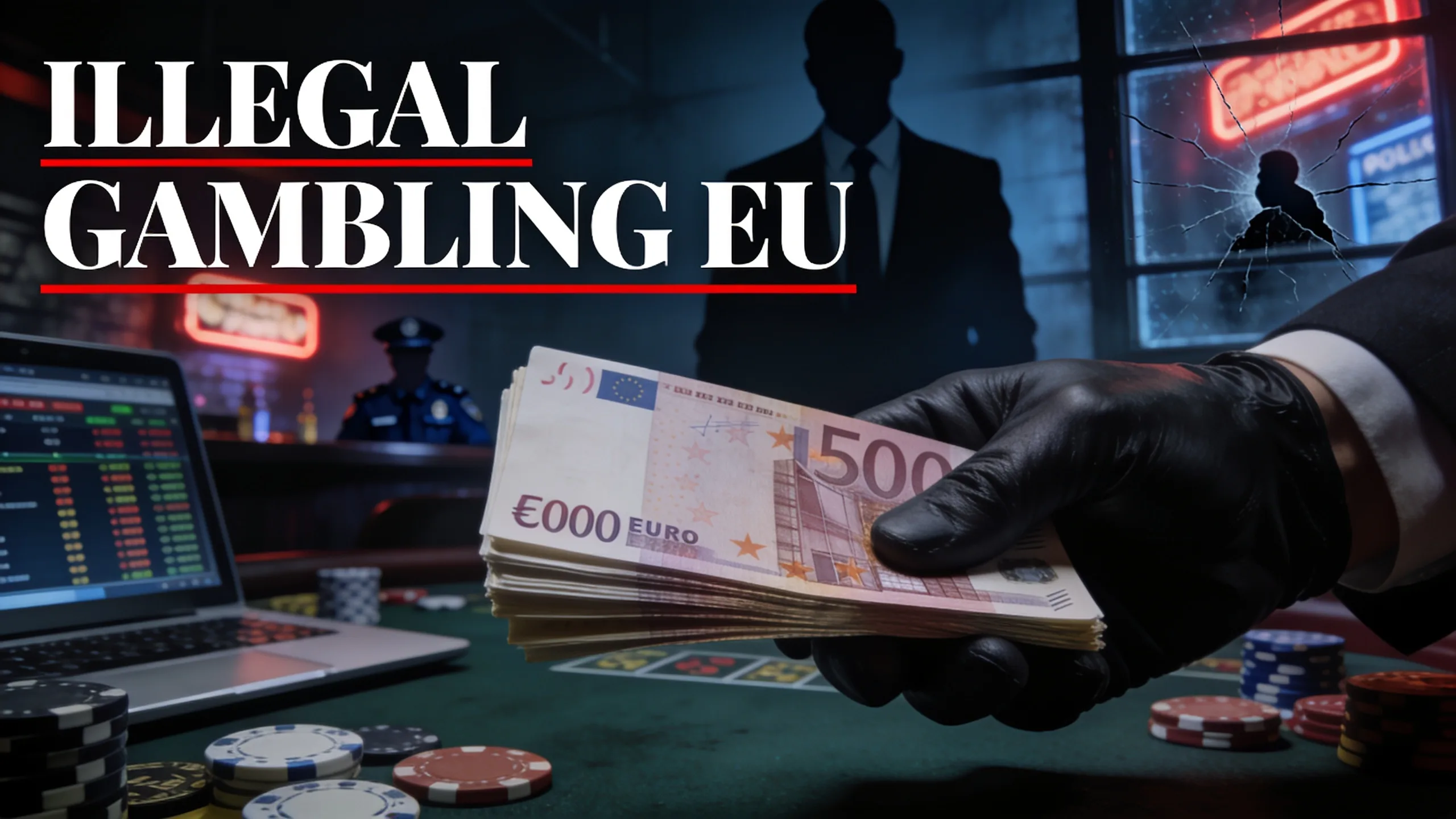
The illegal online gambling market targeting EU consumers reached €91.6 billion in 2025 — up roughly 14% from the prior year — stripping member states of an estimated €22.9 billion in lost tax revenue, according to new data presented at a high-level roundtable in the European Parliament on 3 July 2026. The figures were compiled by Gambling Compliance International (GCI) under an annual commission from the European Casino Association (ECA).
The scale of the problem now dwarfs the regulated sector: illegal operators account for the majority of all online gambling revenue across the EU-27, with more than 6,200 unlicensed operators actively targeting European consumers. The GCI report also found that the overwhelming share of online gambling content Europeans encounter promotes unlicensed sites — a distribution gap that regulators have struggled to close through fragmented national enforcement alone.
In This Article
Scale of the Illegal Market
The 2025 GCI impact study marks the clearest confirmation yet that unlicensed operators have overtaken the licensed sector in revenue terms across the EU. The €91.6 billion figure — up from approximately €80 billion in 2024 — represents gross gambling revenue generated by sites operating without national licences and outside the consumer protections, AML controls, and age-verification requirements that regulated operators must apply.
Illegal platforms, often headquartered outside the EU, reach consumers directly through search engines, social media advertising, and affiliate networks. They pay no gaming taxes in the countries they target, apply no responsible gambling safeguards, and — according to the ECA — actively seek out young adults through personalised bonuses and free-play offers designed to drive compulsive behaviour.
| Metric | 2024 (Est.) | 2025 (GCI Report) | Change |
|---|---|---|---|
| Illegal market size (EU-27) | ~€80 billion | €91.6 billion | +14% |
| Lost tax revenue (EU member states) | Not disclosed | €22.9 billion | — |
| Active unlicensed operators targeting EU | Not disclosed | 6,200+ | — |
| Illegal share of total online GGR | Minority | Majority | Tipping point crossed |
The European Parliament Roundtable
The data was presented on 3 July 2026 at a roundtable hosted by MEP Lukas Mandl in the European Parliament. Attendees included representatives from the European Commission, the Anti-Money Laundering Authority (AMLA), Eurojust, the Joint Parliamentary Scrutiny Group (JPSG) on Europol, national gambling regulators, and industry stakeholders. Discussions took place under the Chatham House Rule, though participants publicly acknowledged the growing severity of the enforcement gap.
ECA Chair Erwin van Lambaart presented the GCI findings and called for coordinated action across European institutions. MEP Mandl described the issue as "a serious cross-border threat that touches on consumer protection, organised crime and the integrity of our internal market," pledging to bring the evidence into future parliamentary work and seek cross-party support.
Europol Mandate Reform: The Policy Window
Timing gave the roundtable added urgency. On 24 June 2026, the European Commission published a legislative proposal to overhaul Europol's mandate — part of a broader security package that also covers Eurojust, the European Investigation Order, and data protection rules. The proposal would transform Europol from a primarily cooperative agency into a more operationally capable force, with dedicated support offices in member states and an expanded data-sharing infrastructure.
The ECA is pressing for illegal gambling to be named as an explicit enforcement priority within that mandate, arguing that the cross-border nature of unlicensed platforms requires the kind of coordinated investigation Europol is uniquely placed to conduct. Specific asks include:
- Targeted cross-border investigative powers for suspected illegal gambling networks
- Streamlined access to financial records and digital footprints tied to unlicensed operators
- Closer integration between Europol, AMLA, financial intelligence units, and national regulators
- Europol's designation as a "trusted flagger" under the Digital Services Act (DSA) for illegal gambling content
The Commission's Europol proposal now moves through the ordinary legislative procedure, requiring agreement from both the European Parliament and the Council before it takes effect.
Social Media and the DSA Question
A recurring theme at the roundtable was the role of online platforms in amplifying unlicensed operators' reach. Industry participants cited social media advertising as a key growth driver for illegal sites, noting that takedown processes remain too slow to limit exposure meaningfully.
The Commission's Executive Vice-President for Tech Sovereignty, Henna Virkkunen, acknowledged concerns about undisclosed advertising for illegal products but stopped short of launching a dedicated probe into gambling promotion specifically. She noted that the existing Digital Services Act already requires very large platforms to assess and mitigate systemic risks from illegal content — including unlawful gambling advertising — and provides user reporting mechanisms through which such material can be flagged for removal.
What This Means for Regulated Operators
For licensed iGaming businesses, the data reinforces a structural competitive disadvantage. Regulated operators bear the full cost of compliance — AML controls, responsible gambling programmes, tax contributions, technical certification — while competing against a black market that carries none of those costs and captures the majority of consumer spend.
The ECA's argument to policymakers is that stronger enforcement is not just a consumer protection issue: it is the only mechanism that makes regulated market economics viable. Without it, increased tax rates and tighter compliance requirements on licensed operators simply accelerate the shift of activity toward unlicensed platforms, ultimately reducing the total tax take for member states — the very outcome the €22.9 billion figure already illustrates.
Sources
Primary sources cited first, followed by secondary reporting. All accessed 9 July 2026.
- European Commission — Europol Mandate Reform Proposal, 24 June 2026 ↗ https://home-affairs.ec.europa.eu/news/commission-strengthens-europol-step-fight-against-cross-border-crime-and-terrorism-2026-06-24_en
- European Casino Association — ECA Position on the Future of Europol ↗ https://www.europeancasinoassociation.org/advocacy?view=article&id=263:the-eca-position-on-the-future-of-europol&catid=53
- European Gaming — Illegal Gambling Costs EU €22.9bn in Tax, 8 July 2026 ↗ https://europeangaming.eu/portal/latest-news/2026/07/08/208999/illegal-online-gambling-eu-tax-revenue-loss/
- iGaming Expert — Is Europol the Vital Weapon Against Europe's Black Market?, 8 July 2026 ↗ https://igamingexpert.com/features/european-casino-association-europol-remit/
- G3 Newswire — Illegal Online Gambling Costs EU Member States €22.9bn, July 2026 ↗ https://g3newswire.com/illegal-online-gambling-costs-eu-member-states-e22-9bn-in-lost-tax-revenue/
If we fail to act now, the illegal online market will continue to grow at the expense of players, public finances and legitimate businesses.
— Erwin van Lambaart, Chair, European Casino Association · European Parliament Roundtable, 3 July 2026