
Gambling Commission Licence Fees Rise 25% from October 2026
DCMS confirms the October hike as UK operators already absorb a 40% Remote Gaming Duty and the new statutory gambling levy.
Category: News · By Growl Games Editorial Team · Thu Jul 16 2026 · Updated Tue Jul 21 2026
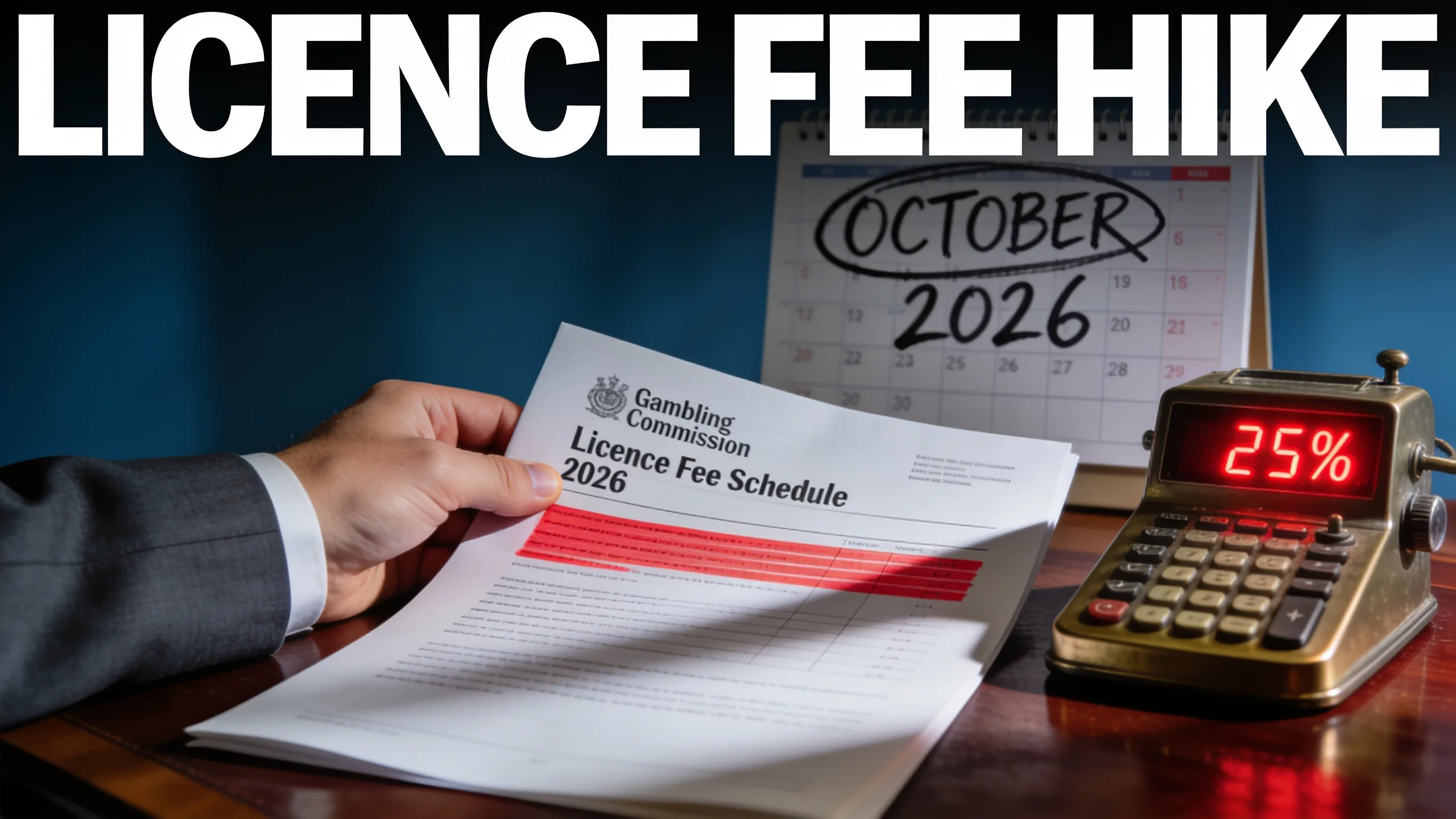
The UK Gambling Commission will become significantly more expensive to operate under from 1 October 2026, after DCMS confirmed a 25% increase in operating licence fees — a decision that lands on top of a 40% Remote Gaming Duty that took effect in April 2026 and an incoming statutory levy. The announcement, published on 30 June 2026, affects the vast majority of licensed operators, suppliers, and personal licence holders across Great Britain.
The Department for Culture, Media and Sport received 47 responses to its consultation, which ran from 27 January to 30 March 2026. Almost all respondents from the licensed industry opposed any rise. Despite that, DCMS concluded that without additional revenue the regulator — currently carrying an annual budget deficit of approximately £4 million — would be forced to cut regulatory activities, including enforcement against the illegal market. Even after the 25% uplift, the Gambling Commission will still need to find a further £8 million in efficiency savings over the next five years.
In this article
What changes on 1 October
The 25% increase applies across most licence categories and is being implemented via secondary legislation. Affected fee types include:
- Annual operating licence fees — tiered by gross gambling yield (GGY), with new fee bands replacing the previous structure
- Application fees for new licences and first annual fees (charged at 75% of the full annual fee)
- Personal licence fees — a flat 25% increase across all categories
- Supplementary operating licence fees and single machine permit fees
- Licence variation fees and fees for corporate control changes
The Gambling Commission has said it will contact operators in the coming weeks with details of how the new fee categories apply to their specific GGY band. An operator's regulatory return data for 2025–26 will determine which tier it falls into under the revised structure.
Who gets a carve-out
Two groups receive meaningful protection from the headline increase. Society lottery licence fees are frozen entirely — DCMS acknowledged that higher fees would reduce money available for charitable good causes. External lottery managers, which are commercial rather than charitable entities, do not qualify for that exemption and face the full 25% rise.
On-course bookmakers holding general betting (limited) operating licences will also see a structural change rather than a straightforward percentage increase. Their fees shift from a model based on operating days to one based on gross gambling yield. DCMS estimates that roughly 44% of operators in this category will pay lower fees under the new system, while most of the remainder face only modest increases averaging around £22.
The cumulative cost burden on operators
The licence fee increase does not arrive in isolation. The table below shows the layered cost changes UK-licensed operators have absorbed or are approaching across the current regulatory cycle.
| Cost item | Change | Effective date |
|---|---|---|
| Remote Gaming Duty (online slots/casino) | 21% → 40% | 1 April 2026 |
| Statutory gambling levy | New — funds research, prevention, treatment | Phased from 2024–25 |
| Gambling Commission operating licence fees | +25% across most categories | 1 October 2026 |
| General Betting Duty (remote) | New 25% remote rate | 1 April 2027 |
DCMS acknowledged in its consultation response that "recent cost increases have created a more challenging environment for operators," but maintained that licence fees remain a small proportion of annual GGY. For the largest operators — those with annual GGY above £100 million — the revised fee structure translates to roughly 0.15% of GGY, up from approximately 0.1%.
Illegal market funding: a sticking point
One of the consultation's flashpoints was whether licence fees should carry a ringfenced portion for illegal gambling enforcement. DCMS had originally proposed a 20% + 10% ringfenced option; the industry pushed back hard. The Betting and Gaming Council has reported that more than £16 billion was staked on illegal platforms in 2025 alone — a figure that has sharpened the government's focus on unlicensed operators.
Rather than ringfencing through the fee structure, the government is directing a separate £26 million Treasury allocation over three years to the Gambling Commission for illegal-market enforcement. A dedicated DCMS Illegal Gambling Taskforce, chaired by Gambling Minister Baroness Twycross, is also examining payment restrictions and potential bans on unlicensed companies sponsoring English sports teams. Critically, licensed operators will not fund that work directly — the fight against the black market remains a central government line item, separate from the licence fee regime.
Sources
Primary regulatory and governmental sources are listed first, followed by trade press coverage used for additional context and industry reaction.
- Gambling Commission — DCMS concludes consultation on gambling regulation funding ↗ https://www.gamblingcommission.gov.uk/news/article/dcms-concludes-consultation-on-gambling-regulation-funding
- DCMS — Government response: proposed changes to Gambling Commission fees ↗ https://www.gov.uk/government/consultations/proposed-changes-to-gambling-commission-fees
- iGaming Business — DCMS confirm 25% increase in Gambling Commission licence fees from October ↗ https://igamingbusiness.com/legal-compliance/licensing/dcms-confirm-25-increase-gambling-commission-licence-fees-october/
- SBC News — DCMS to increase gambling licence fees from 1 October ↗ https://sbcnews.co.uk/europe/2026/06/30/uk-betting-licence-fees
- Harris Hagan — DCMS confirms increase to Gambling Commission fees from 1 October 2026 ↗ https://www.harrishagan.com/dcms-confirms-increase-to-gambling-commission-fees-from-1-october-2026/
If no increases were to be implemented, or even under a 20% headline increase, the Commission would have to make significant cutbacks and deprioritise or stop work in areas that the Commission and government deems important.
— DCMS, Government Response to the Proposals for Changes to Gambling Commission Fees · 30 June 2026