
EU Illegal Gambling Market Hits €91.6bn, Costing Governments €22.9bn in Tax
A new ECA report reveals over 6,200 unlicensed operators now command the majority of EU online gambling revenue, as the bloc's black market grows 14% in a year.
Category: News · By Growl Games Editorial Team · Sun Aug 02 2026 · Updated Sun Aug 02 2026
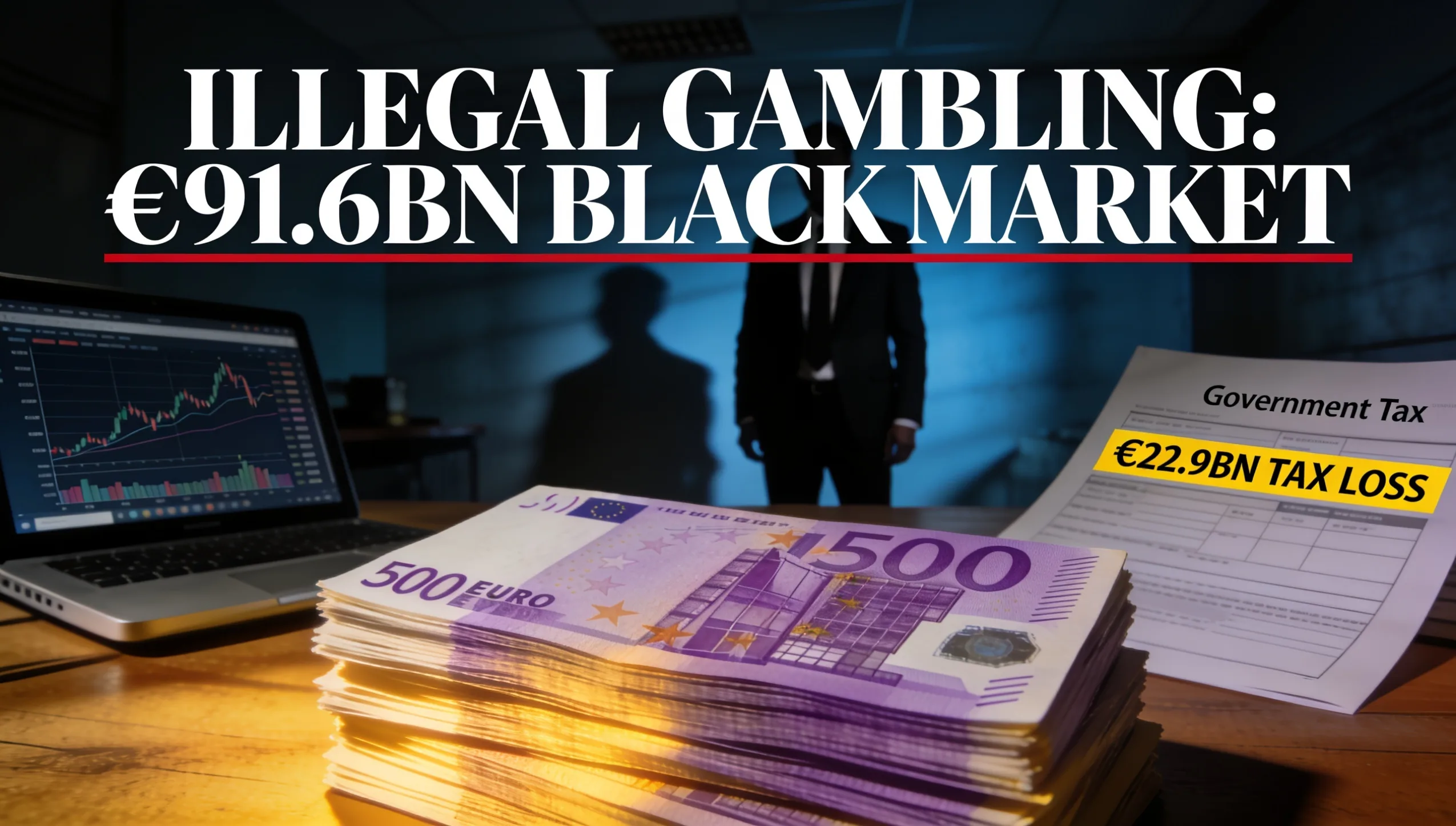
The EU's illegal online gambling market swelled to €91.6 billion in 2025 — a 14% jump from €80 billion the previous year — according to new figures presented at the European Parliament on 3 July 2026. The data, drawn from an annual impact study commissioned by the European Casino Association (ECA) and conducted by Gambling Compliance International (GCI), puts the unlicensed share of the bloc's online gambling market at a majority for the first time.
EU governments collectively lost an estimated €22.9 billion in tax revenue as a result — money that flowed instead to more than 6,200 illegal operators identified as actively targeting European consumers. Those operators largely bypass anti-money laundering requirements, age-verification rules, and responsible-gambling safeguards that licensed businesses must fund and maintain.
Table of Contents
Scale of the Problem
The €91.6 billion figure represents money wagered with unlicensed platforms by players located in EU member states — it is not total global illegal gambling revenue. Within the EU-27, unlicensed operators now capture the larger share of all online gambling activity, a threshold the industry had long flagged as a structural risk to regulated markets.
The illegal sector's 14% year-on-year growth outpaces nearly every licensed market in Europe. Much of the expansion is attributed to aggressive digital advertising: the ECA noted that the majority of online gambling content encountered by European players now promotes unlicensed platforms, not regulated ones.
The Parliament Roundtable
The figures were unveiled at a high-level roundtable hosted by MEP Lukas Mandl in the European Parliament on 3 July 2026. The event brought together representatives from the European Commission, the Anti-Money Laundering Authority (AMLA), Eurojust, and national gambling regulators including the Dutch Gambling Authority and the Danish Gambling Authority.
ECA Chair Erwin van Lambaart (also CEO of Casinos Austria) presented the GCI data and called illegal online gambling "a fast-growing, cross-border problem that puts players at high risk." MEP Mandl framed it as "a serious cross-border threat that touches on consumer protection, organised crime and the integrity of our internal market."
What Licensed Operators Face
The competitive distortion is stark. Licensed EU operators spend heavily on compliance — AML programmes, responsible gambling tools, age-gating, and advertising restrictions — while illegal platforms carry none of those costs. The ECA notes that players who migrate to unlicensed sites lose access to:
- Deposit limits and self-exclusion mechanisms mandated by national regulators
- AML-triggered transaction monitoring and reporting
- Segregated player funds and dispute-resolution processes
- Licensed customer support with complaint escalation pathways
For legitimate operators, the black market's growth suppresses licensed gross gaming revenue, narrows the tax base that funds regulatory bodies, and makes responsible-gambling investment harder to justify commercially.
ECA's Enforcement Demands
The ECA used the roundtable to press EU institutions on three specific enforcement levers:
- Europol mandate expansion — the ECA wants illegal online gambling named as a clear priority within the European Commission's pending Europol reform, giving the agency an explicit cross-border operational role against unlicensed gambling networks.
- Financial intelligence linkage — national enforcement units connected to AMLA's emerging supervisory architecture, so payment flows to illegal operators can be disrupted at scale. Strengthened public-private cooperation — formal frameworks for licensed operators to share intelligence on illegal platforms with regulators and law enforcement in real time.
The ECA also referenced the EU Anti-Money Laundering Regulation (EU) 2024/1624, which applies from 10 July 2027 and will impose the first directly applicable EU-level definition of "gambling services" alongside standardised due-diligence rules — a step the association says must be accompanied by equivalent enforcement capacity against unlicensed actors.
Legal vs. Illegal Market at a Glance
| Metric | Licensed EU Market | Illegal EU Market (2025) |
|---|---|---|
| Market size | Minority share of online GGR | €91.6 billion (majority share) |
| Year-on-year growth | Single-digit in most markets | 14% (from €80bn in 2024) |
| Operators counted | Hundreds, nationally licensed | 6,200+ unlicensed platforms |
| Tax contribution | Pays national gaming duties | €22.9bn in lost government tax |
| AML obligations | Full compliance required | None enforced |
| Responsible gambling | Mandated tools and limits | Absent |
Sources
Primary sources used for this article, in order of authority.
- European Casino Association — EU Member States Miss Out on €22.9 Billion in Tax Revenue ↗ https://www.europeancasinoassociation.org/news/press-releases/eu-member-states-miss-out-on-eur22-9-billion-in-tax-revenue-due-to-illegal-online-gambling
- EEGaming — ECA: EU Member States Miss Out on €22.9 Billion in Tax Revenue ↗ https://eegaming.org/latest-news/2026/07/08/142228/eca-eu-member-states-miss-out-on-e22-9-billion-in-tax-revenue-due-to-illegal-online-gambling/
- iGaming Today — Illegal Gambling Market in the EU Reaches €91.6 Billion as Tax Losses Near €23 Billion ↗ https://www.igamingtoday.com/illegal-gambling-market-in-the-eu-reaches-e91-6-billion-as-tax-losses-near-e23-billion/
- World Casino Directory — EU Illegal Online Gambling Market Hits €91.6 Billion ↗ https://news.worldcasinodirectory.com/illegal-gambling-market-in-eu-reaches-e91-6-billion-123440
- EUR-Lex — Regulation (EU) 2024/1624 Anti-Money Laundering Regulation ↗ https://eur-lex.europa.eu/legal-content/AUTO/?uri=CELEX%3A32024R1624
Illegal online gambling is a fast-growing, cross-border problem that puts players at high risk — and fragmented national action is no longer enough for a market that increasingly operates without regard for borders.
— Erwin van Lambaart, Chair, European Casino Association · European Parliament Roundtable, 3 July 2026