
Senate Convenes First-Ever Hearing on Prediction Markets and Sportsbooks
"No Sure Bets" hearing on May 20 puts the $165 billion U.S. sports wagering market under federal scrutiny, pitting the American Gaming Association against the Coalition for Prediction Markets as match-fixing scandals mount.
Category: iGaming News - USA · By Growl Games Editorial Team · Tue May 19 2026 · Updated Thu Jul 23 2026
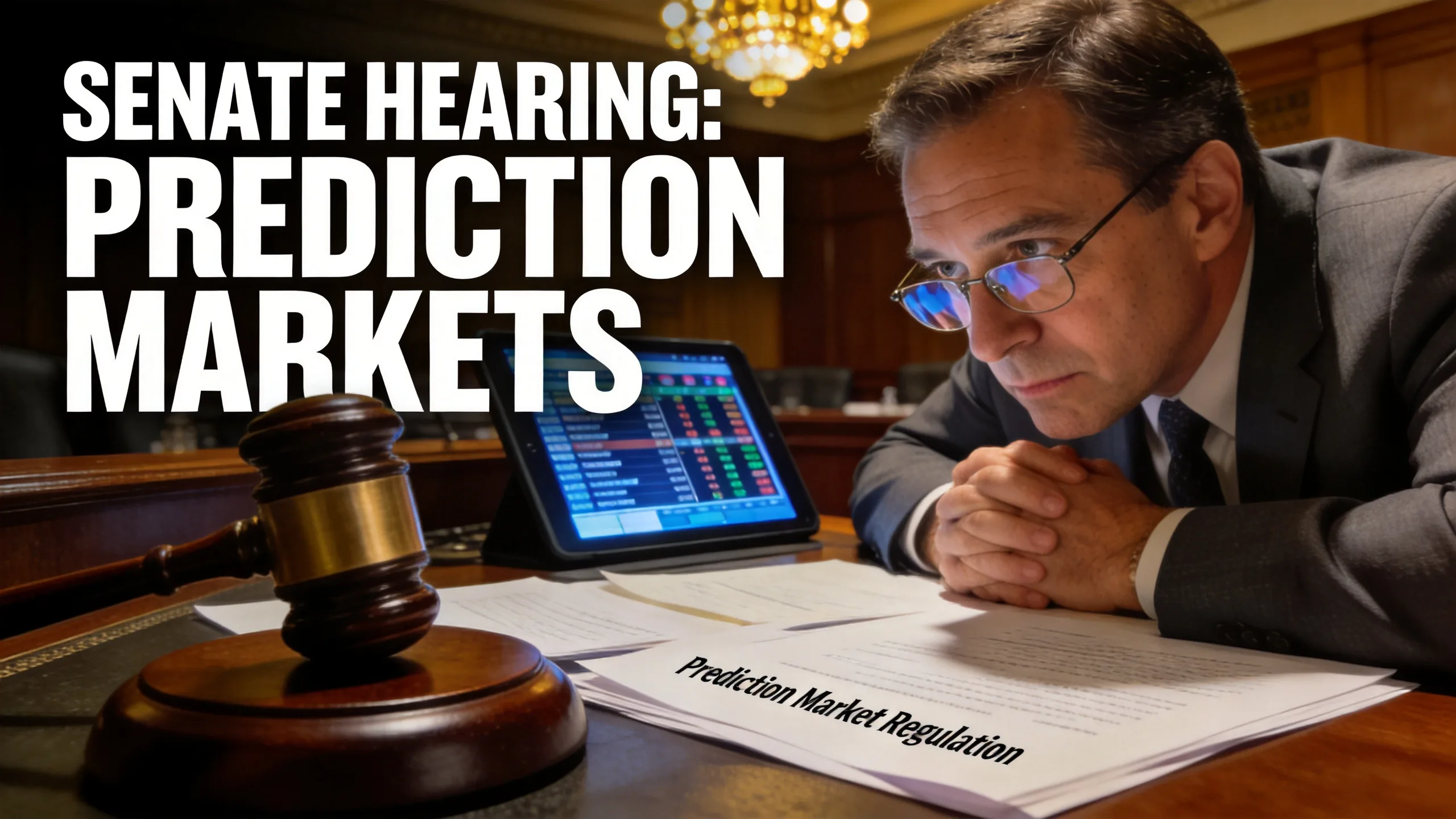
Table of Contents
- Overview
- Witness List and Key Players
- What's at Stake
- Bills in Play
- Industry Pressure Mounts
- Outlook
- Sources
Overview
The U.S. Senate Commerce Subcommittee on Consumer Protection, Technology, and Data Privacy will convene a hearing titled "No Sure Bets: Protecting Sports Integrity in America" on Wednesday, May 20, 2026, at 10:00 a.m. ET. Chaired by Sen. Marsha Blackburn (R-TN), it is the first time any Senate body has directly examined the rise of prediction markets alongside traditional sportsbooks. The hearing comes as U.S. sports wagering has grown into a $165 billion market across 39 states and the District of Columbia, eight years after the Supreme Court struck down PASPA.
Witness List and Key Players
The subcommittee has confirmed four witnesses: American Gaming Association CEO Bill Miller; Tennessee Sports Wagering Council Executive Director Mary Beth Thomas; Integrity Compliance 360 co-founder and CEO Scott Sadin; and former U.S. Rep. Patrick McHenry, now senior advisor to the Coalition for Prediction Markets. The lineup pits two opposing lobbies directly against each other: the AGA, which argues prediction markets are unlicensed sports betting, and the CPM, which defends them as federally regulated derivatives under CFTC oversight.
What's at Stake
The hearing is being driven by two converging pressures. The first is sports integrity: match-fixing and insider-information cases have hit the NBA, MLB, UFC, MLS, and the NCAA over the past year. The second is jurisdictional. Prediction market platforms Kalshi and Polymarket operate nationwide under CFTC authority, including in states where sports betting is illegal. The CFTC has filed suits against Arizona, Connecticut, Illinois, New York, and Wisconsin to block state enforcement, and secured a preliminary injunction in Arizona. Nearly all state attorneys general have lined up against the federal-preemption argument.
Bills in Play
Several measures sit in committee awaiting the hearing's signal. The Prediction Markets Security and Integrity Act of 2026 would ban live-sports wagering on prediction platforms and require federal approval for any state authorizing such markets. The Fair Markets and Sports Integrity Act would bar exchanges from offering sports event contracts under commodities law. Sen. Adam Schiff (D-CA) is pushing a bipartisan companion bill to return authority to states and tribes. None have advanced beyond referral. Blackburn has stated her subcommittee aims to produce a recommendation framework before the August recess.
Industry Pressure Mounts
Lobbying has surged ahead of the hearing. The AGA disclosed $730,000 spent on prediction-market legislation in Q1 2026 alone — its heaviest single-quarter expenditure on the issue in over a year — and more than $2.9 million across five quarters since early 2025. On May 11, a bipartisan group of five lawmakers sent letters to ten operators — bet365, BetMGM, Caesars, DraftKings, Fanatics, FanDuel, Kalshi, Polymarket, PrizePicks, and Robinhood — demanding youth-user data and advertising disclosures by May 29. On May 15, BNP Paribas initiated DraftKings coverage with an "underperform" rating, citing the "dramatic threat" from Kalshi and Polymarket. On May 17, DraftKings co-founder Matt Kalish publicly attacked Kalshi's product experience on social media.
Outlook
A single hearing will not produce enforceable rules, but the inclusion of a dedicated prediction-market representative on the witness panel signals Washington is treating event contracts as a legitimate financial product rather than a closed-door loophole. The most likely deliverables are clearer data-sharing standards with sports leagues, stronger age-verification requirements, and a more defined federal framework. For sportsbook operators, the hearing arrives at an already turbulent moment — Caesars became the last major U.S. operator to drop credit card deposits last month, while DraftKings, FanDuel, and Fanatics have all launched their own prediction products and exited the AGA. The federal floor everyone has been waiting on may finally be drawn this summer.
Sources
- U.S. Senate Committee on Commerce, Science, & Transportation — Hearing Announcement
- SBC Americas — Senate to Discuss Gambling, Prediction Market Integrity
- Bright Side of News — Senate Prediction Markets Integrity Hearing
- Sports Illustrated — Congress Is Coming for Sports Betting
- Legis1 — Congress Takes Action on Sports Betting
- Gambling Insider — Prediction Markets, State Bills to Watch This Week
- Bettors Insider — Five Lawmakers Demand Youth Gambling Data
- Bettors Insider — Sen. Schiff vs. CFTC on Prediction Markets
- Bettors Insider — AGA and IGA Urge Congress to Block Prediction Markets
- Casino.org — DraftKings Hit with 'Sell' Rating
- ReadWrite — DraftKings' Kalish Criticizes Kalshi
- iGaming Business — Prediction Market Roundup