
Senate Grills Sportsbooks and Prediction Markets Over Integrity, Marketing, and CFTC Jurisdiction
Lawmakers on the Commerce Subcommittee questioned industry leaders Wednesday over rigged-game scandals, micro prop bets, advertising aimed at minors, and whether prediction-market platforms are operating as backdoor sportsbooks under federal cover.
Category: iGaming News - USA · By Growl Games Editorial Team · Thu May 21 2026 · Updated Thu Jul 23 2026
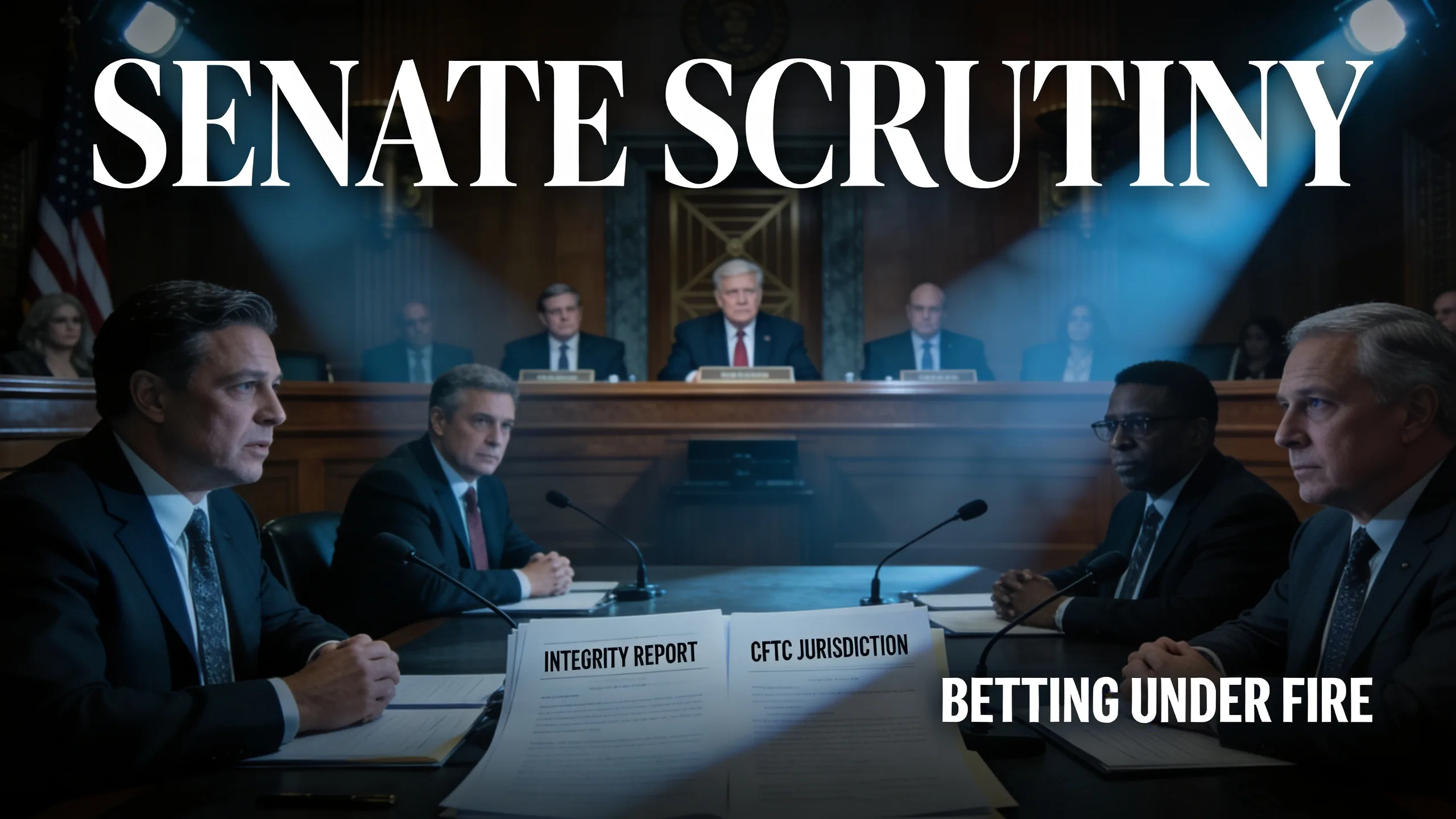
Table of Contents
- 1. Hearing Overview
- 2. The Prediction Markets Fight
- 3. CFTC vs. States
- 4. Game Integrity and Micro Props
- 5. Marketing to Minors
- 6. What Happens Next
- 7. Closing Quote
- Sources
1. Hearing Overview
The U.S. Senate Commerce Subcommittee on Consumer Protection, Technology, and Data Privacy convened a hearing on Wednesday, May 20, 2026, titled around sports betting and gaming integrity. Chair Sen. Marsha Blackburn (R-Tenn.) and full committee chair Sen. Ted Cruz (R-Texas) led questioning of executives from sportsbooks, prediction-market platforms, sports-integrity groups, and gambling-addiction advocates. The backdrop: a U.S. sports betting market that has grown into a $165 billion industry legal in 39 states and the District of Columbia since the Supreme Court struck down PASPA in 2018.
2. The Prediction Markets Fight
The most heated exchanges centered on prediction markets like Kalshi and Polymarket, which list sports-outcome “event contracts” under federal derivatives rules instead of state gaming licenses. Bill Miller, president and CEO of the American Gaming Association (AGA), accused the platforms of running “backdoor sports betting operations” dressed up as financial products. Former Rep. Patrick T. McHenry, now a senior adviser to the Coalition for Prediction Markets, pushed back, arguing exchanges are “fundamentally different” because participants trade with one another while the platform earns transaction fees.
3. CFTC vs. States
Senators questioned whether the Commodity Futures Trading Commission (CFTC) should regulate sports event contracts at all. Ranking member Sen. John Hickenlooper (D-Colo.) said the CFTC has “literally no experience in regulating sports betting.” The agency has already sued Minnesota, Arizona, Connecticut, and Illinois to block state enforcement against prediction markets. On May 18, 2026, Minnesota Gov. Tim Walz signed a law banning prediction markets in the state effective August 1, 2026; the CFTC sued the same week. In April, the 3rd Circuit enjoined New Jersey from enforcing gaming laws against Kalshi. Cruz warned that “unless Congress acts, the Supreme Court may have to decide the issue.”
4. Game Integrity and Micro Props
The panel repeatedly returned to recent cheating scandals across the NBA, MLB, UFC, MLS, and the NCAA, with athletes accused of rigging games or leaking insider information. Witnesses warned that micro prop bets — wagers on single pitches, single possessions, or in-play actions — are easier for one player to manipulate and more addictive than traditional markets. Several senators floated tighter federal guardrails on prop wagering.
5. Marketing to Minors
Blackburn pressed operators on why advertising continues to appear on social platforms whose algorithms cannot reliably exclude minors, calling the practice “disgusting.” Hickenlooper described the wall of gambling promotion aimed at young users as “the hounds of hell.” On May 11, members of Congress had already sent letters to 10 sportsbook and prediction-market CEOs demanding details on how their products are marketed to young adults.
6. What Happens Next
Two bills are now in play. Sen. Adam Schiff (D-Calif.) has introduced legislation, co-sponsored by Republican Sen. John Curtis (R-Utah), that would bar CFTC-registered firms from offering sports betting or casino-style games. A separate bill from Sen. Chris Murphy (D-Conn.), co-sponsored by Hickenlooper, would ban wagering on terrorism, assassinations, wars, and government actions. Blackburn indicated Wednesday’s testimony would feed directly into committee-level rulemaking, with a focus on preserving states’ rights over gaming.
7. Closing Quote
“This is not a Republican issue or a Democrat issue. This is a human issue regarding an addiction crisis that needs to be addressed and prevented.”
— Harry Levant, Director of Gambling Policy, Public Health Advocacy Institute, testifying before the Senate Commerce Subcommittee, May 20, 2026
Sources
- Roll Call — “Tensions over prediction markets dominate Senate hearing” (May 20, 2026)
- NPR — “Senate panel hears testimony on online sports betting, prediction markets” (May 20, 2026)
- Georgia Public Broadcasting — Senate panel coverage (May 20, 2026)
- U.S. Senate Committee on Commerce, Science & Transportation — Hearing announcement
- Gambling.com — U.S. sportsbooks regulatory tracker (May 2026)
- CFTC — Press release on Minnesota prediction-markets suit