
New York iGaming Bill Dead as Hochul Refuses to Back S2614
Governor's silence forces Sen. Addabbo to shelve S2614 for the fourth year running, forfeiting a projected $3–4B annual online casino market to offshore operators.
Category: News - USA · By Growl Games Editorial Team · Thu Jun 04 2026 · Updated Tue Jul 21 2026
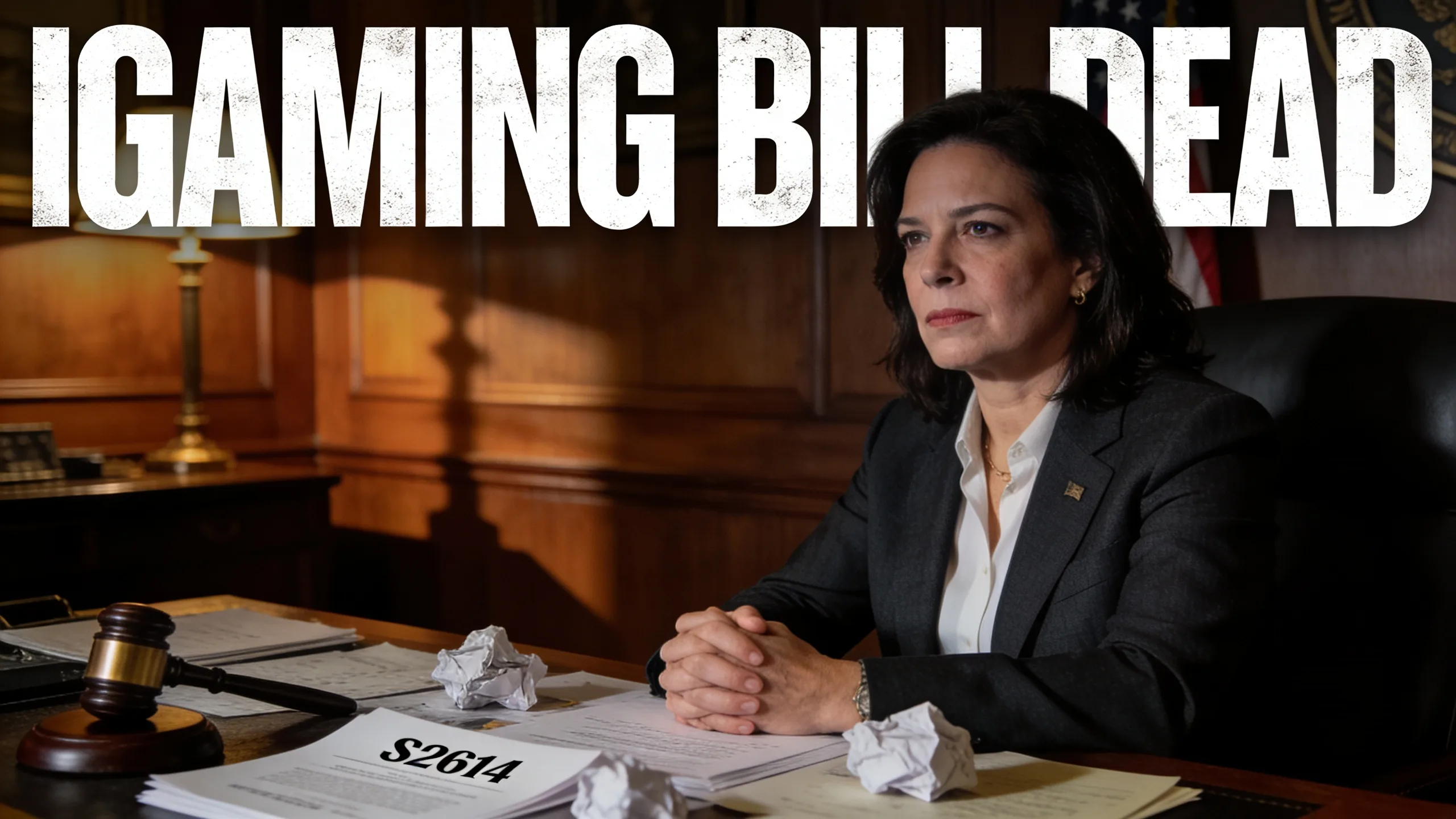
New York's iGaming ambitions have collapsed for the fourth consecutive year. On May 25, 2026, state Sen. Joseph Addabbo Jr. (D-Queens) announced he was shelving Senate Bill S2614 — a full online casino and poker framework — after concluding that Gov. Kathy Hochul would not sign it even if it cleared both chambers before the legislative session's June 4 close. The bill would have opened real-money slots, table games, and poker to New Yorkers for the first time, built on top of the state's existing licensed sports-betting infrastructure.
The fiscal stakes are hard to overstate. New York's mobile sports-betting market generates roughly $2.5 billion a year in gross gaming revenue at the nation's highest operator tax rate — 51% — yet a regulated iGaming market could add $475 million to $1 billion in additional annual tax receipts. Neighboring New Jersey generates more than $200 million a month in online casino gross gaming revenue, a substantial share of it wagered by New York residents who cross the border or route activity through offshore platforms. The Empire State is watching its neighbours pocket billions it has chosen not to regulate.
In This Article
What S2614 Would Have Built
Introduced on January 7, 2026, S2614 would have integrated online gaming directly into New York's existing licensed gambling framework rather than creating a standalone vertical. The bill would have authorized the state's nine licensed sports-betting operators, four upstate gaming facilities, and federally recognized tribes to apply for iGaming licenses covering online slots, table games, and poker. Key structural provisions included:
- All interactive gaming servers required to be physically housed at licensed New York gaming facilities, maintaining state-level regulatory oversight of the infrastructure.
- A framework for future interstate gaming compacts, opening a path to multi-state online poker networks.
- A companion Assembly Bill A6027, sponsored by Assemblywoman Carrie Woerner (chair, Assembly Racing and Wagering Committee), with additional consumer-protection provisions.
Both bills stalled in their respective Racing and Wagering committees without a floor vote. S2614 is essentially the fourth version of legislation Addabbo has filed since 2022 — each cycle blocked by the same executive and political obstacles.
Why Hochul Won't Engage
Gov. Hochul was publicly non-committal on iGaming throughout the 2026 session. Her office declined to signal whether she would sign any bill, and without that assurance, Addabbo concluded "the governor would probably not sign it" and pulled the legislation with less than two weeks left in the session. Two structural blockers explain her silence.
First, New York is mid-process on awarding three downstate casino licences to major metropolitan venues; introducing online casino competition at the same moment risks undercutting the land-based investment case. Second, the New York Hotel and Gaming Trades Council (HTC) has opposed every iGaming bill in Albany since 2022, arguing that online play cannibalises casino floor traffic and threatens union members' jobs. The HTC has consistently refused to engage directly with Addabbo's office, insisting the governor take part in any negotiation — a condition Hochul has not met.
The Price of Inaction
The bill's collapse carries a concrete fiscal cost. New York faces a projected $34 billion state deficit over the next three years, according to state comptroller Thomas DiNapoli. Addabbo's revenue modelling estimated iGaming at $475 million annually in state tax receipts; independent projections run as high as $1 billion per year. A regulated New York iGaming market is estimated to generate $3–4 billion in annual gross gaming revenue — a figure that would make it the largest online casino market in the US overnight.
The offshore leakage problem is substantial. The American Gaming Association's 2026 State of the States report found that unregulated and offshore online gambling operations drain an estimated $53.9 billion in annual revenue from the US market, depriving states of more than $15 billion in lost tax receipts each year. New Yorkers who want to play online casino games currently route that activity through offshore platforms — generating no state tax revenue and receiving no consumer protections.
New York vs. Its iGaming Neighbors
Pennsylvania closed 2025 as the country's largest iGaming market at $3.46 billion in annual gross gaming revenue — up nearly 28% year-over-year — with iGaming surpassing land-based casino GGR in both Pennsylvania and New Jersey for the first time. The US iGaming sector as a whole generated $3.04 billion in Q1 2026 alone, a 20.7% year-over-year increase, per AGA commercial gaming data. New York, the country's most populous metro sports-betting market, contributes nothing to that regulated total.
| State | iGaming Status | Recent Annual GGR | Operator Tax Rate | Live Since |
|---|---|---|---|---|
| New York | Illegal | $0 (regulated) | — | — |
| New Jersey | Legal | ~$2.4B/yr (est.) | 15–17.5% | Nov 2013 |
| Pennsylvania | Legal | $3.46B (2025) | 54% slots / 16% table | Jul 2019 |
| Michigan | Legal | Est. ~$1.8B/yr | 8–28% (variable) | Jan 2021 |
| Rhode Island | Legal | Ramping (launched 2024) | ~51% | Mar 2024 |
| Maine | Launching 2026 | — | TBD | H2 2026 |
What Comes Next
Addabbo has indicated he will introduce a revised bill in the 2027 legislative session. The political landscape is unlikely to shift before then: Hochul is widely expected to win re-election in November 2026, meaning the same executive dynamic could persist through 2028. Maine's iGaming market, cleared by legislation in 2025 and set to launch later this year, will add one more regulated competitor on New York's borders when it goes live.
For operators holding licences in adjacent states: the wait for New York continues, but unregulated demand is not declining. For New York bettors: regulated online casino play within state lines remains unavailable until at least mid-2027. The immediate practical outcome is continued leakage to offshore, unprotected platforms — the precise structural problem that S2614 was designed to fix.
Sources
Primary reporting and regulatory data used in this article. All accessed June 4, 2026.
- Bettors Insider — NY iGaming Bill Dead Again: Hochul Refuses to Back S2614 ↗ https://bettorsinsider.com/casino/2026/06/03/new-yorks-igaming-bill-is-dead-for-another-year-after-governor-hochul-declines-to-back-it/
- The Lines — New York iGaming Bill Dead for 2026 Session ↗ https://www.thelines.com/legal-betting/new-york-igaming-bill-dead-for-2026-session/
- American Gaming Association — State of the States 2026 ↗ https://www.americangaming.org/resources/state-of-the-states-2026/
- American Gaming Association — Commercial Gaming Revenue Tracker, Q1 2026 ↗ https://www.americangaming.org/resources/commercial-gaming-revenue-tracker/
- iGaming Business — NY Lawmaker Optimistic as iCasino Bills Return for 2026 ↗ https://igamingbusiness.com/casino/new-york-lawmaker-optimistic-icasino-bills-return-2026/
- SportsLine — 2026 NY Online Casino Bill Dies, No Support from Hochul ↗ https://www.sportsline.com/casinos/2026-new-york-online-casino-bill-dies-gets-no-support-from-gov-hochul/
Why we're able to protect them is because it's a regulated environment.
— Sen. Joseph Addabbo Jr., Chair, NY Senate Racing, Gaming & Wagering Committee · Arguing for iGaming consumer protections, remarks to iGaming Business, January 2026