
New York iGaming Bill Dead Again as Hochul Withholds Backing
Gov. Kathy Hochul's silence kills S2614 for the 2026 session, locking New York out of a projected $3–4 billion online casino market for at least another year.
Category: News - USA · By Growl Games Editorial Team · Sun Jun 07 2026 · Updated Tue Jul 21 2026
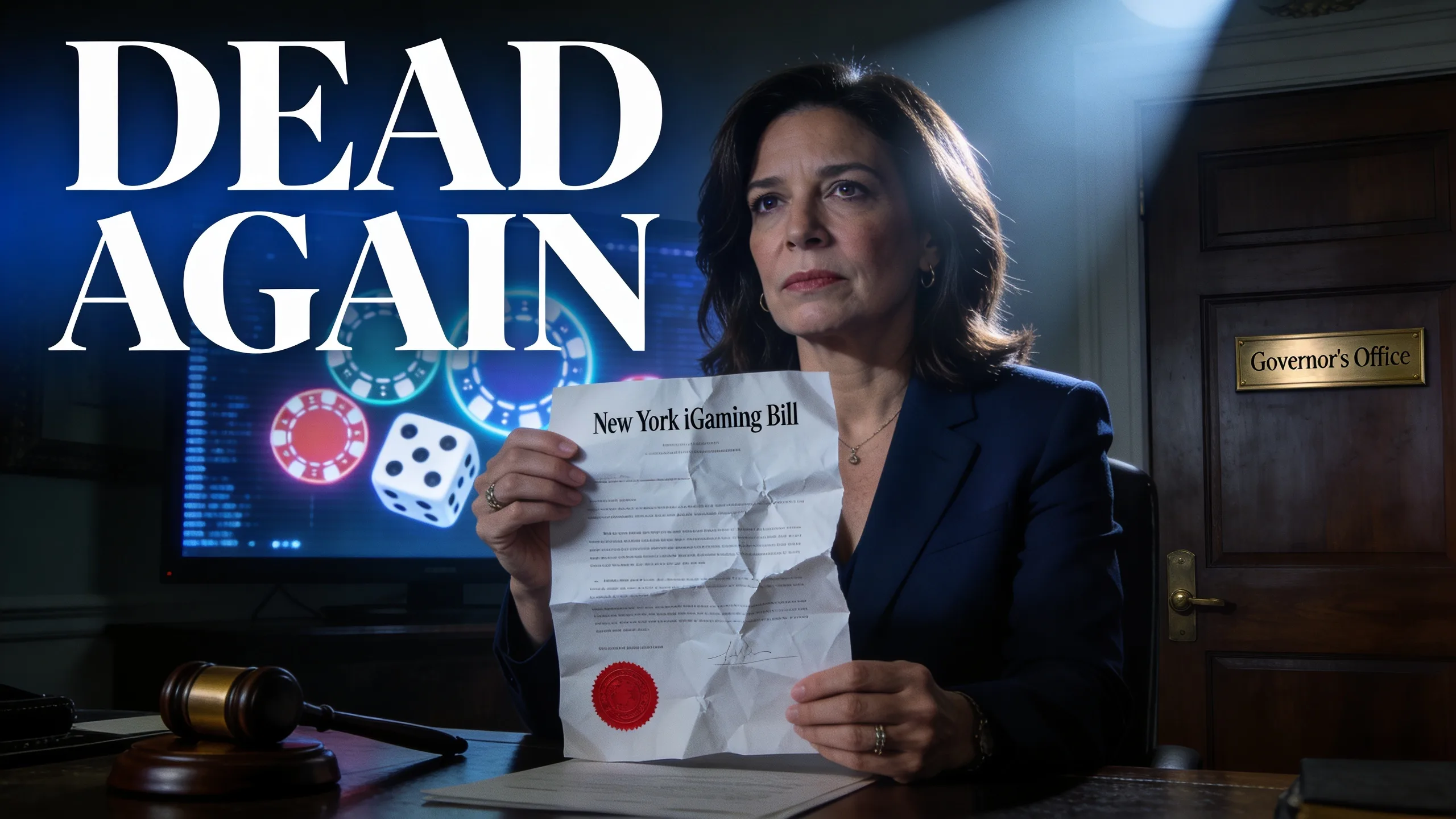
New York's fifth consecutive attempt to legalise online casino gaming has ended without a vote. Sen. Joseph Addabbo (D-Queens), sponsor of Senate Bill S2614 and chair of the Senate Racing, Gaming and Wagering Committee, shelved the legislation in late May 2026 after concluding that Governor Kathy Hochul would not sign it into law even if it cleared both chambers. The New York legislature's session closed on June 4, leaving a state of more than 20 million residents and a $2.3 trillion economy without a regulated iGaming market for at least another year.
The revenue gap this creates is substantial. Industry analysts project a legal New York online casino market would generate between $3 billion and $4 billion in annual gross gaming revenue and up to $1 billion in state tax proceeds. That income continues to flow to offshore operators and neighbouring licensed states. The seven US jurisdictions already running regulated online casinos collectively posted $10.73 billion in iGaming revenue in 2025—a 27.6% year-on-year increase—according to the American Gaming Association (AGA). Illegal online casino play added another $18.6 billion in revenue that generated no tax receipts anywhere.
In This Article
What S2614 Would Have Authorised
S2614 proposed a licensing and regulatory framework for digital slots, table games, live dealer products, and poker tournaments across New York State. Eligible operators would have included New York's nine existing mobile sports-betting licensees, four upstate casino properties, and the three downstate commercial casino licences awarded in late 2025. A companion measure, Assembly Bill A6027, was introduced in the lower chamber by Assemblywoman Carrie Woerner. Both bills set a 30.5% tax on gross gaming revenue—nearly 21 percentage points below the state's existing 51% mobile sports-betting rate—with proceeds earmarked primarily for the state education fund. All interactive gaming servers would have been required to be physically located at licensed New York facilities.
Why the Bill Collapsed
Governor Hochul had not publicly endorsed any iGaming framework during the 2026 session, and her office declined to signal whether she would sign the legislation. Without executive commitment, Addabbo concluded that pursuing a floor vote would serve no purpose. He told reporters he believed the bill could pass both chambers on its merits but chose not to bring it forward: "I'm not going to waste anyone's time here." Hochul's 2026 gambling agenda had focused instead on minors-protection measures and responsible gaming reform, backing rules to restrict underage access to mobile sports-betting platforms without extending that attention to online casino legalisation.
Union opposition has also been a persistent obstacle. The Hotel and Gaming Trade Council, representing workers at New York's land-based casinos, has argued that digital platforms will cannibalise brick-and-mortar floor traffic. The 2026 version of the bill sought to address those concerns directly: all applicants would have been required to demonstrate labour-peace agreements as part of the licensing process, and a dedicated $25 million annual statewide workforce development fund was written into the legislation. Neither concession was enough to move the governor.
The Revenue New York Is Losing
Without a regulated market, New York residents who want to play online casino games do so outside the state's consumer-protection framework. Research estimates New York captures roughly 24% of its total gambling gross gaming revenue through legal channels, compared with an estimated 62% in New Jersey, which has operated a regulated iGaming market since November 2013. The disparity reflects both the absence of legal product and the depth of the offshore market actively serving New York players. The AGA's August 2025 analysis found that illegal online slots and table games generated $18.6 billion nationally—up 38% since 2022—depriving state governments of an estimated $15.3 billion in combined annual tax receipts across all unregulated gaming categories.
The Competitive Landscape
| Jurisdiction | iGaming Tax Rate | Market Status | 2025 iGaming Revenue |
|---|---|---|---|
| New York — S2614 (proposed) | 30.5% | Killed, 2026 session | — |
| New Jersey | 15% | Live since Nov. 2013 | N/D |
| Pennsylvania | 16%+ | Live since Jul. 2019 | $3.46B |
| Michigan | ~8.4% | Live since Jan. 2021 | N/D |
| Connecticut | 18% | Live since Oct. 2021 | N/D |
| Maine | TBD | Launching H2 2026 | — |
| New York — sports betting* | 51% | Live since Jan. 2022 | N/A |
N/D = not disclosed in primary sources reviewed; — = market not yet operational; PA rate varies by product type (16% for table games and poker). *NY sports betting row included for context only.
The states already running legal online casinos are widening their lead. Pennsylvania led all iGaming markets in 2025, posting $3.46 billion in revenue—up nearly 28% year-on-year—and for the first time saw online casino revenue exceed that of its land-based casino properties. New Jersey crossed the same milestone in the same year. Maine, which passed enabling legislation in 2025, is preparing to become the eighth regulated US jurisdiction later in 2026. Each new entrant deepens the consumer habits that New York will need to compete against when it eventually reaches market.
What Comes Next
Addabbo is expected to reintroduce legislation in January 2027—his sixth consecutive attempt. A successful outcome would require either explicit support from Hochul or a change in the governorship. Even if a bill clears both chambers in a 2027 session, operators face a further six-to-twelve-month licensing and compliance window before any platform can go live, making a realistic market launch date late 2027 or 2028 at the earliest.
For operators, the delay means another year of lobbying costs with no commercial return. For players in New York, the nearest fully regulated online casino option remains New Jersey, accessible only when physically present in that state. Addabbo has drawn an explicit parallel with sports betting: New York waited until 2022 to legalise mobile wagering, ceding years of revenue to New Jersey in the process. He and the industry argue the same miscalculation—and the same cost—is being repeated on iGaming.
Sources
Primary legislative and official sources are listed first, followed by specialist industry reporting used to cross-check figures and context.
- NY State Senate — S2614 Bill Text ↗ https://www.nysenate.gov/legislation/bills/2025/S2614
- AGA — State of the States 2026 ↗ https://www.americangaming.org/resources/state-of-the-states-2026/
- Card Player — NY Online Gaming Bill Off the Table for 2026 ↗ https://www.cardplayer.com/poker-news/1660034-new-york-online-gaming-bill-off-the-table-for-2026
- Bettors Insider — NY iGaming Bill Dead Again, June 3, 2026 ↗ https://bettorsinsider.com/casino/2026/06/03/new-yorks-igaming-bill-is-dead-for-another-year-after-governor-hochul-declines-to-back-it/
- SportsLine — NY Online Casino Bill Dies, June 7, 2026 ↗ https://www.sportsline.com/casinos/2026-new-york-online-casino-bill-dies-gets-no-support-from-gov-hochul/
- Legal Sports Report — NY Online Casino Bills Once Again in Play ↗ https://www.legalsportsreport.com/251005/new-york-online-casino-bills-once-again-in-play/
We could pass it in the Senate, we could pass it in the Assembly, and then the governor would probably not sign it. So, I'm not going to waste anyone's time here.
— Sen. Joseph Addabbo, Chair, NY Senate Racing, Gaming and Wagering Committee · Statement to Gambling.com, May 2026