
India's Online Gaming Ban Drives Players Offshore as Enforcement Hits Three-Week Mark
Offshore betting platform usage in India has jumped from 68.3% to 82% after the Promotion and Regulation of Online Gaming Rules 2026 took effect on May 1, with more than 8,376 URLs blocked nationwide.
Category: iGaming News - India · By Growl Games Editorial Team · Tue May 19 2026 · Updated Thu Jul 23 2026
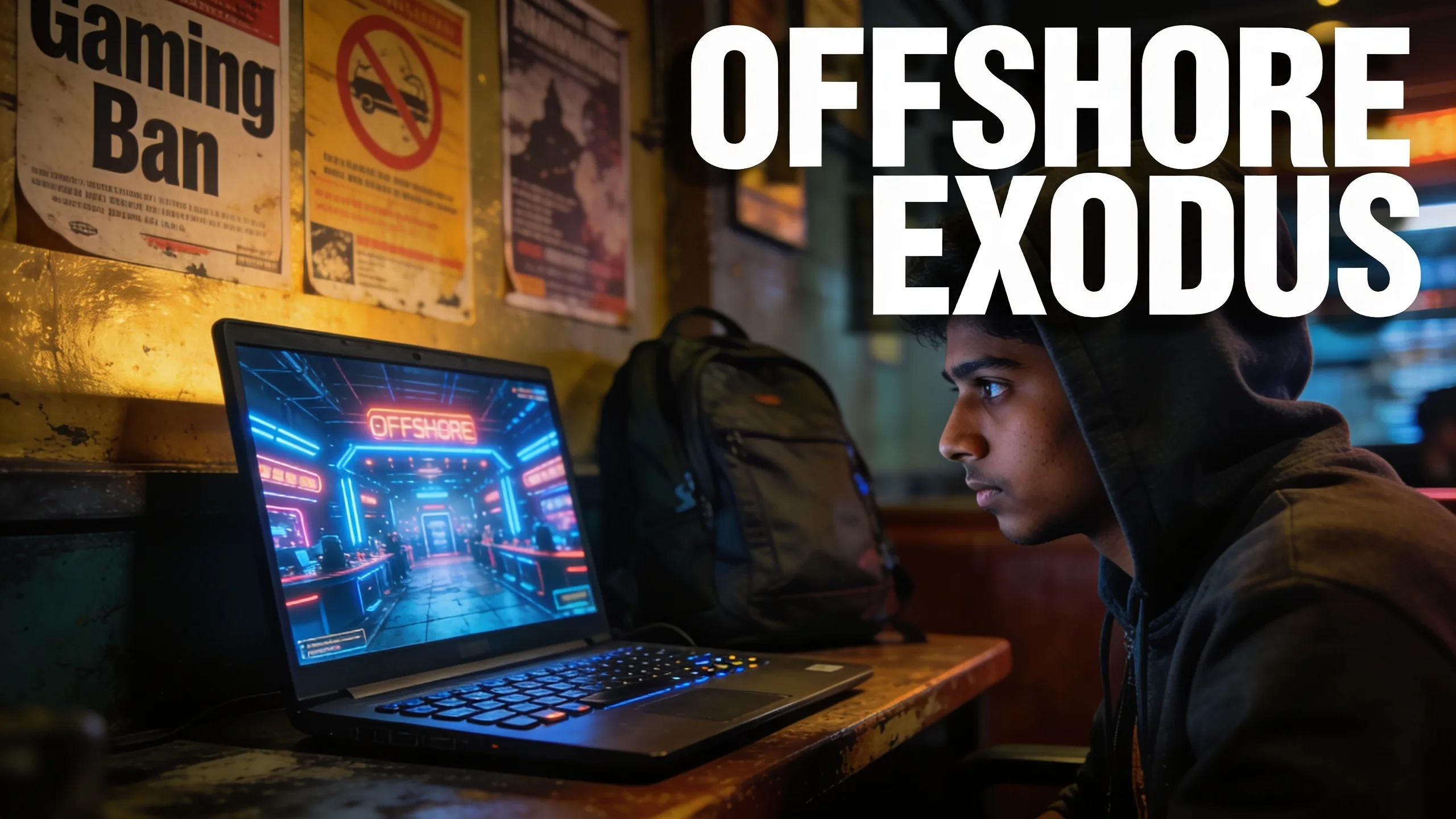
Table of Contents
- 1. What's Changed
- 2. The New Regulator: OGAI
- 3. Industry Fallout
- 4. Offshore Migration
- 5. Constitutional Challenge Pending
- 6. Outlook
- Sources
1. What's Changed
The Promotion and Regulation of Online Gaming (PROG) Rules, 2026, came into force on May 1, 2026, operationalising the PROG Act, 2025 that Parliament passed last August. The framework imposes a nationwide ban on all online money games — covering fantasy sports, rummy, poker, and casino-style products — with no distinction between games of skill and games of chance. Esports and free-to-play social games are permitted. Violations carry up to three years in prison and fines of up to Rs 1 crore, rising to five years for repeat offenders. Penalties apply to operators, advertisers, endorsers, and banks that process linked transactions.
2. The New Regulator: OGAI
The Online Gaming Authority of India (OGAI), an attached office of the Ministry of Electronics and Information Technology, is now operational as a digital-first regulator. Chaired by an Additional Secretary at MeitY, its six-member panel includes joint-secretary-rank representatives from Home Affairs, Finance, Information and Broadcasting, Youth Affairs and Sports, and Law and Justice. OGAI classifies games as money games, social games, or esports; maintains a public list of prohibited titles; and can direct banks and payment intermediaries to suspend transactions tied to non-compliant platforms. Classification decisions are to be completed within 90 days.
3. Industry Fallout
The pre-ban Indian real-money gaming sector was valued at roughly Rs 23,000 crore (about $2.75 billion). Since the Act received Presidential assent in August 2025, the industry has collapsed. Dream11 ended all cash contests, terminated its $43 million BCCI jersey sponsorship, and restructured its parent Dream Sports into eight separate verticals. MPL halted cash gaming. WinZO exited the domestic real-money market. Hike's RMG arm Rush shut down entirely. Head Digital Works, operator of A23 Rummy, told the Supreme Court its headcount fell from 606 to 178 and that foreign investor Clairvest wrote off a Rs 760 crore investment.
4. Offshore Migration
Despite enforcement, demand has not disappeared — it has migrated. A CUTS International study cited in parliamentary disclosures found offshore platform usage in Delhi NCR rose from 68.3% before the ban to 82% afterward, with daily-active usage jumping from 3.4% to 42.3%. Tamil Nadu showed similar patterns, with offshore use up 15.2%. MeitY told the Lok Sabha on April 1 that 8,376 URLs linked to illegal betting and gambling had been blocked or actioned as of March 28, 2026, with more than 4,800 blocked after the Act's passage. Analysts estimate the offshore gaming market addressing Indian users at around $20 billion, with tax evasion in excess of $4 billion.
5. Constitutional Challenge Pending
The Supreme Court is still weighing a batch of petitions challenging the PROG Act's constitutional validity, led by Head Digital Works and others. The hearing was deferred from December 2025 to a three-judge bench convened in 2026. Petitioners argue that the blanket ban erases the long-standing judicial distinction between skill and chance games — protected as a legitimate occupation under Article 19(1)(g) — and that "betting and gambling" remains a State List subject under the Seventh Schedule. The Union government maintains Parliament has full legislative competence and frames the ban as a public-welfare measure citing addiction, fraud, and links to money laundering and terror financing. A ruling could reshape or strike down the framework.
6. Outlook
Three weeks in, the picture is mixed. The government has a regulator, a classification process, and financial-system enforcement levers. Domestic operators have largely complied or wound down. But the policy goal — protecting Indian consumers from gambling harm — is undercut by the offshore surge, which moves activity beyond Indian jurisdiction, beyond consumer protections, and beyond the tax net. With IPL 2026 underway and the Supreme Court yet to rule, both the legal and the market test of the new regime are still ahead.
Sources
- iGaming Business — Government of India publishes new online gaming regulations
- TalkEsport — India's Online Gaming Rules 2026 Are Now in Force
- Business Today — New online gaming rules from May 1: penalties
- India Briefing — India's Online Gaming Law Goes Live May 1
- Indian Television — India's new online gaming rules take effect
- iGamist — India Blocks 8,376 Offshore Gambling URLs in 2026
- MediaNama — India Blocks 242 More Gambling Sites
- Outlook Respawn — India's Gaming Regulator Launches May 1
- Lexology — India's Online Gaming Rulebook Has Arrived
- Outlook Respawn — Dream11 Sports Splits Into 8 New Verticals
- iGaming Business — Supreme Court pushes hearings on RMG ban
- Storyboard18 — SC to hear PROGA petitions on Jan 21
- Bar and Bench — India's gaming industry after PROGA