
India Online Gaming Regulation: PROG Act Bans Real-Money Play
India's new central regulator OGAI goes live under MeitY on 1 May 2026, criminalising online money games while clearing a legal path for e-sports and social platforms.
Category: iGaming News - India · By Growl Games Editorial Team · Wed May 27 2026 · Updated Tue Jul 21 2026
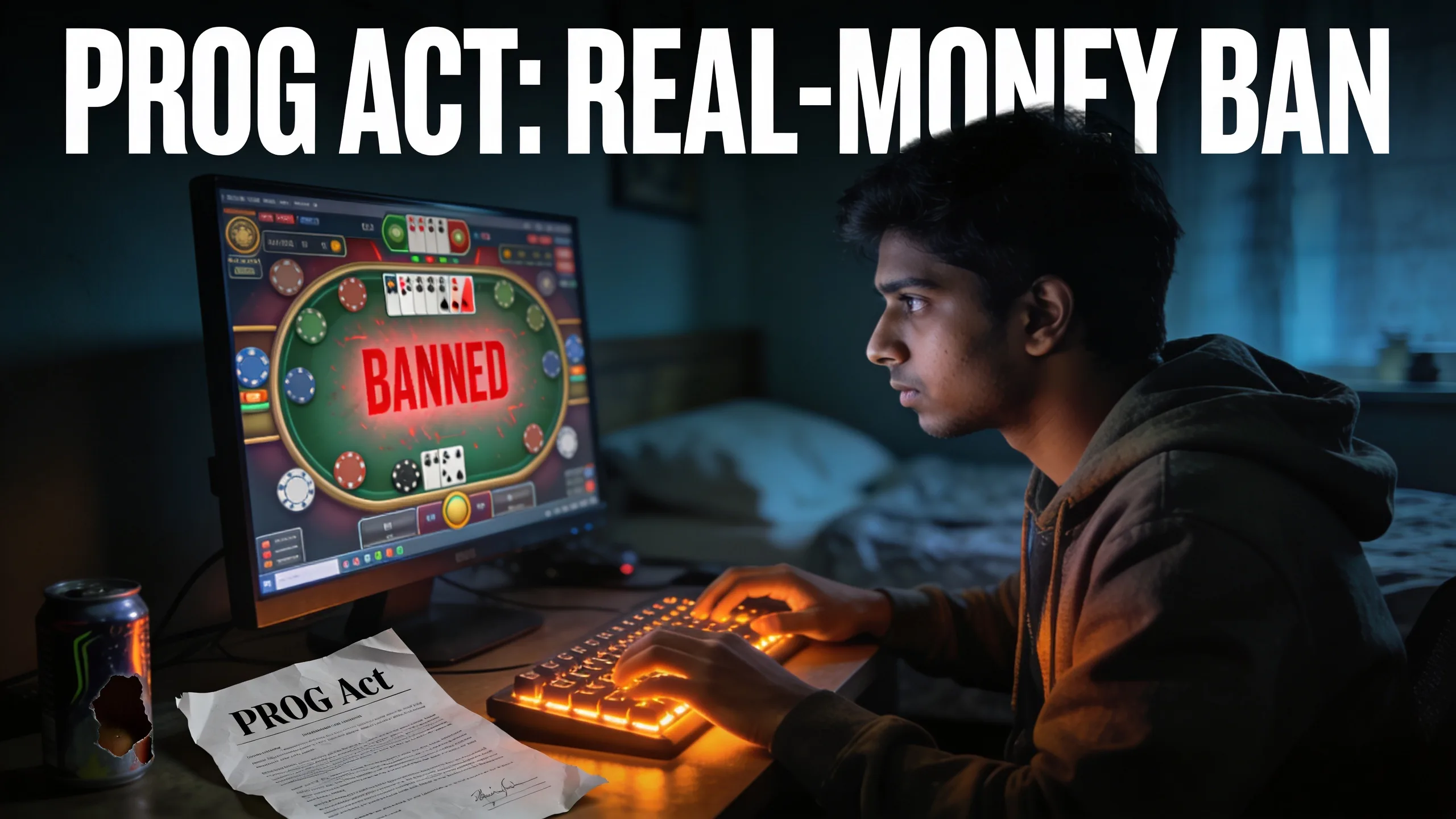
India's Promotion and Regulation of Online Gaming (PROG) Act 2025 and the accompanying PROG Rules 2026 took effect on 1 May 2026, ending years of state-level regulatory fragmentation and triggering the single biggest structural shift ever imposed on the country's online gaming industry. The rules were notified by the Ministry of Electronics and Information Technology (MeitY) on 22 April 2026, giving operators fewer than ten days to align before enforcement began.
The stakes are enormous. India's online real-money gaming market generated an estimated $3.2 billion in revenue in financial year 2024, driven largely by fantasy sports, rummy, and poker. That entire vertical is now prohibited under the new law. Industry data cited during parliamentary debate put annual player losses at $2.3 billion, affecting roughly a third of the adult population—figures the government used to justify a full statutory ban rather than a licensing regime for chance-based formats.
In This Article
The Regulatory Overhaul
The PROG Act 2025 was enacted by Parliament in August 2025, invoking Union List powers to assert central authority over a sector that had previously been governed by a patchwork of state gambling laws dating back to the Public Gambling Act of 1867. The new law supersedes those state frameworks and creates a single national regime administered by the Online Gaming Authority of India (OGAI), a digital-first regulator that sits under MeitY and draws members from multiple ministries including finance, home affairs, and consumer protection.
The OGAI replaces the informal self-regulatory model that prevailed under MeitY's 2023 intermediary guidelines. A key procedural feature is a formal 90-day determination window: when the status of any game is disputed, the OGAI must classify it as either a prohibited online money game or a permissible format within that period. Completed determinations result in a digital registration certificate valid for up to 10 years.
What the PROG Act Bans
The Act defines an online money game as any game in which a user pays a fee or stake with a reasonable expectation of monetary gain. The definition intentionally collapses the longstanding skill-versus-chance distinction that companies like Dream11, Games24x7, and Junglee Games had relied upon to operate legally. Under the new law, skill is no longer a defence if money changes hands on outcomes.
Prohibited activities include:
- Operating or hosting an online money game platform
- Advertising or endorsing any prohibited game
- Processing payments for prohibited platforms
- Playing on an unlicensed platform
Enforcement powers extend to cyber cell officials at state, district, and police station levels, giving the law nationwide investigative reach rather than concentrating authority in a single federal unit.
What Survives: E-Sports and Social Games
The legislation draws a clear line between prohibited money games and two permitted categories. Online social games—titles offered purely for entertainment, recreation, or skill development, where participation fees or subscriptions do not involve wagering—may continue to operate subject to OGAI registration once the government notifies their category.
E-sports receive the most explicit protection. The Act recognises competitive gaming as a legitimate sport and aligns it with the National Sports Governance Act 2025 (NSGA). E-sports titles must be recognised under the NSGA and registered with the OGAI. Operators may charge participation fees and offer prize money in recognised e-sports events without criminal exposure.
| Game Category | Legal Status | OGAI Registration | Advertising | Criminal Penalty |
|---|---|---|---|---|
| Online Money Games | Banned | Not applicable | Prohibited | Up to 5 years + fines |
| Online Social Games | Permitted | Mandatory when notified | Permitted | None if compliant |
| E-Sports | Permitted | Mandatory (NSGA recognition required) | Permitted | None if compliant |
Compliance Timelines and Penalties
Criminal exposure under the Act is severe. Offering or advertising a prohibited online money game carries a sentence of up to five years' imprisonment plus financial penalties. The law extends liability to payment processors and advertisers who knowingly facilitate prohibited play—a significant expansion of the compliance perimeter for banks, fintech firms, and media agencies.
Operators still running real-money formats have no grace period under the Act as written. Legal challenges filed in several high courts before the 1 May 2026 commencement date are still working through the system. Cyril Amarchand Mangaldas, advising multiple sector participants, noted publicly that "the consequences of miscalculation are criminal"—reflecting the hard-edged regulatory environment now in force.
Market Impact and Operator Response
The abruptness of the transition—from a $3.2 billion skill-gaming industry to a near-total ban in under nine months—has left most real-money operators scrambling to pivot toward social and e-sports formats. Several companies had already begun restructuring after the August 2025 legislation passed; others are waiting on the outcome of constitutional challenges that question whether the central government has the power to override state gambling frameworks entirely.
The OGAI's approach to offshore operators remains a key open question. The PROG Rules empower MeitY to direct the blocking of unlicensed platforms, and the Reserve Bank of India is expected to play a supporting role in restricting payment flows to prohibited sites—a mechanism modelled on existing fintech intermediary guidelines. For Indian bettors currently using offshore books, the practical effect of those enforcement tools will determine how much of the market is genuinely redirected versus simply driven underground.
Sources
Reporting draws on the official MeitY notification, primary legal analysis, and specialist trade coverage. Primary and government sources are listed first.
- MeitY — PROG Rules 2026 Official Gazette Notification ↗ https://www.meity.gov.in/static/uploads/2026/04/7e0b02d37fd07f81fa48578a9996aa85.pdf
- Cyril Amarchand Mangaldas — New Game, New Rules: India's New Online Gaming Framework ↗ https://corporate.cyrilamarchandblogs.com/2026/04/new-game-new-rules-indias-new-online-gaming-framework/
- India Briefing — India's Online Gaming Law Goes Live May 1: What Operators Must Know ↗ https://www.india-briefing.com/news/india-online-gaming-regulation-2026-what-operators-must-know-44355.html/
- iGB — Indian Government Publishes Classification and Regulation Framework ↗ https://igamingbusiness.com/legal-compliance/regulation/india-publish-new-online-gaming-regulations/
- Wikipedia — Promotion and Regulation of Online Gaming Act, 2025 ↗ https://en.wikipedia.org/wiki/Promotion_and_Regulation_of_Online_Gaming_Act,_2025
The situation remains ambiguous, and the consequences of miscalculation are criminal.
— Arun Prabhu, Aarushi Jain, Pooja Kapadia & Maya Venkiteswaran, Cyril Amarchand Mangaldas · Legal analysis of PROG Act 2025, April 2026