
India Supreme Court Bans Online Betting — Skills No Defence
Landmark ruling 2026 INSC 594 confirms states can prohibit all staked online games; ₹2.5 lakh crore GST demands now stand
Category: News - India · By Growl Games Editorial Team · Mon Jun 08 2026 · Updated Tue Jul 21 2026
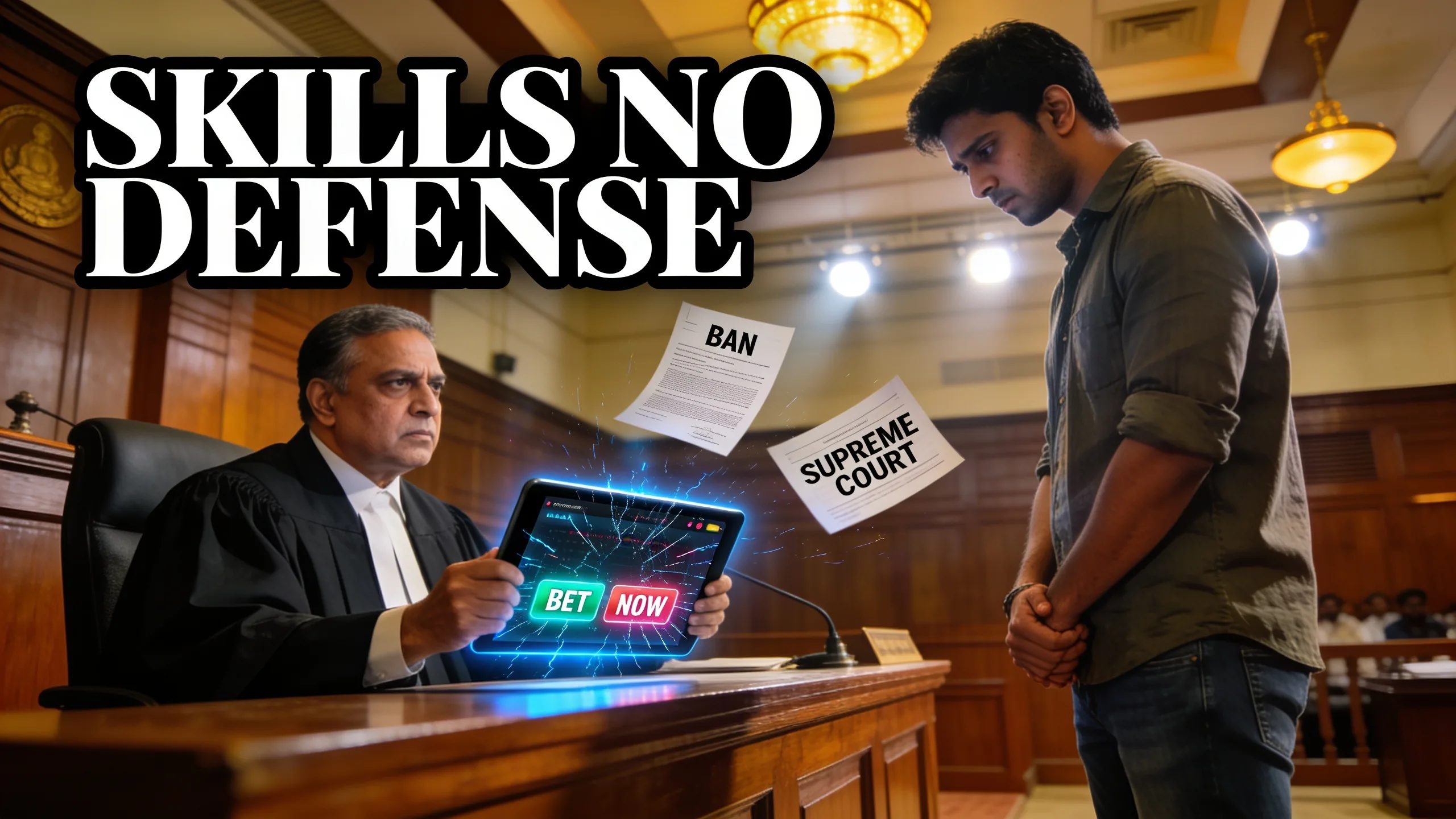
India's Supreme Court has delivered what may be the most consequential judgment in the country's iGaming history. On 27 May 2026, a bench of Justice JB Pardiwala and Justice R Mahadevan ruled in State of Tamil Nadu & Ors. v. Junglee Games India Pvt. Ltd. & Ors. (2026 INSC 594) that any money staked on an uncertain outcome — regardless of whether the underlying game is skill-based or chance-based — constitutes "betting and gambling" under the Indian Constitution, and that state legislatures have full power to ban it outright.
The ruling lands on an industry already dismantled by federal legislation. The Promotion and Regulation of Online Gaming Act (PROGA), enacted in August 2025 and effective 1 May 2026, had already criminalised real-money online games nationwide. The Supreme Court verdict now removes any remaining hope of a successful constitutional challenge, confirms ₹2.5 lakh crore (roughly $30 billion) in backdated 28% GST demands, and has prompted the suspension of real-money operations at every major Indian platform.
In This Article
What the Court Decided
The case bundled Civil Appeal Nos. 6124–6131 of 2023 and connected petitions, all challenging state-level bans on online games played for stakes. The bench set aside earlier judgments from the Madras High Court and the Karnataka High Court, both of which had struck down state amendments on the grounds that skill-based games fell outside gambling law.
The Supreme Court's core holding is stark: the expression "betting and gambling" in Entry 34 of List II of the Seventh Schedule cannot be narrowed to cover only games of pure chance. The moment money is staked on any uncertain outcome, the activity becomes betting and gambling — and is therefore classified as res extra commercium, meaning it carries no fundamental right to trade under Article 19(1)(g) of the Constitution. State legislatures may regulate, restrict, or wholly prohibit it under both Entry 34 and Entry 1 (public order).
The bench also framed online money gaming as a public health and public order matter, noting that technological change has effectively turned every smartphone into what it called a "virtual common gambling house." That framing opens additional legislative pathways for prohibition beyond the gambling entry alone.
The Skill-vs-Chance Distinction: Killed for Good
For years, Indian gaming operators built their entire legal and commercial strategy on demonstrating that their products — online rummy, poker, fantasy sports — were "games of skill" and therefore outside gambling statutes. The Supreme Court has now firmly rejected that architecture.
- The respondents included Junglee Games India (operator of India's largest rummy platform, since acquired by Flutter Entertainment), Gameskraft, Head Digital Works, Galactus (MPL), Play Games 24x7, the All India Gaming Federation, and the Federation of Indian Fantasy Sports.
- All had argued that their platforms charged a platform fee or rake of 7–10% on buy-ins rather than wagering on outcomes themselves — and that skill games were protected commercial activity.
- The court found this distinction legally irrelevant once money is staked, regardless of the rake structure or the operator's role in the outcome.
Flutter had already shuttered Junglee's real-money operations in India following PROGA's enactment. The ruling eliminates any path to restoring them under the current constitutional framework.
Industry Fallout: Platforms, Jobs, and Capital
The combined impact of PROGA and the Supreme Court ruling has been immediate and severe. Dream11, Mobile Premier League, PokerBaazi, WinZO, Zupee, Games24x7, and Baazi Games all suspended real-money operations after PROGA took effect on 1 May 2026. The paid contests that were halted represented over 90% of Dream11's revenue.
More than 3,000 employees have been laid off across the sector. Dream Sports pivoted to its media and travel subsidiaries (FanCode, DreamSetGo). MPL shifted to free-to-play. Paytm First Games formally exited real-money gaming entirely. Venture capital, already cautious after the 2023 GST ruling, is now expected to redirect away from any business model dependent on user deposits and cash prizes.
The GST Shock: ₹2.5 Lakh Crore in Demands
In parallel with the constitutional ruling, the Supreme Court confirmed that backdated 28% GST levies apply to the full face value of all player deposits — not just gross gaming revenue or platform fees. The total validated demand stands at approximately ₹2.5 lakh crore (~$30 billion), described by one legal analyst as exceeding the annual tax revenue of most Indian states.
| Platform | Core Product Affected | Response to PROGA + Ruling | GST Exposure |
|---|---|---|---|
| Dream11 / Dream Sports | Fantasy cricket & sports | Halted paid contests; pivoted to FanCode & DreamSetGo | Among largest — >90% of revenue from paid contests |
| Junglee Games (Flutter) | Online rummy | Flutter shut real-money India ops entirely | Primary respondent; substantial retrospective exposure |
| Mobile Premier League (MPL) | Multi-game cash platform | Moved to free-to-play; staff cuts | Significant — large deposit base |
| PokerBaazi (Moonshine Tech) | Online poker | Suspended real-money games; Nazara stock sell-off | Nazara holds 46% stake — material group exposure |
| Gameskraft | Rummy, casual games | Operations wound down | Named in lead GST case alongside Junglee |
The GST demands predate PROGA and cover the period when real-money gaming was still operating. Companies now owe tax on a business they are simultaneously prohibited from running — a combination that legal commentators have described as existential for many operators.
What Happens Next for Indian iGaming
The ruling does not foreclose all commercial activity. The Supreme Court's analysis was confined to staked money games; it does not address whether Parliament could legislate a licensing framework under the Union List. PROGA itself created a new Online Gaming Authority of India (OGAI) tasked with registering permissible games — primarily e-sports, casual games, and social gaming. These categories receive formal legal recognition for the first time and may continue charging participation fees and distributing performance-based prizes.
The practical consequences for offshore operators targeting Indian players are significant:
- State bans on online money gaming are now constitutionally bulletproof; challenges based on skill-game status will fail.
- The 28% GST on full deposit value applies as a floor — any future licensed operator would face the same tax structure.
- Advertising and payment-processing prohibitions under PROGA remain in force.
- The OGAI framework for e-sports and social gaming is the only currently lawful commercial pathway within India's borders.
India's real-money iGaming market, projected as recently as 2024 to reach $8.6 billion by 2027, has effectively been zeroed out by the combination of PROGA and the 2026 INSC 594 ruling. What emerges from the wreckage — and how quickly — will depend on whether Parliament moves to create a licensed betting framework, something the current government has given no indication of pursuing.
Sources
Primary legal filings and official commentary verified first; trade and specialist press used for industry reaction and market data.
- Supreme Court of India — State of Tamil Nadu & Ors. v. Junglee Games India Pvt. Ltd. & Ors., 2026 INSC 594 ↗ https://www.caseciter.com/2026insc594/
- CAclubindia / Bimal Jain — Full Legal Analysis of 2026 INSC 594 ↗ https://www.caclubindia.com/articles/supreme-court-banning-the-online-money-gaming-is-within-the-states-power-55343.asp
- Asia Gaming Brief — India Supreme Court: Every Mobile Phone a Virtual Gambling House ↗ https://agbrief.com/news/india/04/06/2026/indias-supreme-court-declares-every-mobile-phone-a-virtual-gambling-house-in-landmark-online-gaming-ruling/
- Outlook Respawn — The Legal Battle That Dismantled India's Real-Money Gaming Sector ↗ https://respawn.outlookindia.com/gaming/gaming-originals/the-legal-battle-that-dismantled-indias-real-money-gaming-sector
- Policy Circle — Online Gaming Faces Tax Shock After GST Verdict ↗ https://www.policycircle.org/industry/online-gaming-faces-tax-shock/
- StartupTalky — India's Online Gaming Industry: Banned and Billed ₹1 Lakh Crore ↗ https://startuptalky.com/indias-online-gaming-industry-banned-and-billed-1-lakh-crore-at-the-same-time/
The moment money is staked on the uncertain outcome of any game, the activity becomes betting and gambling — irrespective of whether the underlying game is one of skill or of chance.
— Justice JB Pardiwala & Justice R Mahadevan, Supreme Court of India · 2026 INSC 594, 27 May 2026