
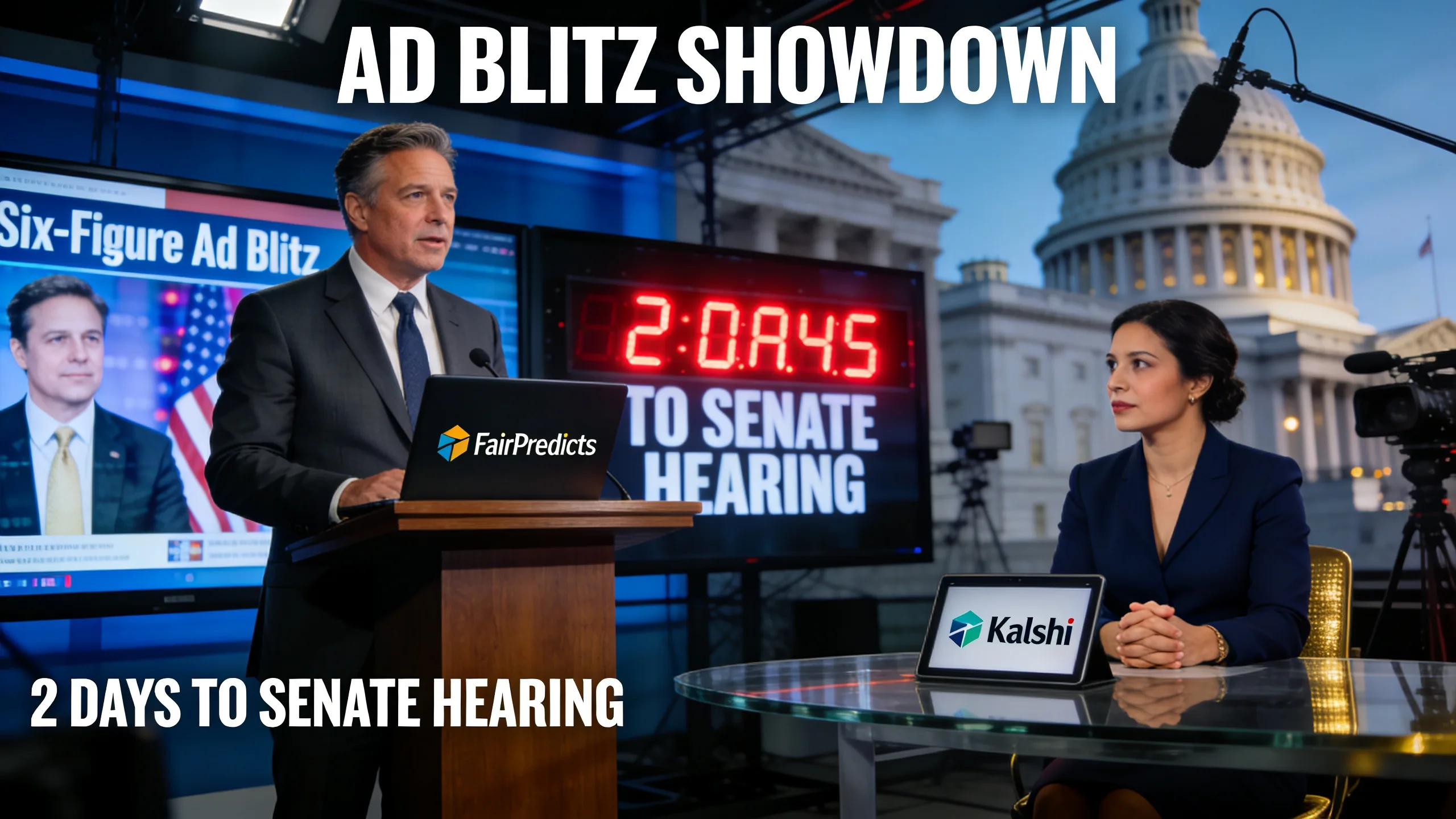
"FairPredicts" Watchdog Launches Six-Figure Ad Blitz Against Kalshi Two Days Before Senate Integrity Hearing
New dark-money nonprofit goes public hours before Wednesday's "No Sure Bets" Senate Commerce hearing; Kalshi calls it "casino-led" while a Polymarket Maduro-tip case and a $100 self-betting Senate candidate test prediction-market integrity in real time.
Category: iGaming News - USA · By Growl Games Editorial Team · Mon May 18 2026 · Updated Thu Jul 23 2026
Contents
- 1. Summary
- 2. FairPredicts Goes Public
- 3. The 20 May "No Sure Bets" Hearing
- 4. Polymarket, Moran and a Live Integrity Stress Test
- 5. Bills Circulating and the Federal Frame
- 6. What Happens After Wednesday
- Sources
1. Summary
A new nonpartisan nonprofit calling itself FairPredicts launched on 18 May with a six-figure advertising campaign targeting Kalshi and other prediction-market operators, two days before the Senate Commerce Subcommittee on Consumer Protection, Technology and Data Privacy holds its "No Sure Bets: Protecting Sports Integrity in America" hearing on 20 May. FairPredicts describes itself as a market-integrity watchdog focused on the gap between what prediction-market platforms tell the public and what they actually do, with sports wagering and insider-information risk at the centre of its concerns. Kalshi's spokeswoman Elizabeth Diana called the group "casino-led" within hours. The watchdog will not disclose its donors. The launch is the most concrete escalation yet in the convergence of the prediction-markets fight with active federal-level scrutiny.
2. FairPredicts Goes Public
FairPredicts launched publicly on the morning of 18 May with what NBC News described as a six-figure ad campaign and a statement saying its mission is "holding Kalshi and other prediction market operators accountable for the growing gap between what they tell the public and what they actually do." The group is structured as a political nonprofit, meaning it is not required to publicly disclose its funders and has declined to identify them. Kalshi's response was immediate and pointed. Spokeswoman Elizabeth Diana said: "Smells like a casino-led effort. Prediction markets are fair, transparent, and open. Casinos limit winners (unfair), price with algorithms (opaque), and set the odds themselves (closed). FairPredicts or UnfairPredicts?" The framing of "casino-led" is significant given the broader pattern of US commercial-casino industry mobilisation against prediction markets, including American Gaming Association CEO Bill Miller's recent characterisation of CFTC Chair Michael Selig as "a joke," MGM-owned Aria's last-minute cancellation of the Predict Summit venue contract in early May, and the AGA's State of the States 2026 report repeatedly grouping prediction markets with sweepstakes casinos and offshore sportsbooks as primary state-enforcement targets.
3. The 20 May "No Sure Bets" Hearing
Senator Marsha Blackburn (R-Tenn), chairing the Senate Commerce Subcommittee on Consumer Protection, Technology and Data Privacy, will convene the hearing at 10:00 a.m. ET on Wednesday 20 May at the Dirksen Senate Building. It is the first US Senate body to address the proliferation of prediction markets directly. The witness list is balanced and pointed: AGA President and CEO Bill Miller; Mary Beth Thomas, Executive Director of the Tennessee Sports Wagering Council (which sent cease-and-desist letters to prediction-market operators earlier this year before Kalshi sued the state and won a preliminary federal injunction); Scott Sadin, co-founder and co-CEO of Integrity Compliance 360, an integrity monitor that has worked on several recent sports-betting scandals; and former Representative Patrick McHenry, now a senior adviser to the Coalition for Prediction Markets. Senate Commerce Committee Chairman Ted Cruz framed the hearing as testing whether "fans shouldn't have to wonder if their favorite player missed a buzzer-beater or dropped a touchdown pass because of a secret bet." Subcommittee members joining Blackburn include Indiana Senator Todd Young, Minnesota Senator Amy Klobuchar, New Mexico Senator Ben Ray Luján and South Dakota Senator John Thune.
4. Polymarket, Moran and a Live Integrity Stress Test
The integrity case has been written in real time over the past several weeks. Federal authorities arrested US special forces soldier Gannon Ken Van Dyke over allegations he used classified information about the US military operation that led to the arrest of Venezuela's Nicolás Maduro to make approximately $409,000 trading on Polymarket. President Trump downplayed the arrest, comparing it to Pete Rose's lifetime ban from baseball. Separately, Kalshi fined and suspended three political candidates for "insider trading" on their own campaigns; one of them, Virginia Democratic Senate candidate Mark Moran, told NBC News he placed a $100 self-bet deliberately to show that "an entire election can be bought" via prediction markets. Kalshi itself disclosed in February 2026 that it has opened 200 investigations into alleged insider trading and referred two to the CFTC. The sports-side integrity record is similarly active: a UFC fight rigging probe, federal indictments of two MLB pitchers over alleged pitch manipulation, an NCAA action against six former college basketball players from three schools, and the Terry Rozier prop-bet arrest in October 2025.
5. Bills Circulating and the Federal Frame
The Prediction Markets Security and Integrity Act of 2026 is circulating among Senate co-sponsors. If passed, the bill would require prediction-market platforms operating in the US to register with either the CFTC or a newly created oversight body and to comply with the same anti-money-laundering and consumer-protection standards already required of licensed sportsbook operators. The AGA has publicly endorsed the framework, arguing a level regulatory playing field is necessary. Separately, Senator Klobuchar's End Prediction Market Corruption Act would ban the US President, Vice President, members of Congress and other public officials from trading on prediction markets while in office. In late April 2026, senators voted unanimously to bar themselves and their staff from participating in prediction markets — framed as a conflict-of-interest measure but also a strong signal of congressional disposition. Kalshi's lobbying spend totalled approximately $500,000 in 2026 alone across Congress and the CFTC.
6. What Happens After Wednesday
The hearing will not in itself produce legislation, but it will set the tonal and witness foundation for whatever federal framework emerges. The Coalition for Prediction Markets' argument — that exchange-based contracts with no house and no algorithmic line-setting are fundamentally a financial product distinct from sportsbook offerings — will collide with the AGA's argument that a $165 billion sports-betting market cannot have a parallel federally regulated channel exempt from state licensing, state taxation and tribal-IGRA compliance. Hill watchers see the witness list as deliberately balanced; the Coalition for Prediction Markets, represented by McHenry, is "at the table" rather than being targeted. Whether that translates into a permissive federal classification of sports-event contracts or into the AGA-endorsed integration framework is the question that Wednesday's three-hour window begins to answer. Either outcome reshapes a sector that has, until now, run almost entirely on state-level law and CFTC interpretation without congressional input.
Sources
- NBC News — Prediction market 'watchdog' launches six-figure ad campaign ahead of Senate hearing
- US Senate Commerce Committee — Commerce Committee Announces Upcoming Hearing on Sports Betting
- Gaming America — Congress Sets May 20 Hearing on Sports Betting Integrity Risks
- Bright Side of News — Senate Prediction Markets Integrity Hearing
- Closing Line — The Early Line: Senate Subcommittee To Hold Hearing On Sports Betting Integrity
- SBC Americas — Senate to Discuss Gambling, Prediction Market Integrity
- iGaming Business — Prediction Market roundup: Prominent conference moved from Vegas to NYC
- Sports Illustrated — Congress Is Coming for Sports Betting and Prediction Markets Have a Seat at the Table
- ReadWrite — Senate hearing on sports betting integrity: risks, regulation, and market growth
- American Gaming Association — State of the States 2026