
Chhattisgarh Police Bust Goa-Based IPL Betting Racket with Live 7-Second Delay Edge
Raigarh Police raid a Candolim Beach villa, arrest six, seize ₹1.03 crore in cash and a note-counting machine; investigators trace Dubai-issued betting IDs and hawala routes back through Raipur and Sakti, echoing the Mahadev network's playbook.
Category: iGaming News - India · By Growl Games Editorial Team · Mon May 18 2026 · Updated Thu Jul 23 2026
Contents
- 1. Summary
- 2. The Candolim Villa Bust
- 3. The 7-Second Edge
- 4. Hawala Trail and Mahadev Echo
- 5. IPL 2026 as the Multiplier
- 6. What's at Stake
- Sources
1. Summary
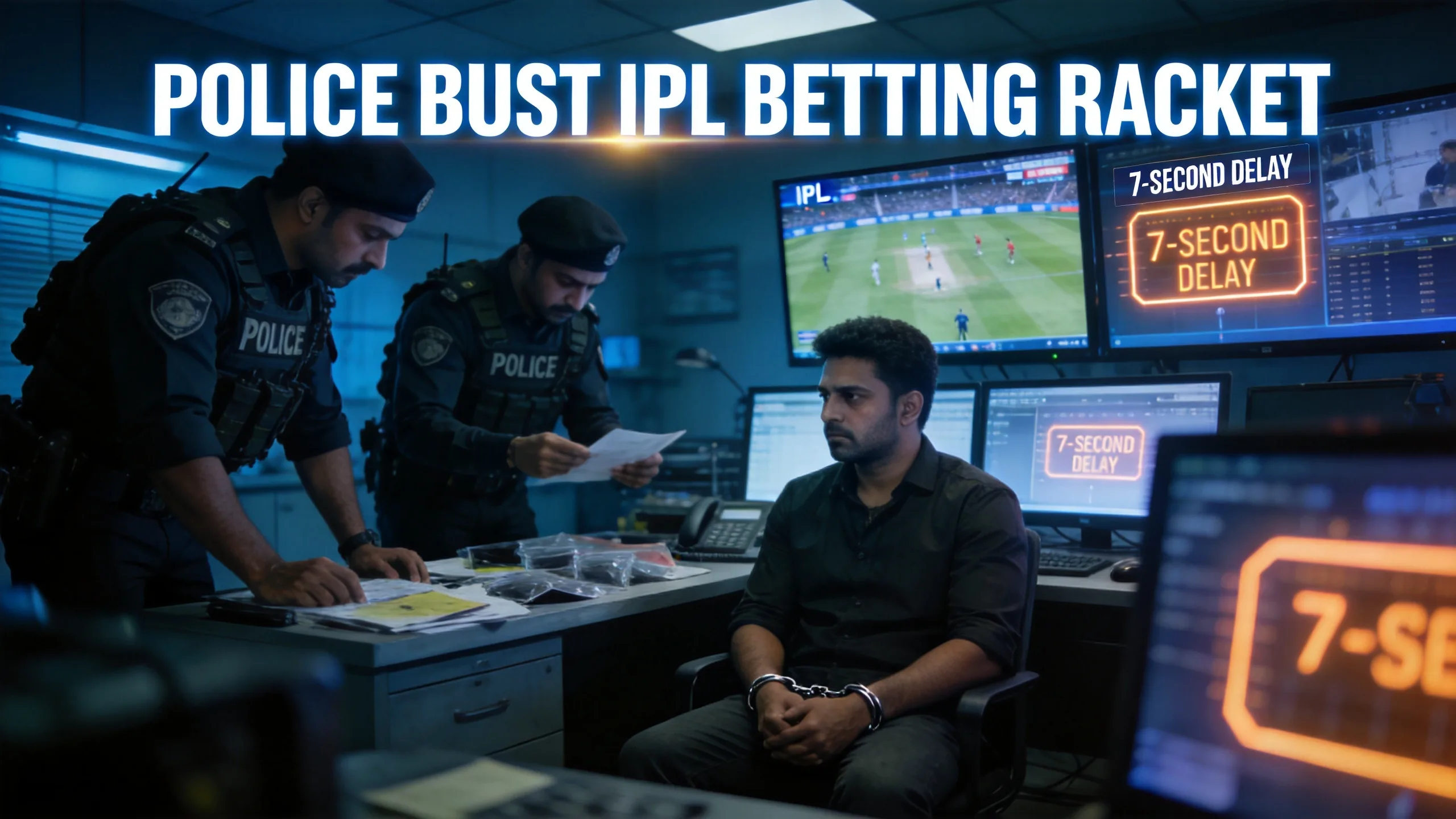
Chhattisgarh's Raigarh Police announced on 17 May the arrest of six men running an online IPL betting syndicate from a rented villa near Candolim Beach in Goa. The operation, conducted under the supervision of Senior Superintendent of Police Shashi Mohan Singh by the district's Cyber Cell and Kotwali Police, follows an earlier 26 April raid in Raigarh that exposed an online IPL betting network and led to the seizure of more than ₹1.03 crore in cash, a note-counting machine and dozens of mobile phones. Investigators say the syndicate used an application that delivered live cricket match feeds about seven seconds ahead of public television broadcasts, letting operators move betting rates with informational advantage. The bust lands in the second half of IPL 2026 and adds fresh material to the wider enforcement push against offshore-anchored cricket betting in the post-PROGA period.
2. The Candolim Villa Bust
Police teams traced digital activity from Raigarh, Raipur, Sakti and Kharsia to a villa in Goa's Candolim Beach area. The accused attempted to destroy mobile phones and documents after spotting the raid; ten mobile phones and several digital records were nevertheless seized. Two of the six — Amit Mittal and Mohit Somani — already face multiple online-betting cases in Raigarh, Kharsia, Gharghoda and Raipur. The Goa raid is a follow-on action; the earlier Raigarh investigation began on 26 April and led to the arrest of six accused with mobile phones and cash. Subsequent technical surveillance, digital transaction analysis and financial scrutiny pointed to a wider syndicate run by Karan Choudhary (alias Karan Agrawal) and absconding accused Jasmeet Singh Bagga (alias Gudda Sardar). Karan Choudhary, Pushkar Agrawal and Sunil Kumar Agrawal were arrested in the Raigarh phase; ₹50 lakh in cash, a note-counting machine and mobile phones were recovered from Sunil Agrawal at Krishna Pride Tower in Raigarh, with another ₹52.60 lakh and further phones seized from Pushkar Agrawal.
3. The 7-Second Edge
The detail with the sharpest commercial implication is the application that gave operators a live-feed advantage of roughly seven seconds over public television broadcasts. Television feeds incur a satellite-and-encoding lag relative to the on-ground event; a low-latency ground-side feed, when overlaid against a public broadcast clock, gives the operator a window in which the result of a delivery is known to the syndicate before the public price has adjusted. The same window can also be used to refuse late "winning" bets retroactively or to settle voids in the operator's favour. The same architecture has surfaced in earlier Indian betting busts and forms part of why the Enforcement Directorate has consistently framed organised cricket betting as a financial-crime issue rather than a sports-integrity issue alone.
4. Hawala Trail and Mahadev Echo
Police say betting proceeds were routed through commercial fronts — petrol pumps, medical stores and similar establishments — before being moved on through suspected hawala channels. Officials have publicly drawn the parallel to the Mahadev Online Book network, in which betting IDs allegedly originated with Dubai-based handlers, were routed through metropolitan Indian operators and then distributed to smaller bookies and players in cities including Nagpur, Raipur and other parts of central India. The Mahadev probe has so far seen the Enforcement Directorate file five chargesheets, arrest 13 people and attach assets totalling ₹2,600 crore. The Raigarh-Goa operation does not yet claim equivalent scale, but the structural similarities — Dubai-issued IDs, multi-state distribution, hawala settlement, cash-intensive commercial fronts — mean the case will likely fold into ongoing ED financial-crime work rather than remain a purely state-police matter.
5. IPL 2026 as the Multiplier
IPL 2026 is in its closing stages, with playoff scenarios crystallising this week. Industry data cited in this year's policy debates puts UK black-market cricket betting alone at meaningful scale, and the Betting and Gaming Council's H2 Gambling Capital research and Gaming Compliance International's recently released report both identify cricket as one of the largest single drivers of unregulated betting volume globally. Within India, post-PROGA data tracked by the Ministry of Electronics and Information Technology and surveys from CUTS International have shown sustained migration of bettors to offshore and mirror-domain platforms despite the prohibition that took effect on 1 May 2026; offshore platform usage rose from 68.3% pre-ban to 82% post-ban in the Delhi NCR sample, with daily access jumping from 3.4% to 42.3% and a new high-spending category (over ₹10,000 per month) emerging where one did not exist before. The Raigarh-Goa bust illustrates the operational reality on the ground: the demand has not disappeared, it has consolidated around organised, Dubai-anchored, multi-state syndicates that India's law-enforcement architecture is now actively dismantling case by case.
6. What's at Stake
Three threads converge in the case. First, this is the first major IPL-season betting bust of 2026 to lead with technical sophistication — a low-latency feed advantage — as part of the public charge sheet. Second, the operation explicitly invokes the Mahadev playbook on Dubai-issued IDs and hawala-routed settlement, signalling that state-level cyber units are now reading the same network architecture the ED has spent two years mapping. Third, the case is geographically resilient: Raigarh police pursued the network from Chhattisgarh into Goa, suggesting that physical-location enforcement is increasingly possible even when betting operations are nominally cloud-based. For licensed sportsbook operators outside India's jurisdiction, the message is the same one that emerged from the Gameskraft and WinZO actions earlier this year — the Indian enforcement apparatus is moving more quickly on the financial rails and the human nodes of organised cricket betting than it did during the IPL 2025 cycle.
Sources
- Dainik Jagran English — Goa-Based IPL Betting Racket Busted, Six Arrested by Raigarh Police
- The Hitavada — Rs 1 cr seized as Raigarh Police bust IPL betting-hawala syndicate
- Patrika — Raigarh Police's Goa Raid Busts Online Cricket Betting Network with Dubai IDs (Hindi)
- Wikipedia — Mahadev Betting App Case (background on network architecture)
- MediaNama — India Blocks 8,376 Gambling URLs After Gaming Ban
- Storyboard18 — 7,800 websites blocked, but MeitY struggles to curb offshore gambling and betting in India
- MediaNama — India Blocks 242 More Gambling Sites, Offshore Use Still Rising
- iGaming Business — Government of India publishes new online gaming regulations (PROGA / OGAI context)
- Business Standard — ED freezes ₹526 crore deposits in money laundering case against Gameskraft (sector context)