
Wisconsin Tribal Sports Betting Law Locks Out DraftKings, FanDuel
Wisconsin's AB 601 makes tribes the only legal operators, forcing a 60% revenue share that major commercial sportsbooks say makes the market unworkable.
Category: News · By Growl Games Editorial Team · Mon Jun 29 2026 · Updated Tue Jul 21 2026
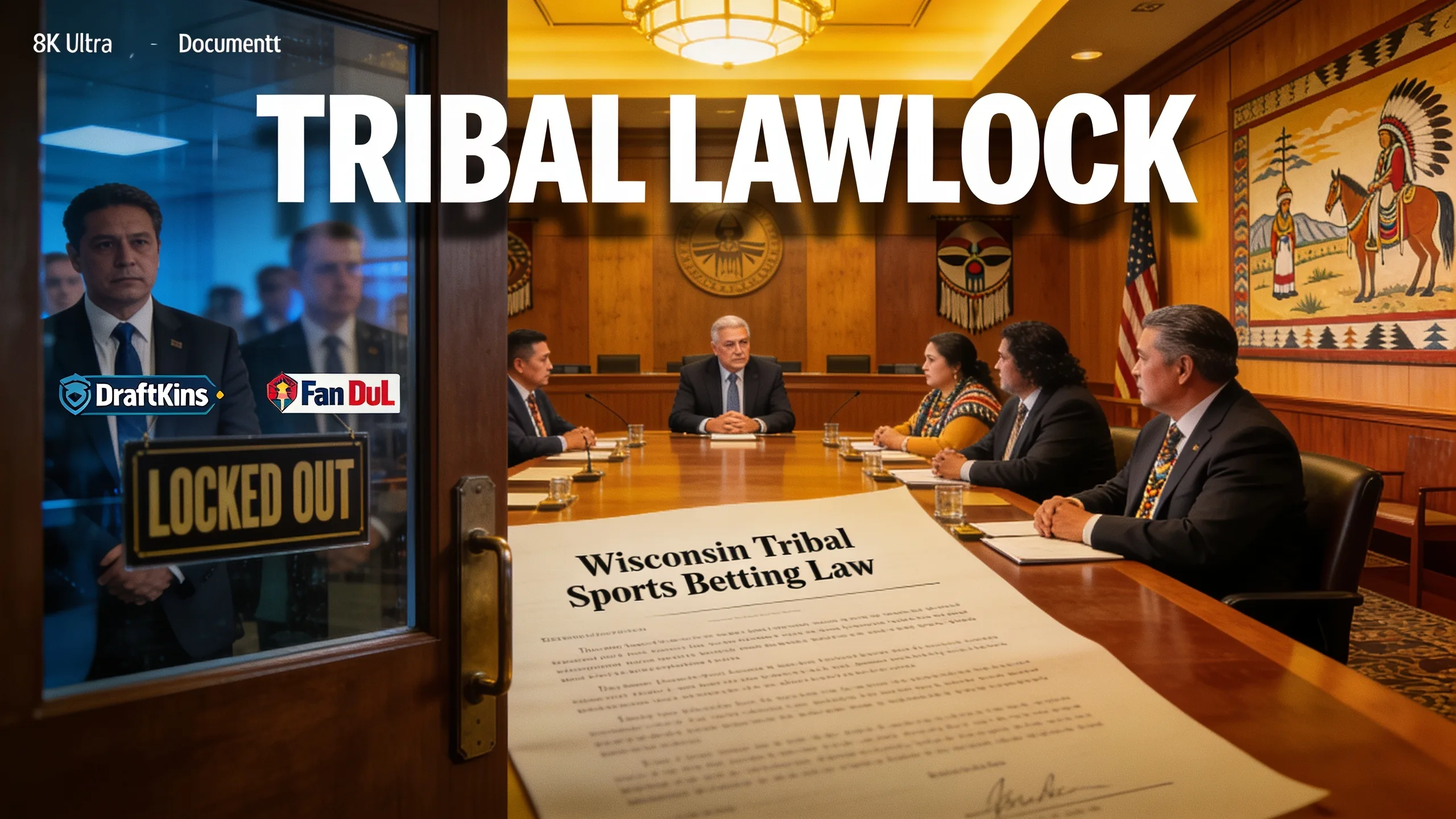
On 9 April 2026, Wisconsin Governor Tony Evers signed Assembly Bill 601 into law, making Wisconsin the 33rd US state to legalise online sports betting. The milestone comes with a structural catch that has split the industry: every bet must route through servers physically located on tribal land, and 60% of net gaming revenue must flow to the tribal operator — terms that the country's biggest commercial sportsbooks say make the market economically unworkable for them.
The Sports Betting Alliance (SBA) — whose members include DraftKings, FanDuel, BetMGM, Bet365, and Fanatics — spent $262,603 lobbying against the bill. The SBA warned lawmakers that surrendering 60% of revenue to a tribal partner is "simply not economically feasible" for low-margin sportsbook operators. Wisconsin's 11 federally recognised tribes, who already hold exclusive licences to run 22 casinos in the state, now have the legal framework — but no launch date has been set, as each tribe must first renegotiate its gaming compact with the governor's office.
In This Article
How the Hub-and-Spoke Model Works
AB 601 uses a "hub-and-spoke" architecture borrowed from Florida, where the Seminole Tribe operates statewide mobile betting through its Hard Rock Bet brand. In Wisconsin's version, the "hub" is a server on tribal land; the "spokes" are smartphones and tablets held by bettors anywhere in the state. Because the wager is legally deemed to occur where the server sits — on sovereign tribal territory — the arrangement satisfies both state constitutional rules that restrict new gambling forms and federal Indian Gaming Regulatory Act (IGRA) requirements.
- All bets must be processed by servers physically constructed on tribal land.
- Tribal operators hold the primary licence; commercial brands may enter only as technology or platform partners.
- Wisconsin's 11 tribes must each renegotiate compact terms individually before going live.
- The model preserves tribal sovereignty and keeps gaming revenue inside the state.
Why DraftKings and FanDuel Are Reluctant
The SBA's position is straightforward: sports betting runs on thin margins, and handing a tribal partner the majority of revenue leaves commercial operators with too little to cover technology, marketing, and operations. The alliance attorney Damon Steward warned that Wisconsin adults "will not be able to use sites like DraftKings and FanDuel — chosen by the vast majority of consumers in other states." That said, the situation is not entirely without precedent. DraftKings and FanDuel both launched in Arkansas under a deal requiring 51% revenue sharing with casino partners, a figure they ultimately accepted after initial resistance. Whether Wisconsin's steeper 60% threshold crosses an irreversible line remains uncertain.
Prediction Markets Are Already There
The urgency behind AB 601 was partly driven by a regulatory vacuum that national brands were already filling. DraftKings and Fanatics had both launched prediction market products in Wisconsin before the bill was signed, operating under federal Commodity Futures Trading Commission (CFTC) oversight rather than state gaming law. FanDuel was expected to follow. Prediction market contracts on sports outcomes require no tribal approval and carry no revenue-sharing obligations — meaning Wisconsin residents who want a national brand may access one through prediction markets regardless of what happens with compact negotiations under AB 601. The Ho-Chunk Nation filed suit against prediction market platform Kalshi in August 2025, calling it a direct threat to tribal gaming revenues.
Revenue Outlook and Tax Rate
AB 601 sets the tax on adjusted gross sports betting receipts at 12%, placing Wisconsin in the middle of the national range. The Wisconsin Legislative Fiscal Bureau projected the state could collect between $30 million and $50 million annually once the market matures, contingent on how many tribes launch platforms and how quickly they attract bettors. For context, neighbouring Illinois — a large, mature market — generated over $1.4 billion in handle in March 2026 alone. Wisconsin's population of roughly 5.9 million suggests a meaningful but more modest opportunity. A portion of tax revenue is earmarked for problem gambling prevention and treatment programmes.
| State | Online Betting Tax Rate | Revenue Share to Tribes/Casinos | National Brands Present? |
|---|---|---|---|
| Wisconsin (AB 601) | 12% of adjusted GGR | 60% to tribal operator (IGRA) | Uncertain — compacts pending |
| Florida (Hard Rock model) | Varies under compact | Seminole Tribe: ~$500M guarantee/year | No — tribal brand only (Hard Rock Bet) |
| Arkansas | 13% of net revenue | ~51% to casino partners | Yes — DraftKings, FanDuel as vendors |
| New York | 51% of GGR | None (state tax only) | Yes — all major brands |
| Nevada | 6.75% of GGR | None | Yes — all major brands |
What Happens Next
The road from signed law to live betting app involves multiple sequential steps, each with its own timeline. Industry observers estimate a launch is unlikely before late 2026 and possibly not until early 2027.
- Each of Wisconsin's 11 tribes must individually negotiate compact amendments with the governor's office.
- Once compacts are renegotiated, tribes must finalise platform and technology partnerships.
- The SBA may revisit its opposition if tribes offer commercial operators a workable revenue-share arrangement — as happened in Arkansas.
- If national brands do not enter, tribal operators will build or licence their own sportsbook platforms, likely offering a narrower product range initially.
- Prediction markets under CFTC oversight will continue to operate in the interim, complicating the tribal market's early growth.
Governor Evers framed the signing as a starting point: "This legislation is the beginning of a conversation, not the end of one. The real work begins today."
Sources
Reporting draws on primary legislative records, a primary court filing from the Courthouse News Service, and cross-checked industry coverage from four additional outlets.
- Courthouse News Service — Wisconsin Governor Signs AB 601 ↗ https://www.courthousenews.com/wisconsin-governor-signs-bill-legalizing-online-sports-betting-run-by-tribes/
- Bright Side of News — Wisconsin Sports Betting 2026: Launch Timeline Uncertain ↗ https://brightsideofnews.com/gambling/wisconsin-sports-betting-2026-online-wagering-law-signed-but-launch-timeline-remains-uncertain/
- Bettors Insider — Why DraftKings and FanDuel May Sit Out Wisconsin ↗ https://bettorsinsider.com/sports-betting/2026/04/10/wisconsin-becomes-the-33rd-state-to-legalize-online-sports-betting-but-dont-expect-draftkings-or-fanduel-to-show-up/
- CBS Sports — Wisconsin's Online Betting Market May Look Very Different ↗ https://www.cbssports.com/betting/news/wisconsins-new-online-sports-betting-market-might-look-a-bit-different/
- Gaming America — Wisconsin Betting Bill: No FanDuel or DraftKings? ↗ https://gamingamerica.com/news/1002632/wisconsin-online-sports-betting-bill-could-launch-in-2026-without-fanduel-or-draftkings
Online sports betting is a low-margin, capital-intensive business. It is simply not economically feasible for a commercial operator to hand over 60% or more of its revenue to an in-state gaming entity just for the right to operate in the state.
— Sports Betting Alliance, Written Testimony to Wisconsin Lawmakers · AB 601 Legislative Hearings, 2026