
Prediction Markets: CFTC Sues States in Sports Betting War
The CFTC has sued eight states this year to protect federally regulated prediction markets from state gambling crackdowns — with Kalshi, tribal rights, and billions in tax revenue at stake.
Category: News · By Growl Games Editorial Team · Fri Jun 26 2026 · Updated Tue Jul 21 2026
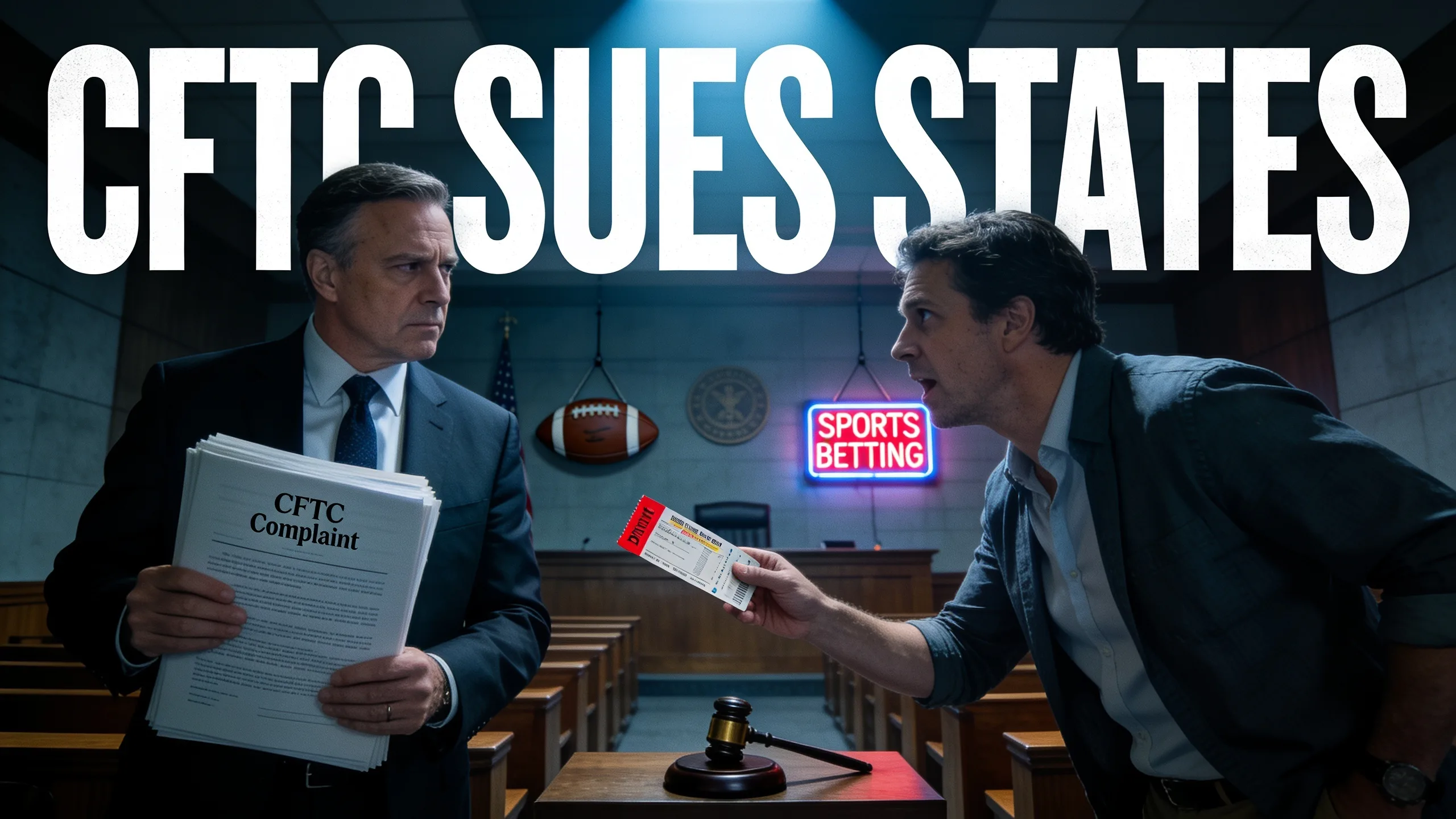
The battle over who regulates prediction markets just escalated dramatically. On June 12, 2026, the Commodity Futures Trading Commission (CFTC) filed a federal lawsuit against New Mexico — the eighth state the federal regulator has sued this year — seeking to permanently block state gaming laws from applying to federally registered prediction market platforms like Kalshi. The complaint, filed in the U.S. District Court for the District of New Mexico, names Governor Michelle Lujan Grisham, Attorney General Raúl Torrez, and members of the New Mexico Gaming Control Board as defendants.
The case lands eight days after New Mexico launched its own state-court lawsuit against Kalshi on June 4, alleging the company was operating unlicensed online sports betting and allowing users as young as 18 to access its platform in a state where the minimum gaming age is 21. The legal collision puts the Commodity Exchange Act and federal preemption doctrine on a collision course with state sovereignty over gambling regulation — a dispute that now spans eight jurisdictions and shows no sign of slowing down.
In this article
What Happened: CFTC Files Suit Against New Mexico
The CFTC's complaint asks the federal court for two things: a declaratory judgment confirming the agency's exclusive authority to regulate event contracts under the Commodity Exchange Act (CEA), and a permanent injunction barring New Mexico officials from enforcing state gaming laws against CFTC-registered platforms.
CFTC Chairman Michael S. Selig framed the action in stark terms, describing New Mexico as the latest state attempting to override settled federal law. The agency argues it already monitors more than 3,000 self-certified event contracts and has signed sports integrity agreements with MLB and the NHL, countering claims that prediction markets operate without meaningful oversight.
The State's Case: Unlicensed Betting, Underage Access
New Mexico's position is direct: Kalshi looks, acts, and operates like a sportsbook, and should be licensed as one. Attorney General Torrez argued publicly that Kalshi's offerings "look like a sportsbook, act like a sportsbook, and proverbially quack like a sportsbook." The state's complaint points to two specific failures it says a licensed sportsbook would never be permitted to make:
- Operating without a state gaming license, bypassing consumer protection and problem gambling frameworks that apply to licensed operators.
- Allowing residents aged 18 to 20 to participate, despite New Mexico's minimum gaming age of 21.
The state's lawsuit was joined by pressure from New Mexico's tribal nations. Four tribal bodies — the Mescalero Apache Tribe and the Sandia, Pojoaque, and Isleta pueblos — filed a separate suit alleging Kalshi violated existing tribal-state gaming compacts and the Indian Gaming Regulatory Act (IGRA) by offering wagering on reservation lands.
The Federal Argument: Exclusive Jurisdiction Under the CEA
The CFTC's core legal theory has remained consistent across all eight state lawsuits. The agency argues that Kalshi is a federally designated Designated Contract Market (DCM), and that the Commodity Exchange Act grants the CFTC exclusive authority over the contracts traded on registered exchanges. State gambling laws are, in the agency's view, preempted and unenforceable.
That theory has drawn a high-profile rebuttal from former CFTC Chair Gary Gensler, who filed an amicus brief in the parallel Sixth Circuit case involving Ohio. Gensler argued the Dodd-Frank Act was never intended to cover sports event contracts, which do not fit the statutory definition of a "swap" because they do not hedge an economic risk. Meanwhile, a U.S. District Judge in the Michigan federal cases ruled in two nearly identical decisions that sports event contracts are likely not swaps under the CEA — a significant early signal against the CFTC's theory.
The Broader Battle: Eight States, Multiple Courts
New Mexico is the eighth state to face a CFTC preemption action. The regulator has filed suit in Wisconsin, New York, Arizona, Connecticut, Illinois, Rhode Island, and now New Mexico. In parallel, 39 states, Washington D.C., multiple tribal nations, and the American Gaming Association (AGA) have all filed briefs supporting Ohio in its contest with Kalshi at the Sixth Circuit — an extraordinary alignment of state and industry interests against federal preemption.
| Jurisdiction / Party | Position | Key Action | Status |
|---|---|---|---|
| CFTC (Federal) | Prediction markets = federally regulated swaps under the CEA | Filed suits in 8 states; seeking permanent injunctions | Active — 8 pending federal cases |
| New Mexico AG | Kalshi operates an unlicensed sportsbook; underage access | Filed state court suit June 4; named Gov., AG as defendants in CFTC counter-suit | Active — dual state/federal track |
| New Mexico Tribes | Kalshi violates tribal compacts and IGRA | Separate suit by 4 tribal bodies | Active — federal court |
| 39 States + AGA | Sports event contracts are gambling; states have authority | Filed amicus briefs in Sixth Circuit (Ohio vs. Kalshi) | Sixth Circuit pending |
| Kentucky AG | Prediction markets + sweepstakes = illegal gambling | Filed suits against Kalshi, Polymarket, VGW; enacted 14.25% prediction market tax | Active — state and federal challenges |
| Michigan Federal Court | Sports event contracts likely not swaps under CEA | Two nearly identical rulings questioning CFTC's theory | Significant adverse precedent for CFTC |
What It Means for Bettors and Operators
For bettors, the immediate picture is fragmented. Prediction markets offering sports contracts remain available in most states — Kalshi currently operates in the majority of jurisdictions, and new platforms like ProphetX and Novig received CFTC designation this month, further expanding supply. But access is patchwork: states including Nevada, Kentucky, and New Mexico have moved aggressively against these platforms, while others have not acted.
For licensed sportsbook operators, the stakes are financial. The AGA estimates prediction markets have already diverted more than $500 million in potential sports betting tax revenue from state coffers since gaining traction. Operators who invest heavily to obtain state licenses — and pay tax rates as high as 51% in New York — are competing against platforms that pay no state gaming tax at all. The question of whether that competitive asymmetry survives judicial review will define the commercial landscape of US online gambling for years to come.
New Mexico is the latest state seeking to nullify black letter law and decades of judicial precedent by imposing state gaming laws on federally regulated derivatives exchanges subject to the CFTC's exclusive jurisdiction.
— Michael S. Selig, Chairman, Commodity Futures Trading Commission · CFTC Press Release, June 12, 2026
Sources
Primary regulatory filings and direct reporting from five independent outlets cross-checked for this article.
- CFTC — Official Press Release: CFTC Sues New Mexico ↗ https://www.cftc.gov/PressRoom/PressReleases/9251-26
- Covers — CFTC Sues New Mexico to Protect Prediction Markets ↗ https://www.covers.com/industry/cftc-new-mexico-lawsuit-prediction-markets-sports-betting-allege-june-2026
- SBC Americas — Another CFTC Suit Against State Fighting Prediction Markets ↗ https://sbcamericas.com/2026/06/12/cftc-new-mexico-prediction-markets/
- DeFi Rate — CFTC Sues New Mexico Over Kalshi, Expanding Prediction Market Fight ↗ https://defirate.com/news/cftc-sues-new-mexico-over-kalshi-expanding-prediction-market-fight-with-states/
- Gambling Insider — Prediction Markets Weekly Roundup: Michigan Ruling, CME Lawsuit ↗ https://www.gamblinginsider.com/news/167702/prediction-markets-weekly-roundup-litigation-launches