
India VPN Gambling Ban: MeitY Moves to Block Offshore Casinos
India's proposed VPN crackdown would force providers to block offshore casino and sportsbook access, escalating the PROG Act 2025 enforcement push.
Category: News · By Growl Games Editorial Team · Sun Jul 05 2026 · Updated Tue Jul 21 2026
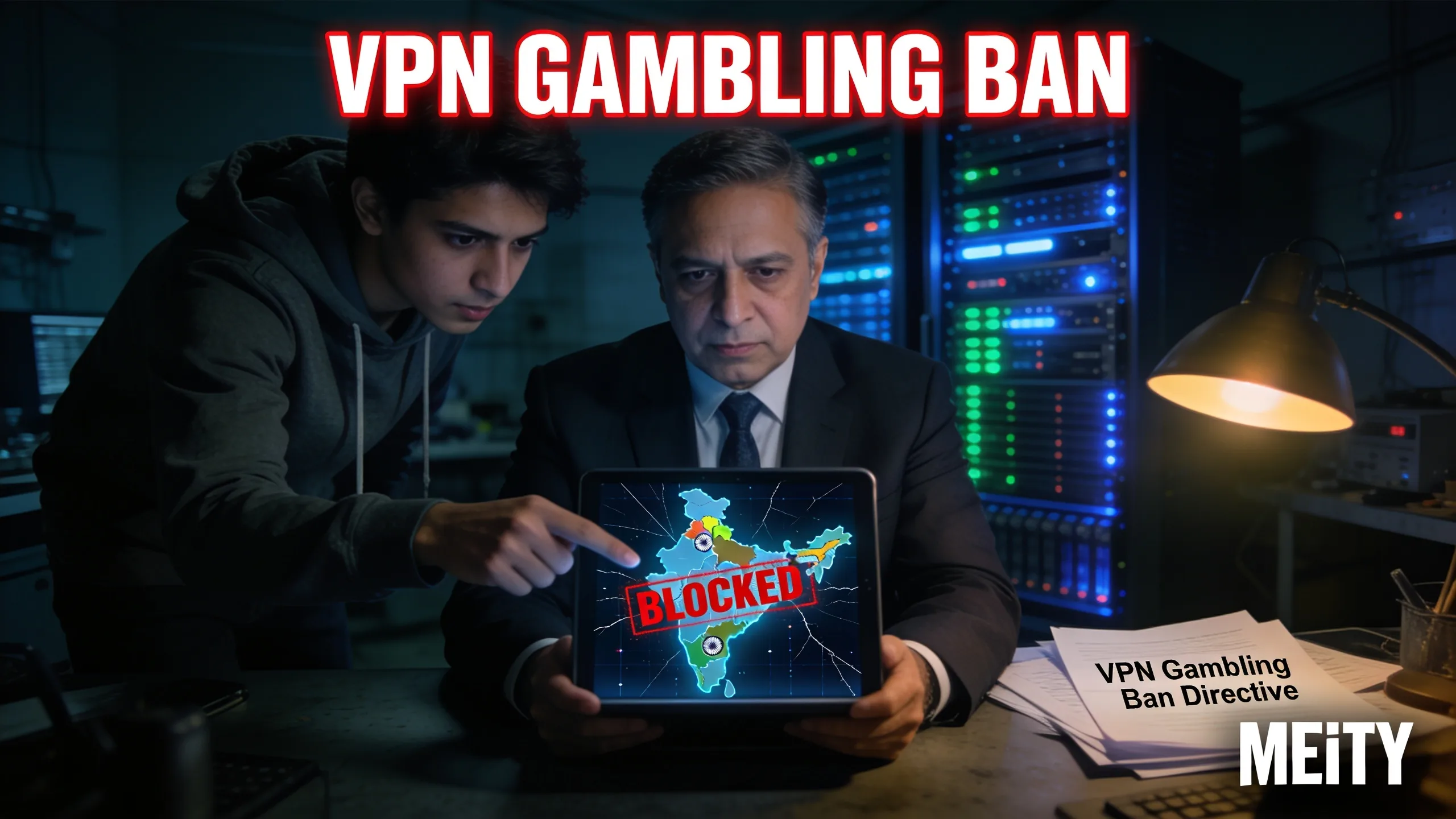
India's crackdown on offshore gambling platforms took a new turn on 3 July 2026 when reports emerged that MeitY is drafting a sweeping VPN regulatory framework that would compel providers to actively block access to banned betting and casino sites — or face criminal penalties. The proposed rules target providers that removed their physical servers from India to dodge the CERT-In data-retention directive of 2022, and represent the government's most aggressive attempt yet to close the loophole that millions of Indian bettors are already exploiting.
The move comes two months into the live operation of the Promotion and Regulation of Online Gaming (PROG) Act 2025 and its accompanying PROG Rules 2026, which came into force on 1 May 2026 and impose a total ban on online money games — covering real-money casino, poker, fantasy sports, and sportsbook products. India's iGaming sector, which served an estimated 45 crore users and was projected to reach ₹316 billion (roughly $3.8 billion) by 2027, has been gutted at the domestic level. The new VPN crackdown signals that New Delhi is now attempting to seal the offshore escape route too.
In This Article
MeitY's New VPN Directive Explained
According to reporting by TechRadar and Outlook India on 3 July 2026, leaked proposals from the Indian government include requirements that offshore VPN companies must establish a physical corporate presence in India and appoint local compliance officers to serve as direct government liaisons. More significantly, providers that refuse to block access to platforms on MeitY's banned gambling list could see local employees face criminal prosecution.
The trigger is simple: the CERT-In 2022 data-logging directive — which required VPN firms to retain user names, verified IP addresses, and usage patterns for five years and surrender them on demand — failed entirely. Major providers including ExpressVPN, NordVPN, Surfshark, Hide.me, and Proton VPN responded by pulling their physical servers out of India, making compliance technically impossible. A senior government official acknowledged the gap directly: "They have simply refused to comply. So, the need for a full-fledged law is being felt."
An earlier April 2026 MeitY order had already instructed VPN providers to block the decentralised prediction platform Polymarket, warning of legal repercussions for non-compliance. That directive tested the new enforcement posture under the PROG framework. The incoming VPN law scales that approach across all banned gambling and betting platforms.
The PROG Framework: What's Already Banned
The PROG Act 2025, passed by Parliament in August 2025, represents India's first dedicated central legislation governing online gaming. Its accompanying rules, notified by MeitY on 22 April 2026 and operative from 1 May 2026, classify all online games into three categories:
- Online Money Games — entirely prohibited, including advertising and payment processing
- Online Social Games — permitted, subject to registration and user-safety requirements
- E-Sports — formally recognised as skill-based competitive sport; eligible for registration with the new regulator
The Online Gaming Authority of India (OGAI), constituted as an attached office of MeitY and headquartered in Delhi, is the enforcement body. It maintains the official banned-games list, classifies new products through a 90-day determination process, coordinates with the Enforcement Directorate and banking regulators, and fields user complaints through a three-tier grievance mechanism. Banks and payment processors are explicitly prohibited from handling transactions related to banned platforms. Criminal liability for operating an online money game starts at ₹1 crore fine and three years' imprisonment for a first offence, rising to ₹2 crore and five years for repeat violations.
Enforcement Reality: Why This Is Hard to Execute
The practical enforcement picture is more complicated than the legislative text suggests. In OGAI's second operational week, formal blocking coordination against offshore platforms identified as serving Indian users moved through MeitY's Section 69A IT Act / Section 14 PROG Act machinery, with payment-system advisories naming specific merchant identifiers for blocklisting. But VPN usage surged in response — a pattern India has seen before, including a dramatic VPN spike when the government blocked Telegram temporarily due to exam-fraud concerns.
Legal experts have flagged an inherent conflict in demanding that VPNs become active enforcers of content blocks. Traffic inspection and selective blocking would require VPN providers to abandon the core architecture of their products. Compliance counsel expect the first writ challenges to early blocking orders to be filed at the High Court level by intermediaries questioning whether the classification stage was satisfied independently of the blocking step.
Impact on Offshore Operators and Indian Bettors
| Stakeholder | Current Situation | Risk Under New VPN Rules |
|---|---|---|
| Indian Bettors | Using VPNs to reach offshore casino/sportsbook sites blocked by OGAI | Access blocked at VPN layer if providers comply; grey-market VPNs likely to proliferate |
| Offshore Operators (licensed abroad) | Domain blocks via Section 69A; payment processor advisories; no Indian licence pathway | Deeper de-platforming across payment rails and app stores; no legal route to serve Indian users |
| VPN Providers | Servers removed from India; operating without local compliance obligations | Criminal liability for local employees if mandatory Indian office is established and orders are defied |
| Domestic RMG Platforms | Shut down or pivoting to free-to-play; over $840 million in write-downs reported in first 90 days post-PROG | Indirect benefit if offshore competition is throttled, but own business models remain prohibited |
| Indian Esports Sector | Formally recognised and eligible for OGAI registration under PROG Rules 2026 | Stands to gain investment redirected from RMG; unaffected by VPN restrictions |
The policy paradox critics have long warned about is now measurable. India had an estimated ₹1,50,000 crore ($18 billion) in annual losses attributed to online money gaming before the ban. Prohibition has not eliminated demand — it has rerouted it through offshore platforms and VPNs, creating precisely the regulatory blind spot the government sought to eliminate. A November 2025 Enforcement Directorate action froze ₹523 crore in deposits and arrested two gaming company co-founders on money-laundering charges — but those prosecutions relied on pre-PROG state gaming laws, not the new central framework.
What Happens Next
Three developments are worth tracking over the next 60 days. First, whether the draft VPN framework is formally gazetted or remains in consultation — the leaked proposals have not yet been confirmed as finalised. Second, OGAI's first wave of esports registration certificates are expected in the coming weeks, which will establish precedent for the determination process. Third, the Karnataka, Madhya Pradesh, and Delhi High Courts are currently hearing petitions challenging the constitutional validity of the PROG Act itself; any interim stay would significantly complicate enforcement.
For Indian punters currently using VPNs to access offshore sportsbooks and casinos, the legal position is unchanged for now: enforcement under the PROG Rules targets operators and platforms, not individual users. But the proposed VPN law, if enacted as leaked, would constrict access further by pressuring the tools bettors rely on to reach those platforms in the first place.
Sources
Primary sources consulted for this report, listed in order of directness. Government-notified documents and official statements are cited first.
- iGaming Business — India Publishes New Online Gaming Regulations ↗ https://igamingbusiness.com/legal-compliance/regulation/india-publish-new-online-gaming-regulations/
- TechRadar — India Weighs Stricter VPN Regulations ↗ https://www.techradar.com/vpn/vpn-privacy-security/india-weighs-stricter-vpn-regulations-to-stop-users-from-bypassing-internet-blocks
- Outlook India — Will VPNs Be Banned in India? ↗ https://www.outlookindia.com/national/outlook-explains-will-vpns-be-banned-in-india-what-the-new-rules-could-mean-for-users
- iPleaders — OGAI: Powers, Registration & Enforcement Under PROGA 2026 ↗ https://blog.ipleaders.in/online-gaming-authority-india-ogai/
- Wikipedia — Promotion and Regulation of Online Gaming Act 2025 ↗ https://en.wikipedia.org/wiki/Promotion_and_Regulation_of_Online_Gaming_Act,_2025
- Drishti IAS — PROG Rules 2026 Explainer ↗ https://www.drishtiias.com/daily-updates/daily-news-analysis/promotion-and-regulation-of-online-gaming-rules-2026
A blanket prohibition sidelines proven regulatory models that channel demand into transparent, well-supervised markets that protect players and generate tax revenue. Instead, it risks driving activity underground, where consumer harm is harder to prevent and oversight is minimal.
— Segev LLC, International Gaming Law Firm · Published commentary on India's PROG Act, August 2025