
India Supreme Court Kills Online Betting's Skill Defence
Landmark ruling in Junglee Games confirms states can ban all real-money wagering; retrospective 28% GST threatens to erase $30 billion from operators.
Category: News - IN · By Growl Games Editorial Team · Wed Jun 10 2026 · Updated Thu Jul 23 2026
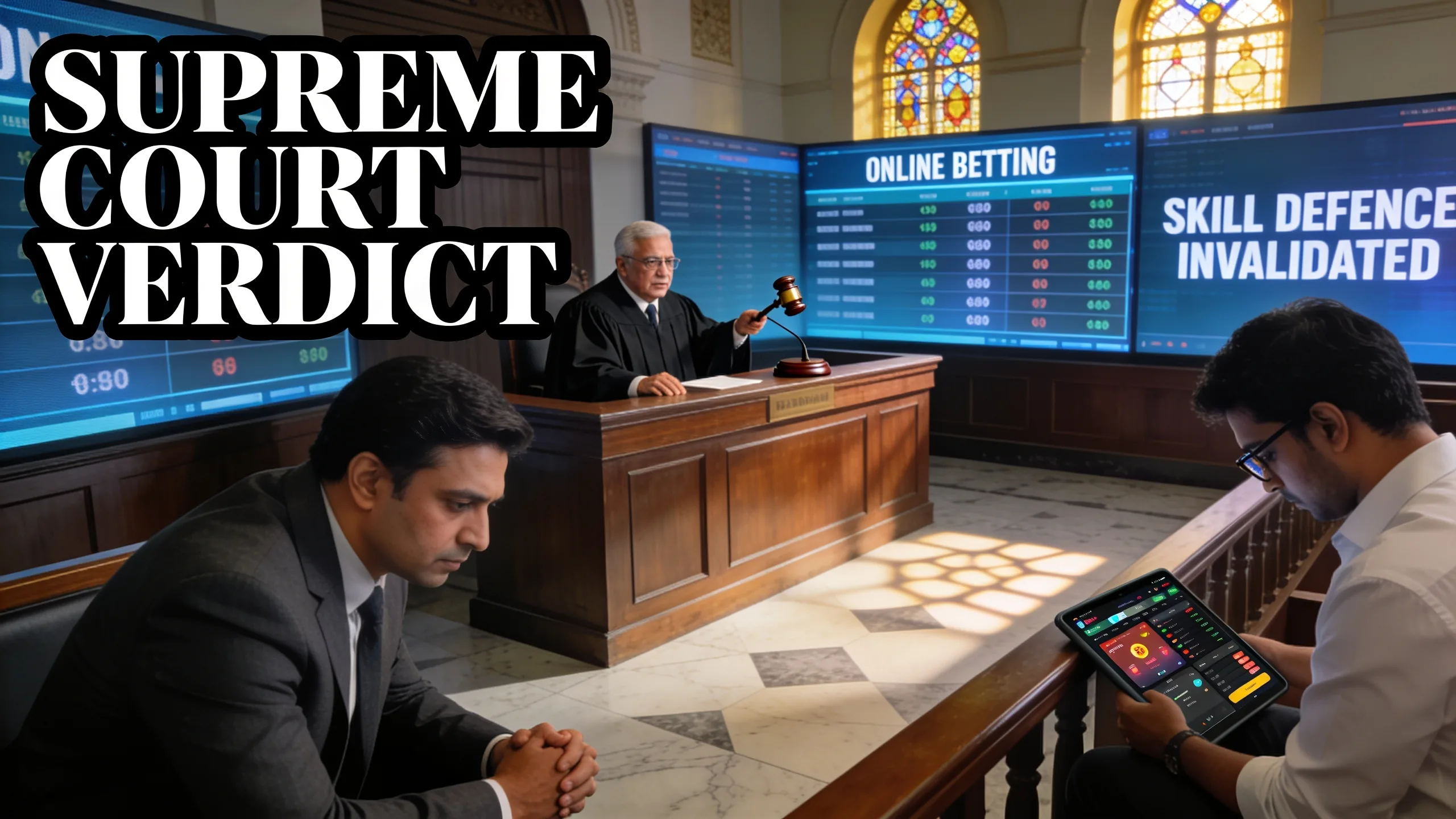
India's online real-money gaming sector has been dealt a triple blow that operators and bettors cannot easily recover from. On 27 May 2026, the Supreme Court of India handed down two companion judgments that erase the legal distinction between games of skill and gambling once stakes are involved — a cornerstone argument the industry had relied on for over a decade. Combined with the Promotion and Regulation of Online Gaming Act 2025 (PROGA), which came into force on 1 May 2026, these rulings amount to a constitutional, legislative and fiscal reckoning arriving almost simultaneously.
The lead case, State of Tamil Nadu & Ors. v. Junglee Games India Pvt. Ltd. & Ors. (2026 INSC 594), was decided by Justices JB Pardiwala and R Mahadevan and resolved a long-running dispute over state laws in Tamil Nadu and Karnataka that criminalised online wagering on rummy, poker and fantasy sports. At the same time, a companion ruling in DGSTI & Ors. v. Gameskraft Technologies Pvt. Ltd. & Ors. confirmed that a 28% Goods and Services Tax (GST) applies on the full value of every stake placed on every platform — not merely the platform fee — effective retrospectively from 1 July 2017. Platforms including Dream11, MPL, PokerBaazi and Zupee had already halted real-money operations when PROGA took effect.
In this article
- The triple blow: PROGA, Junglee Games & GST
- Why the skill-vs-chance argument collapsed
- State autonomy upheld under PROGA
- The retrospective GST liability
- What it means for operators and bettors
The triple blow: PROGA, Junglee Games & GST
PROGA banned real-money online games outright at the federal level in August 2025, with enactment on 1 May 2026. The accompanying Regulation of Online Gambling Rules 2026 created a centralised regulator and introduced a three-way classification: prohibited online money games (wagering on uncertain outcomes), permissible social games, and regulated e-sports. The law also criminalises advertising for banned products, with penalties of up to five years' imprisonment.
The Supreme Court's judgments three weeks later provided constitutional backing for that prohibition. The bench confirmed that staking money on any uncertain outcome — regardless of how much skill the underlying game requires — constitutes "betting" under Entry 34, List II of the Seventh Schedule of the Constitution, falling squarely within state legislative competence. Industry groups had argued that skill-based games were protected commercial activity under Article 19(1)(g); the court rejected that argument without qualification.
Why the skill-vs-chance argument collapsed
For years, operators anchored compliance strategies on a line of High Court rulings — including a 2019 Bombay High Court decision protecting Dream11's fantasy sports as games of skill. The Supreme Court has now overturned that protection. Its core holding is that once stakes enter any game, the activity becomes res extra commercium — outside the scope of protected commerce — and the question of Article 19 constitutional protection does not arise at all.
- The Madras High Court and Karnataka High Court had earlier struck down state bans as unconstitutional; both decisions were set aside.
- Key provisions of the Tamil Nadu Gaming and Police Laws (Amendment) Act, 2021 and amendments to the Karnataka Police Act, 1963 were restored.
- The court explicitly noted that smartphones now function as "virtual common gambling houses," framing online wagering as a public-health and public-order matter rather than purely a commercial one.
State autonomy upheld under PROGA
A related question raised by Tamil Nadu and Karnataka was whether the new federal PROGA framework superseded individual state authority. The Supreme Court answered clearly that it does not. States retain full legislative power to regulate, restrict or prohibit online gaming activities where measures serve public order and consumer protection — even where PROGA's own classification might differ.
This matters for operators because it means a patchwork of state-level restrictions can sit on top of the federal ban. States with historically stricter gambling laws — such as Telangana, Andhra Pradesh and Chhattisgarh — retain authority to enforce their own prohibitions independently of any future federal relaxation. The ruling is expected to trigger further state-level action against skill-gaming and wagering products.
The retrospective GST liability
The companion GST ruling in Gameskraft may prove the most financially devastating. Operators had contested whether GST should apply only to the platform's commission or to the full pool of stakes wagered. The Supreme Court confirmed the latter — full-value taxation — and made it retrospective to 1 July 2017, when GST was first introduced.
| Platform Type | GST Base (pre-ruling) | GST Base (post-ruling) | GST Rate |
|---|---|---|---|
| Fantasy Sports (e.g. Dream11) | Platform fee / GGR | Full stakes deposited | 28% |
| Online Rummy / Poker (e.g. PokerBaazi) | Platform fee / GGR | Full stakes deposited | 28% |
| Online Casinos (Goa / Sikkim licensed) | Gross Gaming Revenue | Full stakes deposited | 28% |
| Sports Wagering / Sportsbook Apps | Margin / commission | Full stakes deposited | 28% |
Retrospective demands are reported to total approximately ₹2.5 lakh crore (~$30 billion), a figure comparable to the annual revenue of most Indian states. More than 30,000 industry jobs have already been lost since PROGA's enactment, with domestic venture-backed operators like MPL and Zupee announcing restructurings within weeks of the ruling.
What it means for operators and bettors
For international operators and bettors targeting India, the practical effect is a market that is now closed at the federal level and increasingly locked at state level too. Players pushed off domestic platforms are already migrating to offshore sites, a dynamic that regulators acknowledge but have limited tools to address given India's existing VPN and payment-blocking infrastructure.
- Offshore sportsbooks and casinos remain accessible via VPN but operate in legal grey territory; advertising into India is now explicitly criminalised under PROGA.
- Goa and Sikkim land-based casino licences are unaffected by the ruling; offshore vessels moored in the Mandovi River continue to operate.
- Horse-race betting retains its statutory exemption and is not affected by the Junglee Games ruling.
- The PROGA central regulator is expected to issue licensing guidance for permissible social and e-sports products in late 2026, creating a narrow compliant corridor operators may seek to exploit.
- Any operator with existing Indian user data faces exposure under the retrospective GST demands if payments can be traced back to Indian residents.
Sources
Reporting is drawn from court judgment texts, legal analysis, and specialist iGaming trade coverage. Primary judicial sources are listed first.
- Supreme Court of India — 2026 INSC 594 Judgment Text ↗ https://api.sci.gov.in/supremecourt/2021/27706/27706_2021_7_1503_71652_Judgement_27-May-2026.pdf
- MeitY — Promotion and Regulation of Online Gaming Act 2025 (PROGA) ↗ https://www.meity.gov.in/static/uploads/2025/10/8a7f103cefc68ed8aaa2ebc9a2ed7c13.pdf
- Bar & Bench — All in: The online real money gaming industry goes bust ↗ https://www.barandbench.com/columns/all-in-the-online-real-money-gaming-industry-goes-bust
- iGaming Expert — India Supreme Court upholds state rights on RMG laws ↗ https://igamingexpert.com/regions/asia/india-state-rights-rmg/
- iGaming Business — Government of India publishes new online gaming regulations ↗ https://igamingbusiness.com/legal-compliance/regulation/india-publish-new-online-gaming-regulations/
- World Casino Directory — India's Supreme Court Rules on Online Betting ↗ https://news.worldcasinodirectory.com/indias-supreme-court-rules-on-online-betting-states-can-regulate-wagering-123052
Once stakes enter any game, regardless of the skill element involved, the activity becomes res extra commercium — operators lose all constitutional protection under Article 19.
— Justices JB Pardiwala & R Mahadevan, Supreme Court of India · 2026 INSC 594, 27 May 2026