
India Real-Money Gaming Ban: Supreme Court Upholds ₹2.5 Lakh Crore GST Blow
India's PROGA ban and a retrospective 28% GST ruling from the Supreme Court have ended the country's real-money online gaming industry, triggering $30 billion in tax demands.
Category: News · By Growl Games Editorial Team · Mon Jun 29 2026 · Updated Tue Jul 21 2026
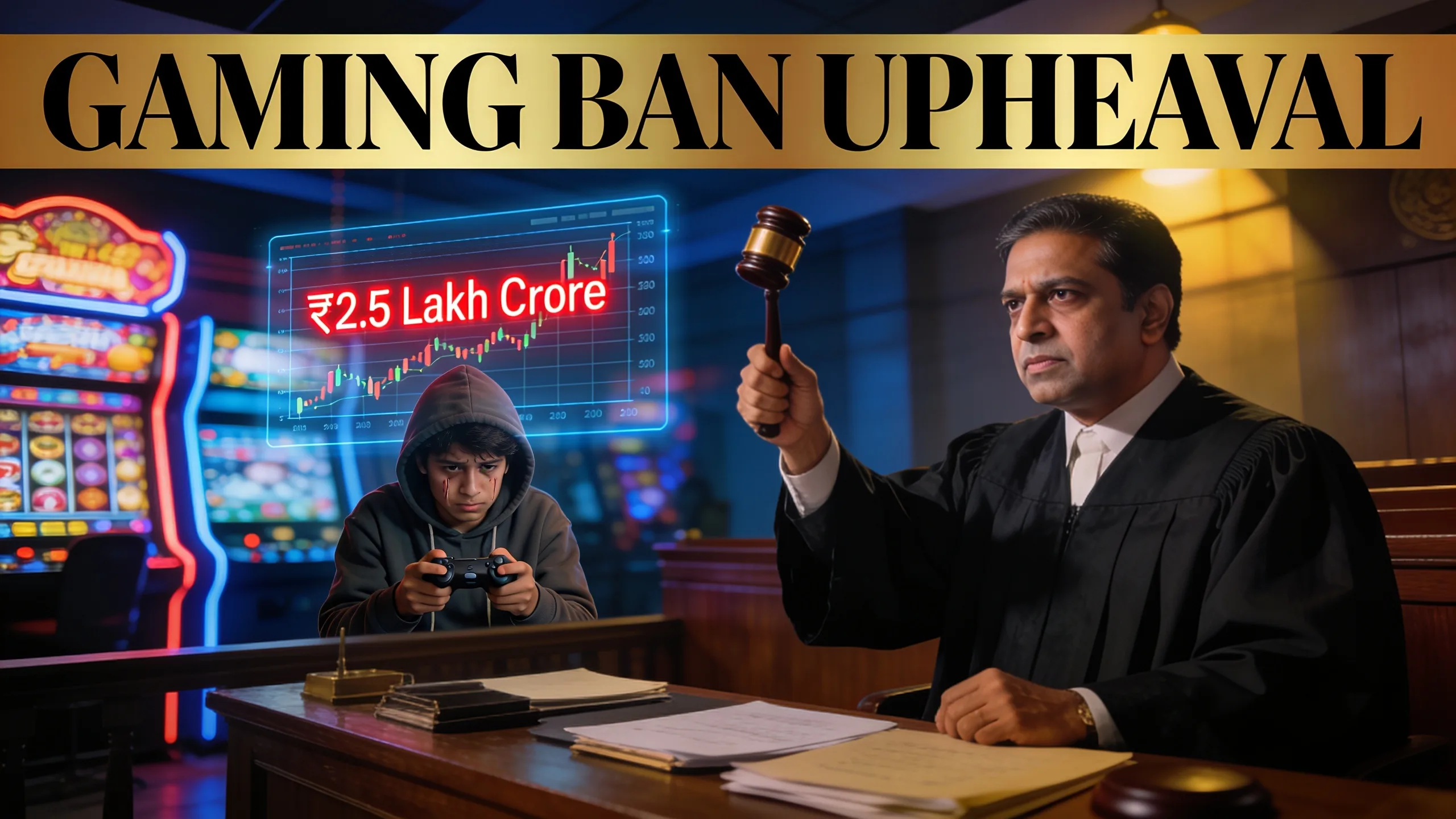
India's real-money gaming sector has been hit by a regulatory one-two punch with no precedent in the country's digital economy. On 1 May 2026, the Promotion and Regulation of Online Gaming Act 2025 (PROGA) came into full force, imposing an absolute federal ban on all online money games. Then, on 27 May 2026, the Supreme Court of India delivered a second blow — upholding a 28% GST levy on the full face value of every player deposit, back-dated to 2017, generating retrospective tax demands estimated at nearly ₹2.5 lakh crore (~$30 billion).
Together, the two actions have effectively closed the market. Major platforms — including Dream11, Mobile Premier League (MPL), Gameskraft, PokerBaazi, and Zupee — had already suspended real-money operations before the ruling landed. Flutter Entertainment shut down its Junglee Games venture and booked an impairment charge of approximately $560 million. Nazara Technologies reported a consolidated net loss of ₹29.35 crore for Q2 FY2025–26, including a ₹914.7 crore write-down on its investment in Moonshine Technologies.
In This Article
PROGA Goes Live: What the Ban Covers
The Promotion and Regulation of Online Gaming Act 2025, passed by both the Lok Sabha and Rajya Sabha in August 2025 and receiving presidential assent on 22 August 2025, was operationalised through the Promotion and Regulation of Online Gaming Rules 2026, notified by MeitY on 22 April 2026 and effective 1 May 2026. The law establishes three categories of online games:
- Online Money Games — any game where users pay fees or deposit funds in expectation of monetary return. Entirely prohibited, with no skill-based exemption and no licensing path.
- Online Social Games — recreational or educational games with subscription or one-time fees and no monetary stakes. Generally permitted; registration is required only when specifically mandated by the Online Gaming Authority of India (OGAI).
- E-Sports — recognised competitive skill-based titles. Permitted, subject to OGAI registration for certified categories.
The penalties for offering, advertising, or facilitating payments for prohibited money games are severe: up to ₹1 crore and three years' imprisonment for operators, and up to ₹50 lakh and two years for advertisers. Under PROGA, banks and payment gateways are also required to verify a game's status before processing any transaction. The OGAI — a six-member, digital-first regulator attached to MeitY and headquartered in Delhi — went live on 1 May 2026, with power to block platform payments, classify games, and adjudicate user complaints within 90 days.
The Supreme Court GST Ruling Explained
On 27 May 2026, a bench of Justice J B Pardiwala and Justice R Mahadevan ruled in Directorate General of GST Intelligence v. Gameskraft Technologies Pvt. Ltd. that online gaming platforms involving monetary stakes supply "actionable claims" — goods under Section 2(52) of the CGST Act — and that the operators are the suppliers, not mere intermediaries. GST therefore applies at 28% on the full face value of every deposit, not on gross gaming revenue.
Crucially, the court held that the October 2023 GST Council amendments were merely clarificatory, and therefore retrospective from 2017. This means tax demands cover the period when platforms believed they were paying the correct rate on commissions only. The ruling dismissed petitions from Gameskraft, Games24x7, Head Digital Works (A23), Play Games24x7, Baazi Networks, and the E-Gaming Federation, and reinstated a ₹21,000 crore show-cause notice against Gameskraft that a Karnataka High Court had previously quashed. The court also rejected the skill-game defence outright: when a monetary stake is placed on an uncertain outcome, the nature of the game — skill or chance — ceases to be legally relevant for GST purposes.
Industry Fallout: Shutdowns, Write-downs, and Layoffs
India's real-money gaming sector had employed roughly 2 lakh workers directly and generated approximately ₹20,000 crore in GST annually before the ban. The combined effect of PROGA and the Supreme Court ruling has made the sector commercially unviable for most operators.
| Operator / Investor | Impact | Amount / Detail |
|---|---|---|
| Flutter Entertainment | Shut down Junglee Games; impairment charge | ~$560 million |
| Nazara Technologies | Net loss Q2 FY2025–26; write-down on Moonshine Technologies | ₹914.7 crore write-down; ₹29.35 crore net loss |
| Head Digital Works (A23) | Foreign investor Clairvest write-off; staff cut from 606 to 178 | ₹760 crore write-off |
| Dream Sports (Dream11) | Ceased real-money ops Jan 2026; pivot to free-to-play, FanCode, DreamSetGo | 90%+ of revenue previously from Dream11 |
| Sector-wide GST liability | Retrospective demands from 2017 across operators, casinos, turf clubs | ~₹2.5 lakh crore (~$30 billion) |
Industry lawyers have warned that the retrospective tax liability alone exceeds the total revenue many operators ever generated. Legal analysts at Krida Legal noted that for companies already unable to operate under PROGA, the GST demands could force widespread insolvency filings at the NCLT.
The Offshore Shift: Where Players Are Going
Evidence from the ground suggests the ban is doing exactly what critics predicted: pushing demand offshore rather than eliminating it. A CUTS International survey of 1,000 former real-money gaming users in Delhi NCR found that use of offshore betting platforms rose from 68.3% before the ban to 82.0% after it. Daily offshore use jumped from 3.4% to 42.3%, while monthly spending between ₹5,000 and ₹9,999 climbed from 7.6% to 26.2% of users. PROGA claims jurisdiction over offshore platforms, but enforcement against sites operating from outside India remains practically limited.
The OGAI has the authority to block UPI payments and direct financial intermediaries to refuse transactions, but these measures affect domestic-facing apps rather than browser-based offshore operators using foreign payment rails. Regulatory risk analysis firm RegTechTimes noted that stringent domestic prohibition without adequate offshore enforcement infrastructure risks creating a shadow economy that is largely invisible to regulators.
What Remains Legal: Esports, Social Games, and Skill Formats
PROGA is explicitly not a ban on all online gaming. Platforms offering subscription-based social games, free-to-play titles, and certified esports remain legally viable. The OGAI applies a five-factor determination test examining fees, monetary return expectations, revenue models, and whether in-game rewards can be redeemed or transferred outside the game. OGAI-issued Certificates of Registration for permitted titles are valid for up to 10 years.
A number of industry participants are retooling accordingly. Dream Sports is leaning into FanCode (media) and DreamSetGo (sports travel). Indie studios and esports organisations have been largely unaffected, and some analysts view the ruling as clearing space for non-wagering gaming investment. What the sector cannot do is revert to its prior model: PROGA removes the skill-game exemption that courts had previously granted, and the Supreme Court's GST ruling makes any attempt to re-classify stake-based games as non-gambling commercially and legally futile.
Sources
Primary legal documents and regulatory notifications cited first, followed by specialist iGaming and legal publications used for cross-verification.
- Legal 500 — India's Online Gaming Reset: Decoding PROGA and the 2026 Rules ↗ https://www.legal500.com/developments/thought-leadership/indias-online-gaming-reset-decoding-proga-and-the-2026-rules/
- Maheshwari & Co — PROG Rules 2026: India Online Gaming Law ↗ https://www.maheshwariandco.com/blog/prog-rules-2026-india-online-gaming-law/
- CA Club India — Supreme Court on GST & Online Gaming (Civil Appeal Nos. 8241–8244 of 2026) ↗ https://www.caclubindia.com/articles/supreme-court-on-gst-online-gaming-tax-applies-on-betting-and-gambling-irrespective-of-skill-or-chance-55335.asp
- Outlook Respawn — India's Supreme Court Delivered the Final Blow to Real-Money Gaming ↗ https://respawn.outlookindia.com/gaming/gaming-originals/the-legal-battle-that-dismantled-indias-real-money-gaming-sector
- iGaming Expert — India Sides With the Taxman on Retro GST Charges ↗ https://igamingexpert.com/regions/asia/india-gst-gambling/
- iGaming Business — Government of India Publishes New Online Gaming Regulations ↗ https://igamingbusiness.com/legal-compliance/regulation/india-publish-new-online-gaming-regulations/
- Bar and Bench — India's Gaming Industry After PROGA: From Grey Zones to Guardrails ↗ https://www.barandbench.com/view-point/indias-gaming-industry-after-proga-from-grey-zones-to-guardrails
- MediaNama — Delhi HC Orders Blocking of Rogue Domains; CUTS International Offshore Survey Data ↗ https://www.medianama.com/2026/03/223-delhi-hc-blocks-fake-dream11-websites/
When the element of betting and gambling enters the picture, the nature of the game ceases to be of relevance.
— Justices J B Pardiwala & R Mahadevan, Supreme Court of India · DGGI v. Gameskraft Technologies, Civil Appeal Nos. 8241–8244 of 2026, 27 May 2026