
India Real-Money Gaming Ban Now Law as GST Ruling Adds ₹91,685 Cr Tax Blow
Supreme Court's Gameskraft judgment and PROG Rules 2026 delivered a one-two punch that ended India's $3.5 billion domestic real-money gaming industry.
Category: News · By Growl Games Editorial Team · Sat Jun 27 2026 · Updated Tue Jul 21 2026
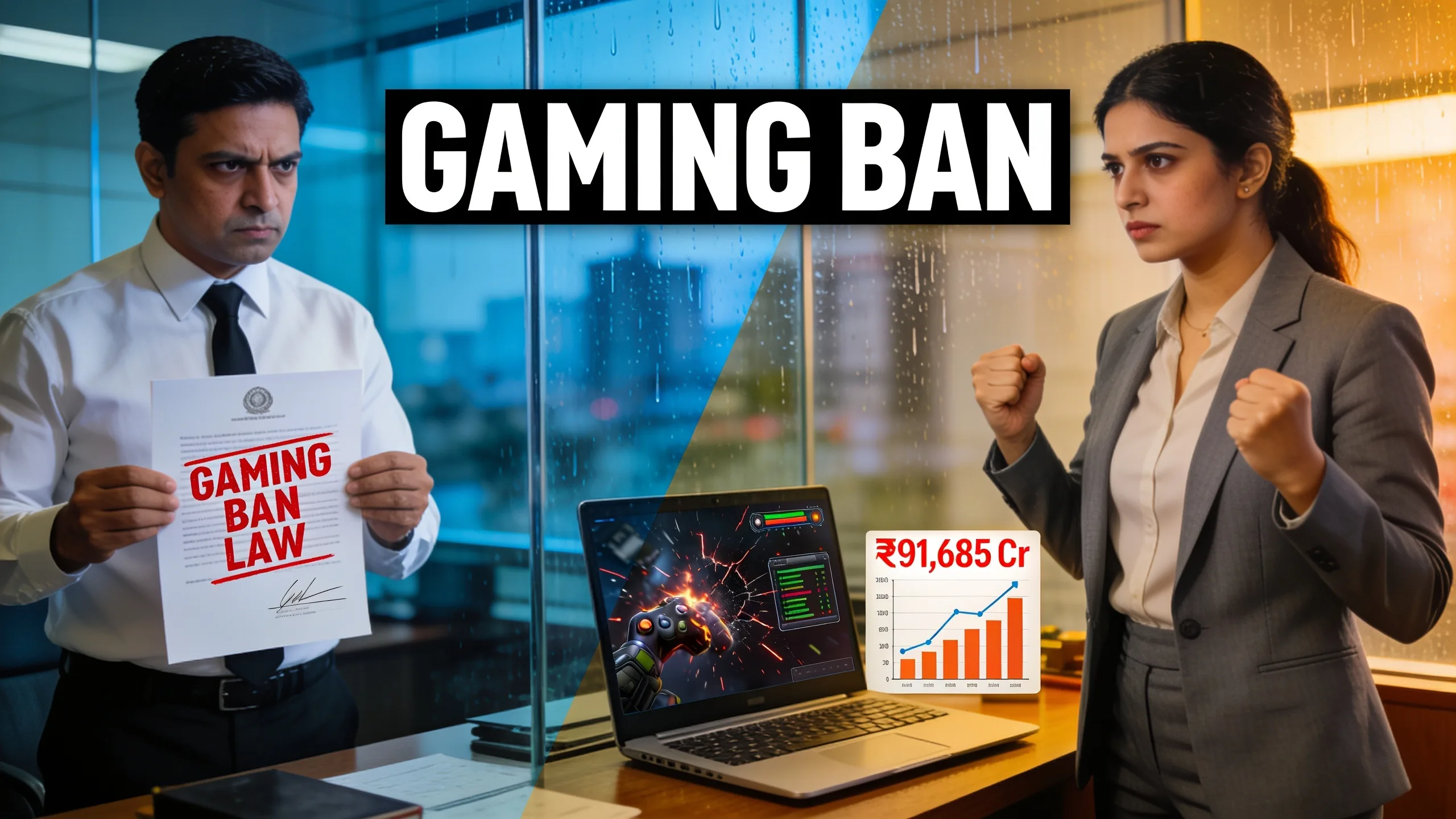
India's real-money gaming sector was dealt its death blow in two acts. On 1 May 2026, the Promotion and Regulation of Online Gaming (PROG) Rules, 2026 came into force, making the PROG Act, 2025 fully operational and banning all online money games with criminal penalties of up to 3 years imprisonment and fines of up to ₹1 crore. Then, on 27 May 2026, the Supreme Court's landmark Gameskraft ruling upheld retrospective 28% GST on the full face value of player stakes — validating back-dated tax demands that analysts estimate at a combined ₹91,685 crore for digital operators alone, rising to over ₹1,08,500 crore when casino operators are included.
The two events, separated by less than four weeks, effectively dismantled what had been a $3.5 billion domestic RMG industry employing tens of thousands. Platforms including Dream11, Games24x7, Mobile Premier League (MPL), Head Digital Works (A23 Rummy), WinZO, and Baazi Games suspended real-money operations after the PROG Rules notification. The Supreme Court ruling means those same platforms now owe tax on every rupee staked under their old operating models. For an industry that had argued for years that its products were constitutionally protected games of skill, the twin blow removed both the legal and fiscal floor simultaneously.
In This Article
PROG Rules 2026 — What Came Into Force on 1 May
The Promotion and Regulation of Online Gaming Act, 2025, passed by Parliament on 21–22 August 2025 and receiving Presidential assent that same week, created India's first dedicated central legislation for online gaming. Its implementing rules were notified by MeitY (Ministry of Electronics and Information Technology) on 22 April 2026 and took effect 1 May 2026.
The Rules established the Online Gaming Authority of India (OGAI) — a six-member, digitally-first regulatory body headquartered in Delhi, chaired by the Additional Secretary of MeitY and including joint-secretary-level representatives from the Ministries of Home Affairs, Finance, Information and Broadcasting, Youth Affairs and Sports, and Law and Justice. The framework draws a hard three-way classification:
- Online Money Games — any game where players deposit funds with an expectation of monetary return. Completely prohibited, regardless of skill content. Banks and payment processors are explicitly barred from facilitating transactions.
- E-Sports — competitive, multiplayer skill-based formats recognised under the National Sports Governance Act, 2025. Permitted and subject to mandatory OGAI registration.
- Online Social Games — non-monetary recreational games. Permitted; selective risk-based registration applies.
The OGAI's "determination" process — classifying individual games — must be completed within 90 days of a complete application. Games landing in the money-game category face an immediate shutdown notice. The three-tier grievance system (provider → OGAI → Secretary MeitY) requires each level to respond within 30 days.
The Gameskraft Ruling — Skill vs Chance Made Irrelevant
The Supreme Court judgment in Directorate General of GST Intelligence v. Gameskraft Technologies Private Limited (2026 INSC 595), handed down on 27 May 2026 by a bench of Justices J.B. Pardiwala and R. Mahadevan, ran to 316 pages and settled three overlapping areas of law in one stroke.
At the centre of the dispute was a show-cause notice dated 23 September 2022 demanding ₹2,09,89,31,31,501 (approximately ₹21,000 crore) from Bengaluru-based Gameskraft — a sum that dwarfed the company's entire revenue of roughly ₹4,650 crore for the period 2017–2022. The Karnataka High Court had quashed that notice in May 2023, ruling online rummy a game of skill outside betting and gambling. The Supreme Court reversed that decision entirely.
The ruling rested on a single principle: the character of betting and gambling does not depend on whether the underlying activity requires skill or chance — it depends on whether stakes are placed on uncertain outcomes. Once money enters the picture, the skill-vs-chance distinction becomes legally irrelevant for GST purposes. The court further held that the 2023 legislative amendments to the CGST Act clarifying this position were not new law but simply clarificatory, making them applicable retrospectively to all past transactions. This opened the way for the Directorate General of GST Intelligence (DGGI) to pursue all outstanding notices across the sector.
The Damage: Jobs, Write-downs, Offshore Flight
The immediate operational damage began before either event formally landed. Following Presidential assent to PROGA in August 2025, banks and payment gateways withdrew services from RMG platforms immediately, citing penal exposure. Head Digital Works (A23 Rummy) disclosed in court filings that its workforce dropped from 606 employees to 178 within months, and foreign investor Clairvest reportedly wrote off its entire ₹760 crore investment. Games24x7, MPL, and Baazi Games undertook further layoffs. Total industry job losses exceeded 3,000 following the May 2026 enforcement date.
A study by public policy think tank CUTS International found that usage of offshore betting platforms rose from approximately 68.3% to 82% of the betting population after the domestic prohibition came into effect — precisely the outcome critics of the blanket ban had predicted. RMG asset write-downs across the industry had already exceeded $840 million by mid-November 2025, before the Gameskraft ruling added a retrospective tax liability running into tens of thousands of crores.
GST + PROGA: What Each Blow Means for Operators
| Factor | PROG Act / Rules 2026 | Gameskraft GST Ruling |
|---|---|---|
| Date effective | 1 May 2026 (Rules); 22 Aug 2025 (Act) | 27 May 2026 (judgment date) |
| Core impact | Complete ban on real-money online games; criminal liability for operators, advertisers, payment facilitators | Retrospective 28% GST on full player stake value — not platform fee — across all prior years of operation |
| Financial exposure | Up to ₹1 crore fine + 3 yrs imprisonment per violation | Total industry liability estimated at ₹91,685 crore (digital) to ₹1,08,500 crore (incl. casinos) |
| Skill-vs-chance test | Abolished — stake involvement alone determines classification | Abolished — skill irrelevant once money is at stake (following RMDC precedent reinterpretation) |
| Regulator | OGAI (MeitY) — classification, registration, enforcement | DGGI — enforcement of outstanding SCNs now fully restored |
| Who is personally liable | Operators, advertisers, senior payment executives (D&O exposure noted) | Company and key managerial personnel named in original notices |
What Happens Next — Courts, States, and Offshore Platforms
Multiple petitions challenging the constitutional validity of PROGA — filed by Head Digital Works, Clubboom 11 Sports, Bagheera Carrom, and others — remain pending before the Supreme Court under Articles 14 and 19(1)(g). The petitioners argue that the blanket prohibition on stake-based games, including those with a skill element, violates fundamental rights to carry on a business. The court has consolidated these petitions; no stay has been granted.
Separately, a June 2026 Supreme Court ruling upheld state governments' independent authority to regulate gaming within their jurisdictions alongside the central PROGA framework, following requests for clarity from Tamil Nadu and Karnataka. States retain the power to restrict or prohibit online gaming where they deem it against public welfare — potentially opening a patchwork of additional state-level restrictions on top of the central ban.
For India-facing offshore platforms, the enforcement trajectory is unambiguous. Between 2022 and June 2025, 1,524 betting and gambling websites and mobile apps were blocked by MeitY under Section 69A of the IT Act. The PROG framework extends these powers explicitly to offshore operators accessible in India, and banks are now active compliance gatekeepers rather than passive processors. The offshore bettor shift documented by CUTS suggests the prohibition is pushing demand underground rather than eliminating it — a regulatory reality that will continue to define the Indian market for the foreseeable future.
Sources
Primary sources — government notices, court filings, and official regulatory publications — are listed first. Secondary legal and industry analysis follows.
- Supreme Court of India — Gameskraft Judgment 2026 INSC 595 ↗ https://www.verdictum.in/supreme-court/directorate-general-of-goods-and-services-tax-intelligence-hqs-v-gameskraft-technologies-private-limited-2026-insc-595-28-gst-1615025
- iGaming Business — PROG Rules 2026 Come Into Force ↗ https://igamingbusiness.com/legal-compliance/regulation/india-publish-new-online-gaming-regulations/
- Mondaq — PROG Rules 2026: A New Era for India's Online Gaming ↗ https://www.mondaq.com/india/gaming/1804174/the-prog-rules-2026-ushering-in-a-new-era-for-indias-online-gaming-industry
- Outlook Respawn — The Legal Battle That Dismantled India's RMG Sector ↗ https://respawn.outlookindia.com/gaming/gaming-originals/the-legal-battle-that-dismantled-indias-real-money-gaming-sector
- Legal 500 — India's Online Gaming Reset: Decoding PROGA and the 2026 Rules ↗ https://www.legal500.com/developments/thought-leadership/indias-online-gaming-reset-decoding-proga-and-the-2026-rules/
- iGaming Expert — India Supreme Court Upholds State Rights on RMG ↗ https://igamingexpert.com/regions/asia/india-state-rights-rmg/
The combination is existential — PROGA meant the industry could no longer operate. The Supreme Court verdict meant the industry also owes a tax liability on everything it earned while it was operating.
— Vidushpat Singhania, Managing Partner, Krida Legal · Outlook Respawn, May 2026