
India Gaming Ban: Supreme Court Confirms ₹1 Lakh Crore GST Blow
The PROG Act went live on 1 May 2026 and India's highest court followed weeks later with a landmark retrospective GST ruling that could shatter what remains of the country's regulated online gaming sector.
Category: News · By Growl Games Editorial Team · Mon Jul 06 2026 · Updated Tue Jul 21 2026
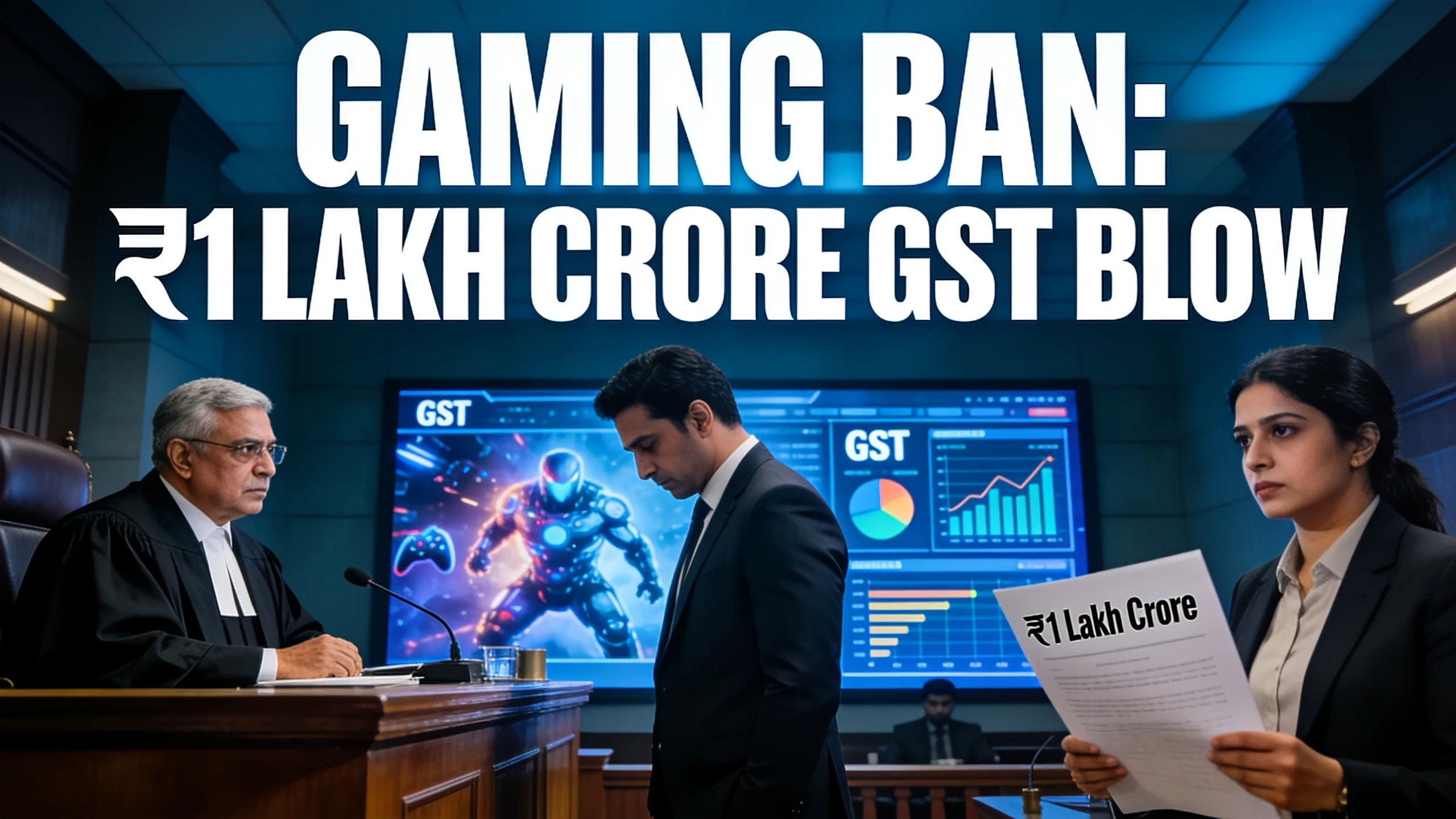
India's online gaming sector absorbed two seismic blows within weeks of each other. On 1 May 2026, the Promotion and Regulation of Online Gaming (PROG) Act 2025 and its accompanying rules came into force, standing up the country's first central regulator — the Online Gaming Authority of India (OGAI) — and making real-money online gaming a criminal offence. Then on 27 May 2026, the Supreme Court confirmed retrospective 28% GST on the full face value of every bet ever placed on domestic platforms, validating a combined industry tax bill estimated at over ₹1 lakh crore (approximately $1.2 billion USD).
The two rulings together amount to a structural extinction event for India's regulated gaming market. Dream11, once valued at $8 billion, had already ceased real-money operations by 22 January 2026. Gameskraft, Mobile Premier League (MPL), Games24x7 and Delta Corp face individual show-cause notices ranging from ₹16,822 crore to ₹40,000 crore. Industry write-downs in the first 90 days after PROGA passed topped $840 million. Yet offshore operators — largely untouched by either ruling — are filling the vacuum at speed.
In This Article
PROG Act & OGAI: What went live on 1 May
The PROG Rules 2026, notified by the Ministry of Electronics and Information Technology (MeitY) on 22 April 2026 and in force from 1 May 2026, operationalise India's nationwide ban on online money gaming. The framework draws a hard three-way line between categories:
- Online Money Games — any game where players stake money with an expectation of monetary return. Completely banned. Advertising, payment facilitation, and platform operation each carry criminal penalties of up to 3 years' imprisonment or a ₹1 crore fine.
- E-Sports — skill-based competitive games recognised under the National Sports Governance Act 2025. Permitted, with mandatory OGAI registration. Prize money for performance is allowed; spectator betting on e-sports is not.
- Online Social Games — recreational games with no monetary stakes. Permitted with lighter-touch registration.
The OGAI sits as an attached office of MeitY, chaired by the Additional Secretary of MeitY and staffed at Joint Secretary level by representatives from the Ministries of Home Affairs, Finance, Information & Broadcasting, Youth Affairs & Sports, and Law & Justice. It maintains the official ban list, registers e-sport titles, hears user grievances within a 30-day window per tier, and — critically — can direct banks and UPI platforms to block payments to any prohibited service. Enforcement proceedings must conclude within 90 days.
Supreme Court's ₹1 lakh crore GST ruling
In Directorate General of GST Intelligence v. Gameskraft Technologies (Civil Appeal Nos. 8241–8244 of 2026, decided 27 May 2026), a bench of Justices J.B. Pardiwala and R. Mahadevan set aside the Karnataka High Court's May 2023 judgment that had quashed Gameskraft's ₹21,000 crore show-cause notice. The court held that online gaming platforms are not mere intermediaries but suppliers of actionable claims, making the entire contest entry amount — not just platform fees — the taxable base. The skill-versus-chance distinction that platforms had relied upon for 60 years was ruled irrelevant for GST purposes: once money is staked on an uncertain outcome, it constitutes betting and gambling. The October 2023 GST amendments were further found to be clarificatory and therefore retrospective in effect.
The knock-on exposure across the sector is severe. Dream11 faces a show-cause notice of ₹40,000 crore; Delta Corp, ₹23,204 crore; Games24x7, ₹20,000 crore. Total industry liability is estimated at over ₹1.5 lakh crore — against companies that, per the PROG Act, no longer have a legal product to sell.
Impact on operators and investors
| Operator | GST Show-Cause Notice | Operational Status (July 2026) | Key Investor Impact |
|---|---|---|---|
| Dream11 (Dream Sports) | ₹40,000 crore | Paid contests shut Jan 2026; pivoting to free-play & FanCode | Valued at $8 bn in 2021; no current RMG revenue |
| Gameskraft | ₹21,000 crore (restored) | Real-money rummy suspended | Karnataka HC relief permanently overturned |
| Games24x7 | ₹20,000 crore | Money games ceased | Full asset write-down exposure |
| Delta Corp | ₹23,204 crore | Online segment shut; Goa casinos ongoing | Only land-based revenue stream survives |
| Head Digital Works | Under notice | Workforce fell from 606 to 178 employees | Clairvest wrote off entire ₹760 crore investment |
| Nazara Technologies | Not primary target | Listed; reported ₹29.35 crore net loss Q2 FY2025-26 | ₹914.7 crore impairment on Moonshine Technologies |
The offshore surge India cannot stop
The most consequential unintended effect of the ban is the migration of Indian bettors to unregulated offshore platforms. A survey by public policy think tank CUTS International found that offshore platform usage in Delhi NCR climbed from 68.3% pre-ban to 82% post-ban. In Maharashtra, the figure reached 91.7%. Daily access to offshore sites in the sampled cohort jumped from 3.4% to 42.3%.
MeitY told Parliament it had blocked or actioned 8,376 URLs linked to betting and gambling by 28 March 2026, with more than 4,800 of those blocks applied after PROGA came into force. But operators including Parimatch, 1XBet, RajaBets, and Odds92 continue to reach Indian users through mirror domains, social media funnels, influencer deals, and mainstream UPI payment routes. The Advertising Standards Council of India reported that offshore betting advertisements made up 72.14% of all advertising violations flagged in FY26 — the largest single category. The offshore market was conservatively estimated at $20 billion by IGAP partner Dhruv Garg, with annual tax evasion exceeding $4 billion.
What happens next: enforcement and constitutional battles
The constitutional validity of the PROG Act has not been finally settled. Multiple petitions challenging the law — on grounds that Parliament overstepped its authority over a subject reserved to states under Entry 34 of the Seventh Schedule, and that the ban erases 60 years of judicially recognised skill-game protection — have been consolidated before the Supreme Court. No interim relief has been granted. Separately, the Karnataka High Court is hearing challenges arguing the OGAI framework effectively criminalises skill-based gaming. Until the Supreme Court issues its final ruling on constitutional validity, the industry sits in a legal limbo where the ban is live and enforced, but its foundations remain contested.
For operators eyeing India from offshore, the enforcement picture is mixed. OGAI can direct financial institutions to block payments, use Section 69A of the IT Act to order platform blocks, and coordinate with law enforcement on money-laundering investigations. However, corporate lawyer Divya Sharma noted that offshore platforms remain accessible because they evade Indian KYC and AML requirements, using VPNs and mirror domains to stay online — making prosecution "extremely difficult."
Sources
Primary and institutional sources are listed first, followed by trade and legal analysis.
- Wikipedia — Promotion and Regulation of Online Gaming Act, 2025 ↗ https://en.wikipedia.org/wiki/Promotion_and_Regulation_of_Online_Gaming_Act,_2025
- CA Club India — Supreme Court GST Ruling: Full Judgment Analysis ↗ https://www.caclubindia.com/articles/supreme-court-on-gst-online-gaming-tax-applies-on-betting-and-gambling-irrespective-of-skill-or-chance-55335.asp
- Business Today — Supreme Court Upholds 28% GST; ₹1 Lakh Crore Burden ↗ https://www.businesstoday.in/latest/corporate/story/supreme-court-upholds-28-gst-on-online-gaming-rs1-lakh-cr-tax-burden-looms-533671-2026-05-27
- iGaming Business — India Publishes New Online Gaming Regulations ↗ https://igamingbusiness.com/legal-compliance/regulation/india-publish-new-online-gaming-regulations/
- Legal 500 — India's Online Gaming Reset: Decoding PROGA and the 2026 Rules ↗ https://www.legal500.com/developments/thought-leadership/indias-online-gaming-reset-decoding-proga-and-the-2026-rules/
- Gambling Talk — India Sees Surge in Offshore Betting Ads Despite Ban ↗ https://gamblingtalk.net/news/india-sees-surge-in-offshore-betting-ads-despite-real-money-gaming-ban
- iGaming Today — India Bans 8,376 Websites as Offshore Access Persists ↗ https://www.igamingtoday.com/india-bans-8376-websites-associated-with-online-betting-and-gambling-as-offshore-access-persists/
- SiGMA — India SC to Hear Challenge to RMG Ban, Industry in Flux ↗ https://sigma.world/news/india-hears-challenge-to-rmg-ban-industry-in-flux/
With reported tax exposure across the sector estimated at over ₹1 lakh crore, this is no longer merely a litigation issue — it is a balance-sheet event.
— Sivakumar Ramjee, Executive Director, Indirect Tax, Nangia Global Advisors LLP · quoted in Business Today, 27 May 2026