
Gambling Disorder Study Bill Targets $400M Federal Betting Tax
Moore and Goldman's bipartisan Gambling Disorder Health Study Act would redirect 10% of federal sports excise tax into the first-ever federal addiction study — with annual HHS reports to Congress.
Category: News - US · By Growl Games Editorial Team · Sat Jun 06 2026 · Updated Tue Jul 21 2026
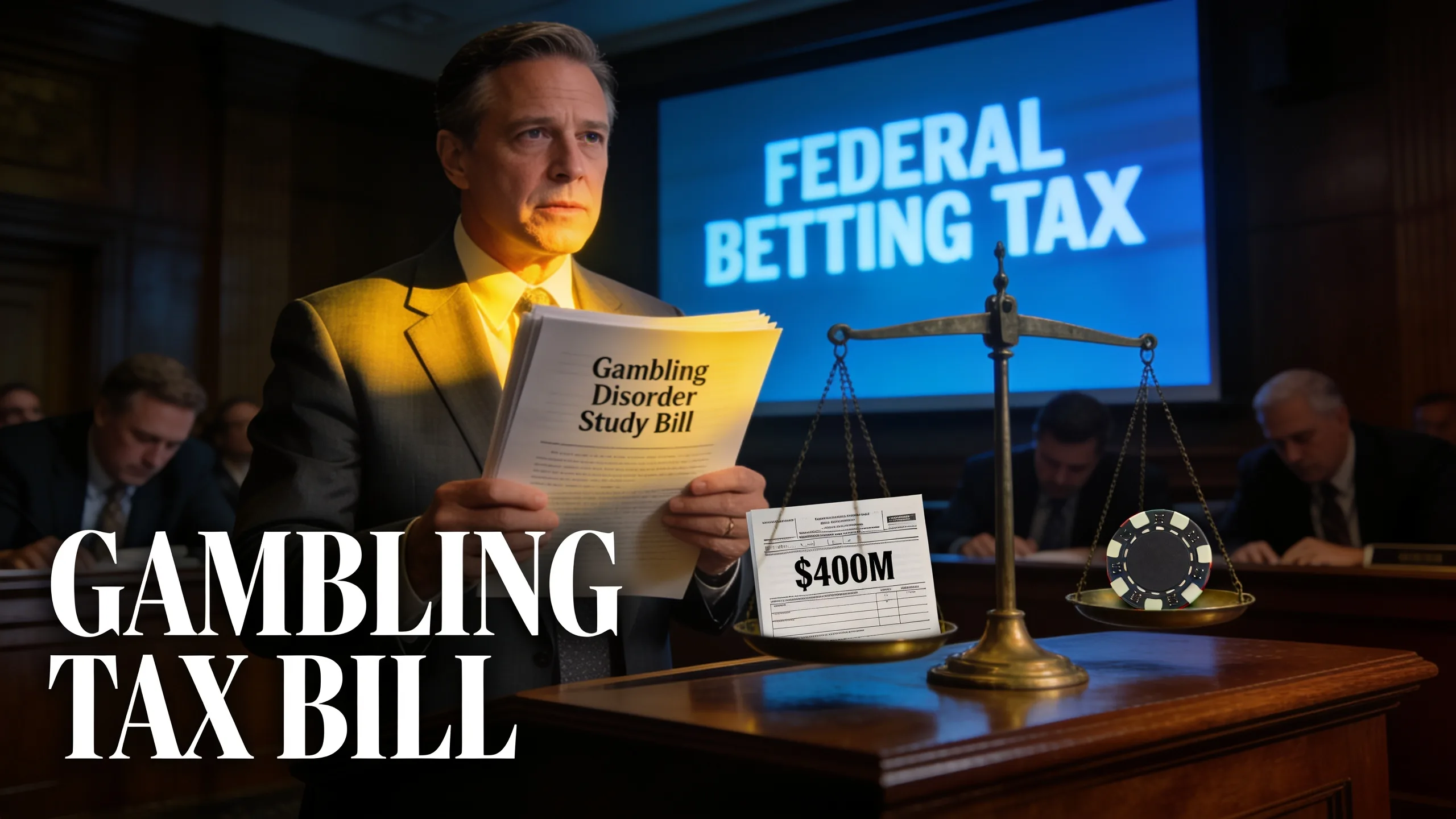
The United States has collected more than $400 million a year in federal excise taxes from legal sports wagers since the market opened state by state after 2018, yet no federal agency holds a mandate—or a dollar—to research what that expansion is doing to public health. A bipartisan bill introduced on 4 June 2026 aims to close that gap for the first time.
Representatives Blake Moore (R-UT) and Dan Goldman (D-NY) filed the Gambling Disorder Health Study Act, directing the federal government to conduct a comprehensive multi-year investigation into the causes, demographics, and long-term effects of gambling disorder. The funding mechanism is straightforward: 10% of federal excise tax revenue from state-authorized wagers, redirected from the General Fund into an HHS-led study for up to three fiscal years—roughly $40 million per year that currently lands unassigned in America's general budget.
Contents
Gambling Disorder Research: Why No Federal Funding Has Existed
The federal excise tax on sports betting runs at 0.25% on every legal wager, plus a $50-per-employee annual levy on licensed sportsbook operators. Together those two charges generate approximately $400 million a year — every cent deposited into the General Fund with no designated purpose and no requirement to study the harms that may accompany them.
Gambling disorder is classified as a behavioral addiction in the Diagnostic and Statistical Manual of Mental Disorders (DSM-5), yet no federal body carries a research mandate and no dedicated federal dollars exist for the condition. Sports betting operated in a single state in 2017; by 2025 it was live across 39 states, Washington D.C., and Puerto Rico. Combined annual wagers on traditional sportsbooks and prediction markets have grown from $4.7 billion in 2017 to roughly $220 billion — a near-47-fold increase in eight years with no corresponding federal health research programme.
The Scale of Gambling Disorder in the U.S.
The bill's statutory findings draw on national data that illustrate how sharply consumer exposure has outpaced the research base:
- Approximately 2–3% of the U.S. population meet at least one DSM-5 criterion for gambling disorder and experience problems due to gambling behaviour.
- 27% of all Americans now hold an active online sportsbook account; the proportion rises above 50% among men aged 18–49.
- 33% of men aged 18–49 report using an online prediction market to bet on a sporting event.
- Internet searches for gambling addiction help have climbed 23% since the Supreme Court's Murphy v. NCAA ruling in 2018 overturned the federal sports-betting ban.
- Commercial gaming gross revenue hit a record $78.72 billion in 2025, a 9.2% year-on-year rise, against just $29 billion in 2003.
Moore described the situation as "a new age of gambling addiction" in which lawmakers are without the data to craft targeted responses. Under the bill, the HHS Secretary would file annual progress reports and policy recommendations to Congress for each year the study is funded.
Two Federal Gambling Excise Bills Compared
Moore and Goldman's bill is not the first proposal to redirect excise revenue toward gambling harm. In March 2026, Congress received the POINTS Act (Providing Opportunities for Individuals in Need of Treatment and Support), which proposed channelling at least one-third of excise receipts into a federal grant programme for state treatment and prevention services. The POINTS Act stalled in the House Energy and Commerce Committee with no hearings scheduled. The Gambling Disorder Health Study Act takes a narrower, research-first approach and routes accountability through a named cabinet official.
| Feature | POINTS Act (March 2026) | Gambling Disorder Health Study Act (June 2026) |
|---|---|---|
| Excise tax earmark | At least one-third (~$133M/yr est.) | 10% (~$40M/yr est.) |
| Use of funds | Federal grants to state treatment programmes | Federally directed multi-year study |
| Lead / administering body | Not specified | HHS Secretary |
| Annual report to Congress | No | Yes, with policy recommendations |
| Scope | Treatment & prevention grants | Causes, demographics, advertising, social dynamics |
| Status (June 2026) | Stalled, House Energy & Commerce Cmte. | Newly introduced |
What Operators and Bettors Need to Watch
For licensed sportsbooks and online casinos, the bill signals a meaningful shift in Washington's posture toward regulated gambling. Research findings mandated under this legislation could directly underpin future federal action on advertising restrictions, app design standards, mandatory responsible-gambling safeguards, or deposit limits — measures that would reshape compliance costs across the industry and require platform changes well ahead of any formal rulemaking.
The bill arrives in an already crowded legislative environment. The One Big Beautiful Bill Act (OBBBA), signed 4 July 2025, capped gambling loss deductions at 90% of winnings, creating taxable "phantom income" for bettors who break even or lose overall. Bipartisan repeal efforts — Rep. Dina Titus's (D-NV) FAIR BET Act and Sen. Catherine Cortez Masto's (D-NV) FULL HOUSE Act — have both stalled in committee. With oversight pressure building simultaneously on tax treatment, advertising, and now addiction research, operators should expect the federal scrutiny landscape to continue intensifying well into 2027.
The Gambling Disorder Health Study Act is endorsed by the Kennedy Forum, the National Council on Problem Gambling (NCPG), the American Society of Addiction Medicine (ASAM), the New York Council on Problem Gambling (NYCPG), the Foundation on Drug Policy Solutions (FDPS), Stop Predatory Gambling, and Texans Against Gambling.
Sources
This article is built from two primary Congressional sources and cross-checked against specialist gaming industry coverage published within 24 hours of the bill's introduction.
- Rep. Blake Moore (R-UT) — Official Press Release, 4 June 2026 ↗ https://blakemoore.house.gov/media/press-releases/moore-goldman-introduce-legislation-to-launch-federal-investigation-into-impact-of-widespread-sports-betting
- Rep. Dan Goldman (D-NY) — Official Press Release, 4 June 2026 ↗ https://goldman.house.gov/media/press-releases/goldman-moore-introduce-legislation-launch-federal-investigation-impact
- Casino.org — Gambling Disorder Health Study Act Would Force Research, 5 June 2026 ↗ https://www.casino.org/news/gambling-disorder-health-study-act-would-force-congress-research/
- Gaming Intelligence — Bipartisan Bill Calls for First Federal Study on Gambling Disorder, 5 June 2026 ↗ https://www.gamingintelligence.com/legal/231619-bipartisan-bill-calls-for-first-federal-study-on-gambling-disorder/
Congress must take a more active role in fighting gambling addiction.
— Dan Goldman, U.S. Representative (D-NY-10) · Introducing the Gambling Disorder Health Study Act, 4 June 2026